
RWA Basics
An Attestation Is Not an Audit, and Neither Proves Solvency
"Attestation" and "audit" are not synonyms, and the difference decides how much a reserve report is worth. A practical method for checking backing claims, what on-chain proof can and cannot show, and the five failure modes that no attestation would catch.
Every RWA product says it is backed. The claim is almost always true in some sense, and almost never true in the sense a reader assumes.
The gap is not usually fraud. It is that "backed" compresses at least four separate questions into one word:
- Does the asset exist?
- Is it held for you, or owned by the issuer?
- Is the amount held equal to the tokens outstanding, right now?
- Who checked, how hard, and how recently?
A reserve report answers question 1 and partially answers question 3. The wrapper — covered in the four legal wrappers — answers question 2. Question 4 is where most readers stop too early, because the vocabulary is deliberately similar-sounding.
This article is about doing question 4 properly.
Attestation is not audit
These two words get used interchangeably in crypto marketing. In accounting they are different engagements with different levels of assurance, and the difference is not subtle.
An attestation (or agreed-upon-procedures engagement) is a point-in-time confirmation. Management asserts something — "we held 47,312 fine troy ounces at 23:59 UTC on 31 March" — and the accounting firm performs specified procedures to confirm that assertion as of that moment. The firm is checking a snapshot against the records and, for commodities, usually against vault confirmations.
An audit is an opinion on financial statements covering a period, with the auditor designing their own procedures, testing internal controls, and taking responsibility for detecting material misstatement.
The practical difference: an attestation tells you the asset was there on the date stated. It tells you very little about the 89 other days in the quarter, about whether the asset was pledged, lent, or encumbered between snapshots, or about whether the controls preventing that are any good.
This is not a reason to dismiss attestations. A monthly attestation from a serious firm is meaningful evidence and far better than nothing. It is a reason to read the cadence and the scope rather than the headline.
Cadence, in practice:
- PAX Gold publishes monthly third-party attestations, with KPMG named as the attesting firm.
- Tether Gold publishes quarterly assurance opinions, audited by BDO Italia.
Both are real. Monthly is a tighter net than quarterly. Whether that difference matters to you depends on position size and holding period, but you should at least know which one you are relying on.
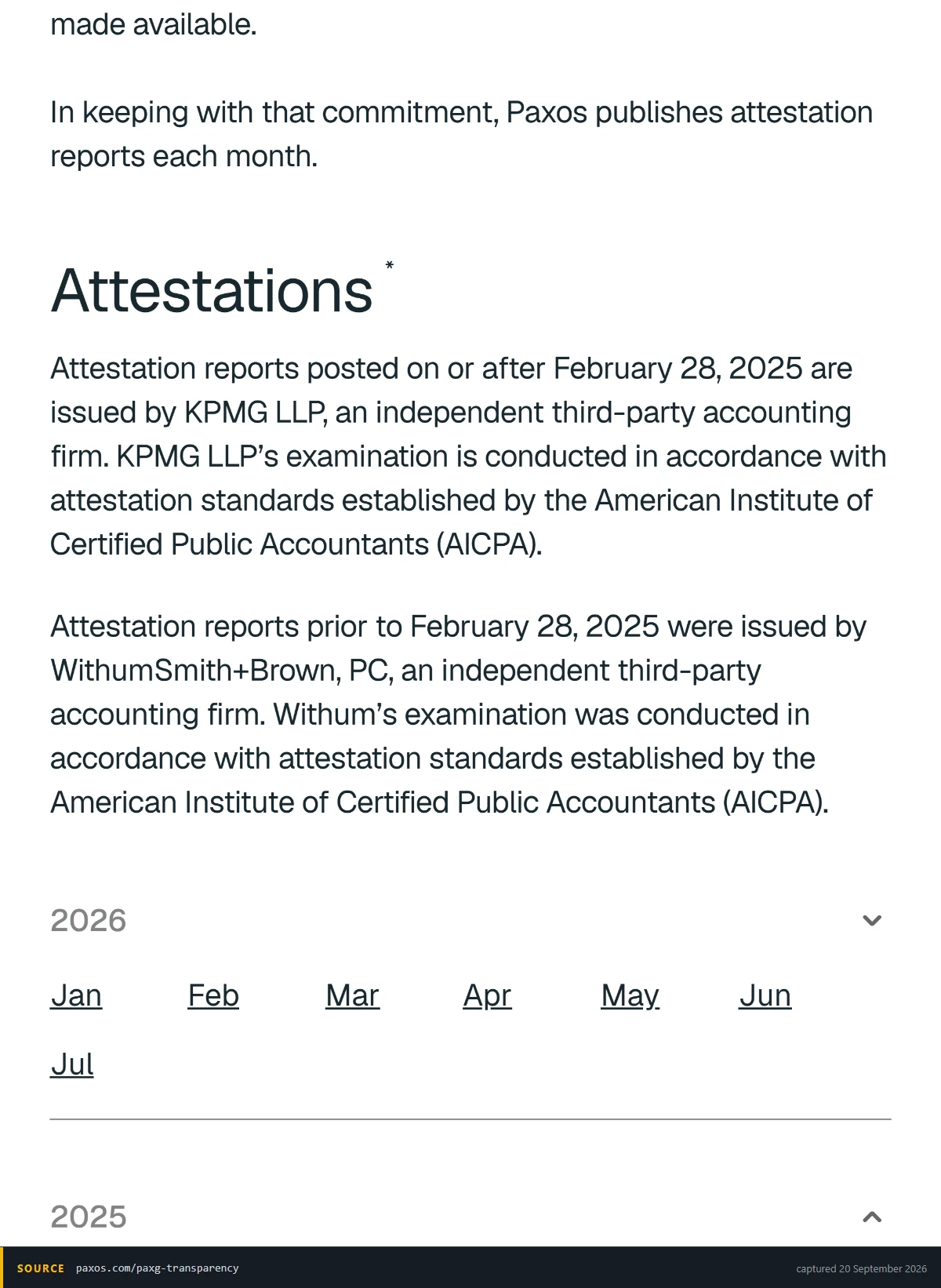
An examination under AICPA attestation standards, published monthly, by a named firm. The word audit appears nowhere on the page, and the month-by-month list underneath is how you check that the cadence has not quietly slipped.
Read the report, not the press release
When you open an actual reserve report, four things decide its value. Most readers look at the number and skip all four.
Who signed it — A named firm with a professional licence carries liability for the statement. An unnamed "third-party verification partner," a consultancy with no audit practice, or a report with no signature block carries approximately none. This is the single fastest quality filter.
What exactly was confirmed — Read the scope paragraph. It will say something like "we confirmed the quantity of gold held in the vaults listed in Appendix A as of [date]." Then check: does the scope cover all reserves, or one vault, or one custodian among several? Partial-scope reports are legitimate and clearly labelled — and routinely quoted as if they covered everything.
As of when. Find the effective date and compare it to today. A report published in September with an effective date of 30 June is telling you about June. During the intervening period you are trusting controls, not evidence.
Against what liability — Reserves are only meaningful relative to tokens outstanding. A report stating reserves without stating the corresponding token supply at the same instant is half a fraction. The good ones state both and show the ratio.
If the report clears all four, you have real evidence. If it fails two or more, you have marketing with a PDF attached.
What on-chain verification can and cannot do
Crypto has a strong instinct that the chain settles arguments. For RWAs it settles exactly one side of the ledger.
What the chain genuinely proves:
- Total token supply, exactly, at any block. This is not a claim; it is arithmetic on public data.
- Mint and burn history, with timestamps.
- Who holds what, and how concentrated holdings are.
- For some products, a link between a token and a specific serial-numbered asset. Tether Gold publishes a bar lookup, where a token holder can retrieve the specific LBMA-accredited bar associated with their holding: a useful feature, and rarer than it should be.
Reading the supply yourself takes one command. Token supply is a public function call, so you never have to accept anyone's figure for it. On Ethereum:
curl -s https://ethereum-rpc.publicnode.com \
  -H 'Content-Type: application/json' \
  -d '{"jsonrpc":"2.0","id":1,"method":"eth_call","params":[{"to":"0x45804880De22913dAFE09f4980848ECE6EcbAf78","data":"0x18160ddd"},"latest"]}'
That address is the PAX Gold contract and 0x18160ddd is totalSupply(). The answer comes back as hex; divide by 10^18 because PAXG carries 18 decimals. Tether Gold is 0x68749665FF8D2d112Fa859AA293F07A622782F38 and carries 6 decimals, not 18; using the wrong divisor is the usual way this goes wrong. If you would rather not touch a terminal, any block explorer shows the same number on the token's contract page; the point is that it is verifiable rather than reported.
Read on 19 September 2026, those two calls returned 431,889.66 PAXG and 707,747.09 XAUt outstanding. Each token represents one fine troy ounce, so those figures are also the ounces each issuer must be able to show. Run the calls yourself and compare what you get against the ounces in the latest attestation; that single comparison is the whole of what on-chain verification can do for you, and it is an hour well spent.
What the chain cannot prove, ever:
- That the bar exists. A serial number on-chain is a reference to a physical object. The reference can be accurate and the object can still be absent, pledged to someone else, or double-referenced. Only a physical inspection closes that gap, which is what the vault confirmation in an attestation is for.
- That the custodian's records match the vault's records.
- That reserves are unencumbered.
So the honest formulation is: the chain tells you the liability side with certainty and the asset side not at all. Supply is trustless. Backing is not. Anyone presenting an on-chain dashboard as complete proof of reserves is either confused or counting on you to be.
The strongest position available today is the combination: exact on-chain supply, checked against a named-firm attestation of reserves with a recent effective date and full scope. When both sides line up, you have done what can be done.
Five failure modes a clean reserve report will not catch
This is the part to internalise. Every item below is compatible with a perfectly accurate attestation.
-
Encumbrance — The asset exists, is in the vault, is the right quantity — and is pledged as collateral to a lender. Attestations confirm existence and quantity. They do not always confirm that the asset is free of competing claims. Look for the word unencumbered in the scope. Its absence is informative.
-
The wrapper undoes it; You can have flawless 1:1 backing and still be an unsecured creditor of the issuing vehicle, with no property right in the asset at all. This is the normal case for tracker certificates. Perfect backing plus a weak wrapper equals a claim that is only as good as the issuer. Backing and ownership are separate questions and a reserve report only speaks to the first.
-
Redemption is theoretical for you — Reserves are fully there. The redemption clause restricts redemption to onboarded, eligible, or institutional holders. Your practical exit is the secondary market, so what determines whether you can get out at a fair price is order-book depth — not the reserve ratio. See why tokenised stock prices drift.
-
Operational and access risk — The issuer can restrict, suspend or unwind access for regulatory, sanctions or eligibility reasons. Binance states this explicitly for bStocks. Nothing about the reserves changes; your access does.
-
Concentration in the plumbing — One custodian, one vault operator, one broker, one chain. A single-point failure in the operational stack affects you regardless of how much gold is in the building. Reserve reports do not have a field for this. Read the product page for who the custodian, broker and clearing firm are, and notice when the same names appear under every product you own.
A checklist you can run in ten minutes
For any RWA token, before buying:
- Name the issuing legal entity and its jurisdiction of incorporation.
- Find the most recent reserve report. If you cannot find one in under five minutes, that is the finding. For the two largest gold tokens they live on Paxos's transparency page and Tether's.
- Check who signed it: a named firm with an audit practice, or nobody in particular.
- Check the effective date and compute how stale it is today.
- Check the scope: all reserves, or a subset? Does it say unencumbered?
- Check reserves against token supply at the same instant, not against a supply figure from a different date. Take the supply from the contract yourself using the call above rather than from the same page that is making the claim.
- Read the redemption clause and identify who it applies to. If it is not you, stop evaluating backing and start evaluating liquidity instead. The clauses are published: Backed's issuance and redemption page states that primary-market access requires onboarding, KYC and a whitelisted wallet; Ondo's sit in its documentation.
- Measure the liquidity you would exit into. For Solana-based tokens,
https://lite-api.jup.ag/tokens/v2/search?query=TSLAxreturns a dollarliquidityfigure per token with no account required. Compare it against the position you are contemplating. - Name the custodian, the broker, and the chain. Note any overlap across your other holdings.
Seven of these eight are reading comprehension, not finance. That is the point: most of the risk in this asset class is sitting in plain text that nobody opens.
Run the eight and you end up somewhere specific rather than reassured: you know who issued this, what you legally are to them, who last checked the reserves and how recently, and what your exit looks like if the issuer stops answering the phone. Certainty is not on offer, and any process promising it is selling something.
This explains a method; it does not recommend a product. Attestation cadence, scope and named firms change over time; verify against the issuer's current published reports before relying on anything here.