
RWA Basics
What Do You Actually Own When You Buy an RWA Token?
Two tokens can both be called "tokenised Apple stock" and give you completely different legal rights. Here are the four wrappers in use today, what each one makes you in a bankruptcy, and how to identify which one you are holding in about five minutes.
Search for "tokenised Apple stock" and you will find at least three products. They track the same share price. They have similar names. Their marketing pages use the same words — 1:1 backed, fully collateralised, real shares held with a regulated custodian.
One of them makes you a shareholder of Apple, with voting rights delivered through a proxy agent.
One of them makes you the holder of a rights token issued by a special purpose vehicle in Abu Dhabi, with no share ownership at all.
One of them makes you an unsecured creditor of a Jersey company.
All three statements are accurate descriptions of live products. Nothing is being hidden; it is all in the offering documents. It just isn't on the buy button.
This article is the reference the rest of this site builds on. If you understand which of the four wrappers you are holding, most of the other questions — can I redeem, do I get dividends, what happens if the issuer fails, why is my price drifting — answer themselves.
Why the wrapper is the whole product
A token is a claim. It is not the asset.
The blockchain records who holds the token. It does not, and cannot, enforce what that token entitles you to. That enforcement lives entirely in a legal document filed somewhere in the physical world: a prospectus, a trust deed, a terms-of-service page, a transfer agent's register.
When people say "RWA tokenisation removes intermediaries," this is the thing to be precise about. Tokenisation removes some settlement intermediaries. It does not remove the legal intermediary. There is always an issuer standing between you and the asset, and the wrapper defines what that issuer owes you.
So the only question that matters is: if the issuer stops cooperating tomorrow, what do I actually have?
Four answers are in common use.
Wrapper 1: The bearer debt instrument (tracker certificate)
Live example: xStocks, issued by Backed Assets (JE) Limited
This is the structure most retail users encounter first, because it has the broadest geographic distribution.
Backed Assets (JE) Limited is a special purpose vehicle registered in Jersey with the Jersey Financial Services Commission, holding the COBO and CGPO consents required to issue security tokens. The issuer or its broker buys the real share on a traditional exchange, deposits it with a regulated custodian, and mints a token against it.
Here is the part that matters. Each xStock is legally a bearer debt instrument, classified as a tracker certificate. It is a debt of the issuer that promises to track the price of the underlying equity.
You are not a shareholder. You are a creditor.
What follows from that:
- No voting rights. You are not on the share register; the custodian is.
- Dividends are passed through, not owed to you as a shareholder. With xStocks the cash never reaches you at all: the custodian receives the dividend, it is reinvested into more of the same stock net of applicable withholding, and your balance rises through an on-chain multiplier. You cannot elect to take it in cash. Some corporate actions are handled instead by rebasing your token balance.
- You almost certainly cannot redeem. Redemption exists, but it sits with the issuer's institutional channel. A retail holder does not have a direct line to the underlying share. Your exit is the secondary market, selling the token to someone else.
- In an insolvency, you queue. The collateral arrangements are designed to protect holders, but your claim is a claim against the issuing vehicle, ranked against other creditors of that vehicle. It is not a direct property right in an Apple share sitting in your name.
This is not a scam structure. It is a well-understood European certificate format with decades of history, and it is why xStocks can be distributed to retail across many jurisdictions where issuing actual securities would be impossible. But "tracker certificate" and "stock" are different products, and only one of them is on the label.
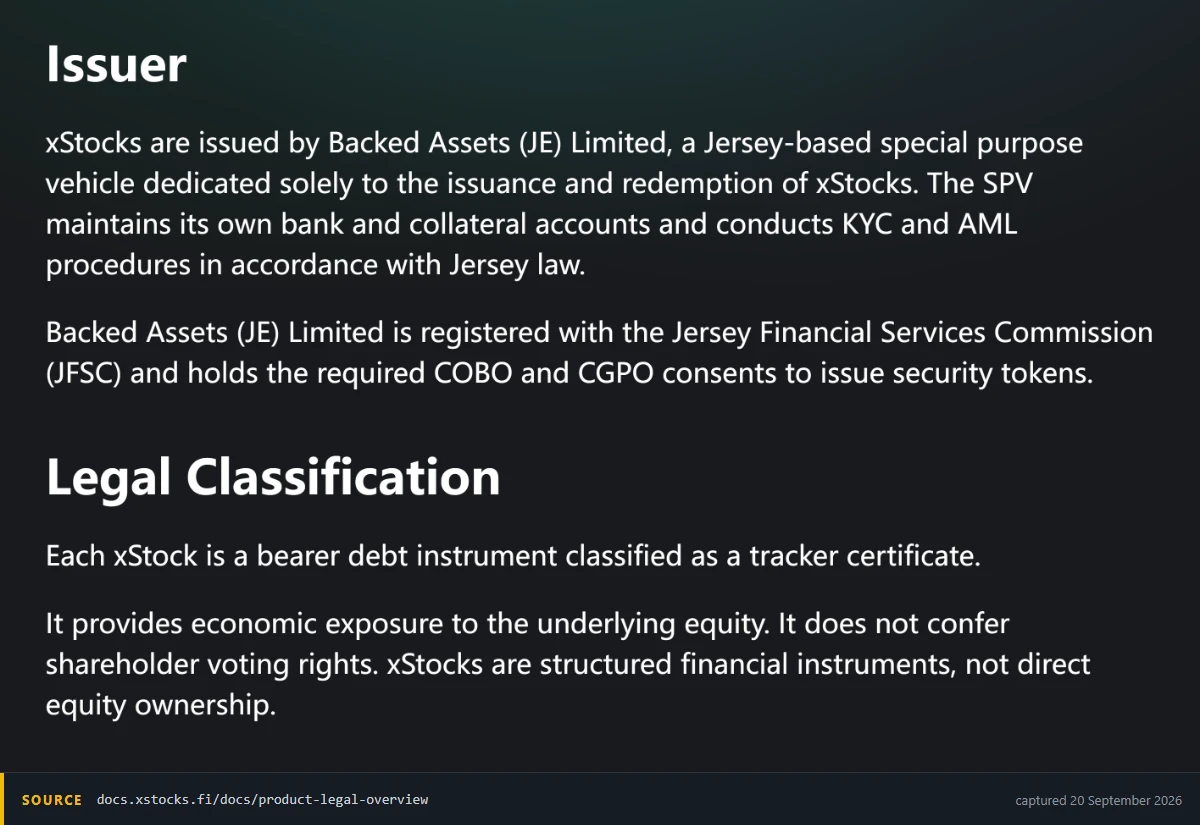
Two sentences, one paragraph apart, and between them they define the product: Backed Assets (JE) Limited is the counterparty, and what it issues is debt rather than equity.
Wrapper 2: The SPV rights token
Live example: Binance bStocks, issued by BTech Holdings Limited
Structurally adjacent to wrapper 1, but with a different regulatory anchor and a different set of trade-offs.
BTech Holdings Limited is a Binance Group affiliate incorporated as a special purpose vehicle in the Abu Dhabi Global Market. Each bStock is a BEP-20 token on BNB Chain. The plumbing behind it is conventional brokerage: Nest Trading Limited, an ADGM-regulated introducing broker, with Alpaca Securities handling clearing, custody, dividends and corporate actions. Each token is backed 1:1 by a real share held with a regulated custodian.
The tokens represent rights tied to the underlying securities without conferring direct share ownership in the listed company.
What follows:
- No direct share ownership, and no voting. Same as wrapper 1 in substance.
- Dividends and splits arrive by rebase. Your balance adjusts automatically rather than you receiving a separate payment. This is operationally cleaner than airdrops, but it means your token count changes, which matters for your own accounting and for any downstream protocol that assumed a fixed balance.
- Dividends arrive net of US withholding tax. For non-US holders this is typically 30% before any treaty relief. This is not a platform fee and it is not avoidable by moving venues; it is US tax law applied at the custodian. See our risk and tax checklist for what you can and cannot reclaim.
- The offering is jurisdictionally narrow. bStocks are offered under an Approved Prospectus in the ADGM and are not publicly offered anywhere else. Outside the ADGM, access is on a secondary-market basis only, to eligible users in permitted jurisdictions. Access can be restricted, suspended or unwound if the issuer determines a transaction breaches applicable law, product restrictions, eligibility criteria or sanctions requirements.
That last bullet is the one people skip. "Available in my country" and "publicly offered in my country" are different things, and the difference shows up when rules change.
Wrapper 3: The registered security entitlement
Live example: Ondo Stocks (formerly Ondo Global Markets)
This is the structurally strongest wrapper for equities currently available, and the newest.
Ondo's US subsidiary Oasis Pro TA is an SEC-registered transfer agent. Shares are held in custody and tokenised as security entitlements; the same legal construct that sits under your ordinary brokerage account. Under this model the token holder has full ownership and voting rights in the underlying stock, with Broadridge, a mainstream Wall Street back-office firm, handling proxy voting and shareholder communications for token holders. BlackRock's iShares Core S&P 500 ETF (IVV) and Micron shares were among the first securities issued this way.
What follows:
- You are an owner, not a creditor. This is a genuine difference in kind, not degree.
- Voting reaches you, through the same proxy infrastructure that serves conventional brokerages.
- Redemption is real but gated. Redemptions are processed only for holders who have completed onboarding and are eligible. If you have not onboarded, you cannot redeem; your options are to keep holding or to sell on a secondary market where permitted.
- The eligibility gate is the cost. The strength of the wrapper comes from operating inside the US securities framework, and that framework asks who you are.
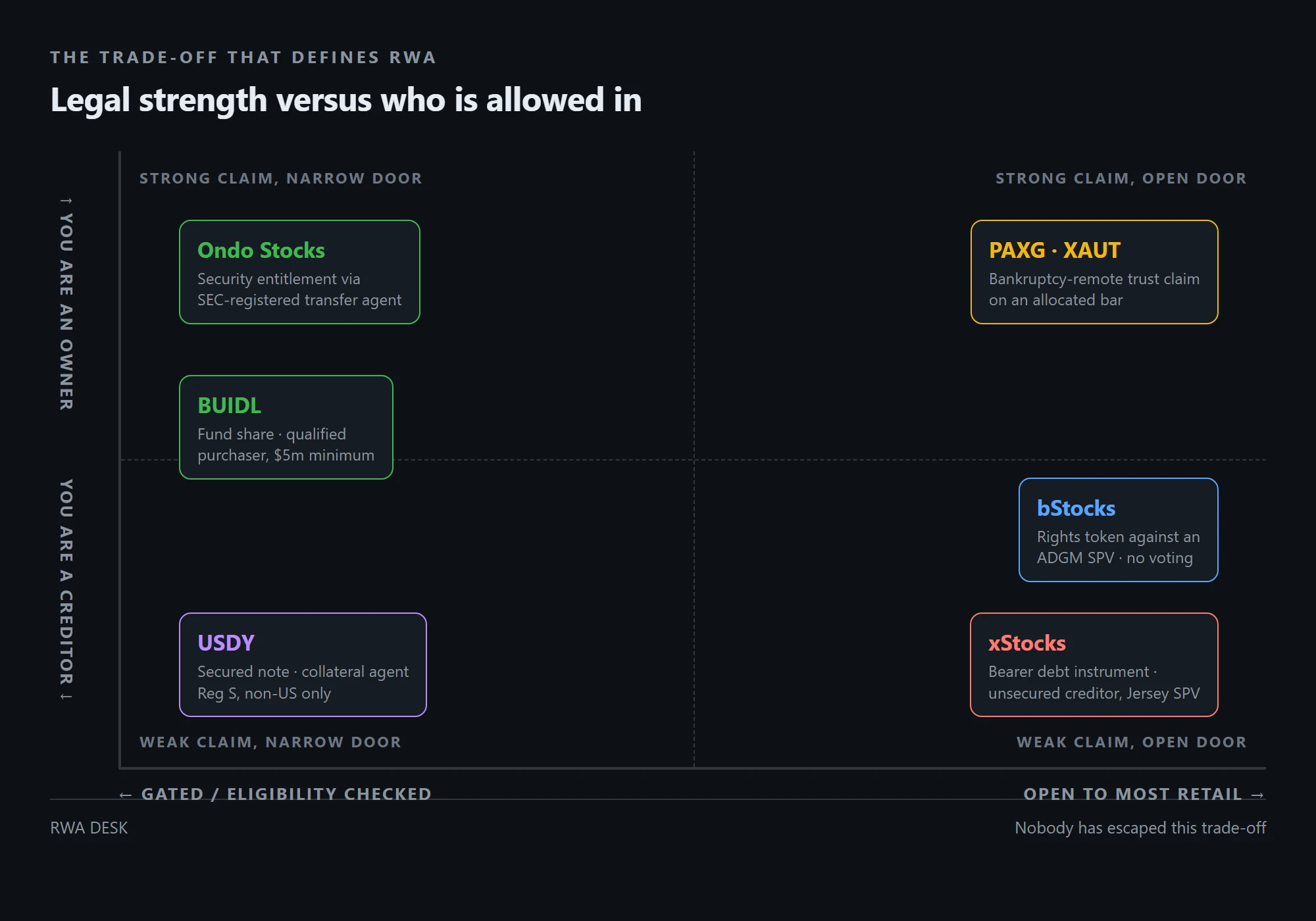
The pattern here generalises: legal strength and permissionless access trade off against each other. Every wrapper on this list sits somewhere on that line. Nobody has escaped it, and you should be suspicious of any product claiming to have.
Wrapper 4: The bankruptcy-remote trust claim
Live example: PAX Gold (PAXG), issued by Paxos Trust Company
Commodities get a different and generally cleaner structure, because there is no share register to reconcile with.
PAXG is issued by Paxos Trust Company, a regulated custodian supervised by the New York State Department of Financial Services. Each token corresponds to an allocated gold bar held in LBMA-approved vaults, with monthly third-party attestations. Client assets are typically held bankruptcy-remote under US trust law; meaning the gold is held for you, not owned by Paxos, and is designed not to form part of the estate if the issuer fails.
Tether Gold (XAUT) occupies the same category with different parameters: Swiss vaults, each token linked to a specific LBMA-accredited bar verifiable on-chain, quarterly assurance opinions from BDO Italia rather than monthly attestations.
What follows:
- You have a genuine property claim on a specific physical thing. This is the strongest position on the list.
- Redemption exists for retail: with conditions. PAXG offers pathways to redeem for allocated bullion or cash equivalents through the issuer or approved partners, subject to KYC/AML and fees. XAUT has historically required bar-sized minimums for physical redemption, with secondary dealers offering smaller conversions on varying terms.
- "Redeemable" rarely means "redeemable in the amount you hold." The gap between the theoretical right and the practical minimum is where most disappointment lives. We break the actual numbers down in what physical redemption costs.
A note on fund shares: tokenised money market funds like BlackRock's BUIDL are a close cousin of wrapper 3; you hold an actual fund share, recorded by a transfer agent, with the token as the register. The wrapper is strong. The eligibility gate is brutal, which is why most readers of this site will never hold one.
How to identify your wrapper in five minutes
Do this before you buy, not after.
-
Find the issuing entity's full legal name — Not the brand. The brand is "xStocks"; the issuer is "Backed Assets (JE) Limited". The brand is "bStocks"; the issuer is "BTech Holdings Limited". If a product page does not name a legal entity anywhere, stop — that alone is disqualifying.
-
Find where it is incorporated and who regulates it — Jersey, ADGM, New York, Delaware, Cayman all imply different creditor treatment and different enforcement realities for you specifically.
-
Search the offering document for three words; These are published, not secret: Backed publishes the base prospectus and final terms for each xStock, Ondo its product and legal documentation, and Paxos the PAX Gold terms and attestation history. Open the prospectus or terms and search for
certificate,entitlement, andnoteordebt. The word you find tells you the wrapper. "Tracker certificate" or "debt instrument" means wrapper 1. "Security entitlement" means wrapper 3. Trust language with "allocated" means wrapper 4. -
Find the redemption clause, and find who it applies to — Almost every product says redemption is available. The operative sentence is the one specifying eligible, onboarded, qualified, or institutional holders. If that sentence excludes you, your only exit is the secondary market, and your real risk is liquidity rather than credit.
5. Check what happens to dividends or yield, and whether tax is withheld before you see it. A 30% withholding on dividends materially changes the return on a dividend-paying stock, and it will not show up in any price chart you are comparing against.
If you cannot complete these five steps for a product, you do not know what you are buying. That is a complete answer on its own, and usually the right one.
Most RWA coverage sorts products by asset class: gold here, stocks there, treasuries over there. That sorting is nearly useless for decision-making, because two gold tokens can have more legally in common with two different stock tokens than with each other.
Sort by wrapper instead. Then the questions become tractable:
- Holding a wrapper 1 certificate? Your dominant risk is issuer credit, and your exit is the order book. Size accordingly and watch the liquidity.
- Holding a wrapper 2 SPV token? Same, plus jurisdictional access risk you do not control.
- Holding a wrapper 3 entitlement? You own the thing. Your work is onboarding properly so redemption stays open to you.
- Holding a wrapper 4 trust claim? You are in the strongest position on this list. Check the attestation cadence and know your realistic redemption minimum.
Sorting by wrapper is what makes the remaining questions answerable at all.
Nothing here is investment advice. Product terms change; always verify against the current offering documents from the issuer before committing funds.