
Gold & Commodities
PAXG Redemption Starts at 12 Kilograms
Both PAXG and XAUT require 430 troy ounces for physical delivery — one full LBMA bar. Here is the complete cost stack beyond that threshold, why your redemption right is effectively theoretical, and why it still matters enormously that it exists.
"Redeemable for physical gold" is the line that sells tokenised gold. It is true. It is also, for approximately everyone reading this, irrelevant in the way people assume it is relevant.
That is not a criticism of the products, but an argument that the redemption right does something more important than what you think it does, and once you see what that is, you will evaluate these tokens differently.
Start with the arithmetic.
The threshold
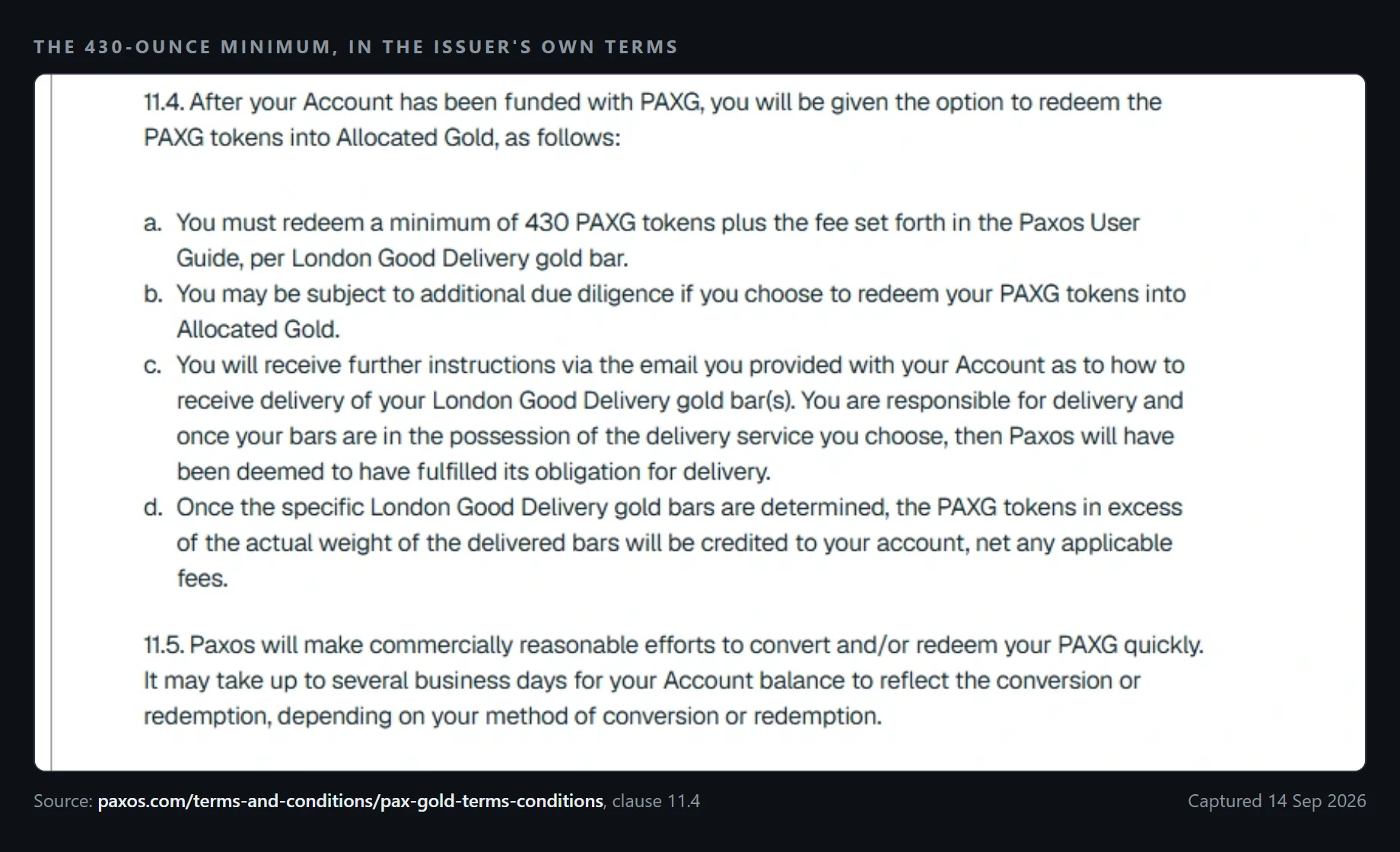
PAXG: a minimum of 430 PAXG plus fees to redeem into gold bars.
XAUT: physical delivery subject to a 430 XAUT minimum, with TG Commodities Limited arranging secure transit to a delivery address in Switzerland.
The 430 figure is not a marketing decision. London Good Delivery bars are not uniform; they range from roughly 370 to 430 troy ounces. When you redeem, you are allocated a specific bar, and the issuer cannot know in advance which one. Paxos requires a 430 balance so that your account covers the maximum possible weight of whatever bar is assigned, plus baseline transaction fees.
So the unit of physical redemption is one bar.
 Not 430 ounces of gold in a convenient form: one specific, serial-numbered, industrially-standard lump of metal weighing about 12.4 kilograms.
At any gold price of the past several years, that is a position in the high six figures, and at more recent prices comfortably into seven. If your gold position is not at least that size, physical redemption is not a feature you own. It is a feature the product has.
The costs that come after the threshold
Suppose you do hold 430 ounces. The threshold is where the cost stack begins, not where it ends.
Issuer fees — Paxos charges creation and destruction fees on buying or selling PAXG through a Paxos account, including conversions to or from USD, gold bars, or unallocated gold. Tether charges 25 basis points on redemption plus delivery costs. On a seven-figure position, 25bp alone is several thousand dollars.
Secure transit and insurance — You are moving 12.4kg of gold. This is specialist logistics — armoured transport, chain-of-custody documentation, and insurance priced against full replacement value. The issuer arranges it; you pay for it. Costs scale with distance and destination risk.
Delivery geography — XAUT delivers to a Swiss address. If you are not in Switzerland, you now have a second logistics problem — and an international one — on top of the first. PAXG's routes run through the issuer or approved partners, which offers more flexibility but does not make the metal teleport.
Import duties and VAT — This is the one that ambushes people, and it is jurisdiction-specific. Investment-grade gold is exempt from VAT in some jurisdictions and not in others. Import it into the wrong country and you can face a double-digit percentage charge on the full value. Check your own jurisdiction's treatment before, not after — on a seven-figure bar, a 20% VAT charge is a six-figure mistake.
Storage on the other end — You now possess a 12.4kg bar. Home storage of a seven-figure bar is not a serious plan — insurance is difficult, and the security problem is real. So you will pay for professional vaulting, which is an ongoing cost that did not exist while you held the token, since both issuers currently charge zero storage.
Assay on resale — Once a Good Delivery bar leaves the accredited chain of custody, it may need assaying before it can re-enter at full value. Chain-of-custody integrity is precisely what makes a Good Delivery bar worth spot price rather than spot minus a discount. Taking delivery breaks that chain. Getting back in costs money and time.
Add it up and the honest summary is: taking physical delivery converts a zero-carrying-cost, instantly-sellable position into an expensive, illiquid one. For almost every purpose, that is a downgrade.
Then why does redemption matter?
Because redemption is not a feature for you. It is the mechanism that makes the price real.
Here is the chain of logic, and it is the most useful idea in this article:
- Some participants hold enough to redeem: institutions, market makers, large holders.
- If the token trades meaningfully below the value of the gold backing it, those participants buy tokens, redeem for metal, and sell the metal. That buying pressure closes the discount.
- If it trades meaningfully above, they deliver gold, create tokens, and sell them. That closes the premium.
- Because everyone knows this can happen, it rarely needs to.
The redemption right is an arbitrage anchor. Its value to you is not that you will ever use it; it is that its existence is why the token you hold tracks gold at all.
This is why the 430-ounce threshold, which looks like an exclusion, is fine. The mechanism only requires that somebody can redeem, not that everybody can. And it is why you should care a great deal that the redemption right is genuine, enforceable and used; even though you will never personally exercise it.
Apply this test to any RWA product: is there a functioning redemption path for somebody, and is it used? If redemption is theoretical for everyone, nothing anchors the price to the asset, and you are holding a token whose value rests entirely on sentiment about backing rather than on a mechanism.
It is also exactly the problem with tokenised equities, where the same anchor exists but is weaker and more easily withdrawn, and the problem with most tokenised real estate, where there is frequently no anchor at all.
What to do instead, if you want physical
Three realistic routes, none of which involve redeeming a bar.
- Approved-partner conversions. PAXG offers pathways through the issuer or approved partners, and the partner network is where smaller-denomination options exist. A dealer that accepts PAXG and delivers standard retail bars or coins gets you physical metal in usable sizes. You pay a dealer premium over spot, which is the normal cost of buying retail gold and not a tokenisation penalty.
- Cash settlement, then buy locally. Both issuers offer cash settlement, and you can equally just sell the token on an exchange. Take the proceeds to a local bullion dealer. You pay the exchange spread plus the dealer premium, and you avoid international transit, import duties, and the assay problem entirely. For most people wanting physical gold, this is simply the correct route. It is also usually cheaper than redemption, once every line item is counted.
- Don't take delivery at all. If your reason for wanting gold is portfolio exposure rather than possession, the token already does the job, at zero storage cost, with instant liquidity. The desire for physical possession is usually a desire for a specific kind of insurance: against counterparty failure, banking system failure, or capital controls. That is a legitimate goal. Just be clear that it is the goal, because it is the only one that requires the metal in your hands, and it is worth paying for only if you have thought through the storage and security problem it creates.
What this means at your position size
If you hold less than 430 ounces: physical redemption is not available to you. Your exit is selling. Evaluate these tokens on custody quality, attestation cadence, regulatory supervision and market depth, not on a redemption right you cannot exercise. PAXG vs XAUT compares exactly those attributes.
If you hold more than 430 ounces: redemption is available and is still probably the wrong move. Price the full stack — issuer fees, transit, insurance, import VAT, vaulting, assay — against simply selling and buying locally. The second route wins more often than people expect.
Either way: care that the redemption mechanism exists and functions, because it is what keeps the price you see connected to the metal. That is the part that is doing work for you every single day, whether or not you ever touch it.
For information, not advice. Redemption terms, fees and minimums change, and tax treatment of physical gold varies significantly by jurisdiction. Verify current terms with the issuer and take local tax advice before taking delivery.