
Gold & Commodities
Krugerrands vs Tokenised Gold: An SA Comparison
South Africans have three easy routes to gold: a Krugerrand from any dealer, a JSE-listed gold ETF, or PAXG on an exchange. They cost different amounts, fail in different ways, and only one of them crosses a border.
South Africa is a gold-producing country with a coin that is recognised worldwide. Most of us have a relative who keeps a few Krugerrands somewhere. So when tokenised gold arrives, the comparison is unusually concrete here; we are not choosing between an abstraction and a coin, we already know what the coin is.
Three routes, and they are not substitutes.
The comparison
| PAXG (tokenised) | Gold ETF (JSE) | Krugerrand | |
|---|---|---|---|
| Ongoing cost | Zero storage and transfer fees at present | Annual management fee | Vault fee, or your own security problem |
| Upfront cost | Exchange spread | Brokerage commission | Dealer premium over spot |
| Counterparty | Paxos Trust Company (NYDFS-supervised) | Fund, trustee, custodian | None, once in your hands |
| Minimum | Fractional: a few rand | One unit | One coin (1 oz, or 1/2, 1/4, 1/10) |
| Funding | Stablecoin, via a local provider | Rand, from your broker | Rand, cash, in person |
| Exchange control | Draws on your allowance | Domestic, no allowance used | Domestic, no allowance used |
| Hours | 24/7 | JSE hours | Dealer hours |
| Verification | Monthly KPMG attestations + on-chain supply | Audited fund reports | Your own eyes |
Two rows decide most of it for a South African: exchange control and counterparty.
The exchange control difference is the local headline
This is the part that does not appear in any international comparison of gold products, and for us it is decisive.
A Krugerrand bought from a South African dealer with rand is a domestic transaction. It uses none of your allowance. Same for a JSE-listed gold ETF.
PAXG is different. Buying it means moving rand into a stablecoin and out to a platform, which draws on your single discretionary allowance — R2 million per calendar year since April 2026 — or your foreign investment allowance. SARB's draft Crypto Asset Manual explicitly defines transfers from a local authorised provider to an offshore provider or a non-custodial wallet as cross-border.
So the honest framing: if your allowance is scarce and you want gold, the Krugerrand and the JSE ETF do not compete for it. That is a genuine advantage of the domestic routes that has nothing to do with gold itself.
Cost: tokenised wins on carrying, the coin wins on nothing
PAXG charges no ongoing storage fee and, since May 2026, no on-chain transfer fee either (it previously charged 0.02%). Moving it costs network gas only. Over a decade of holding, that is a real edge over a fund that deducts a management fee every year.
The Krugerrand's cost is front-loaded and underestimated. You pay a dealer premium over spot immediately, and a spread again when you sell. Smaller coins carry higher premiums per ounce. Then storage: either an ongoing vault fee, or a home arrangement whose true cost includes insurance that may not cover full value, and in South Africa the security problem is not theoretical.
One caveat on the tokenised zero: it is a business decision, not a contractual commitment. Paxos reserves the right to introduce storage fees with notice. Zero today does not guarantee zero in 2031. Re-read the fee schedule annually if you hold long-term — Paxos publishes it alongside the attestation history.
Counterparty: the coin wins outright
PAXG's counterparty is Paxos Trust Company, supervised by the New York State Department of Financial Services, with client assets typically held bankruptcy-remote under US trust law and monthly attestations from KPMG. That is a strong arrangement, among the strongest in this asset class.
It is still a counterparty. A Krugerrand in your possession has none. No issuer can restrict it, no custodian can fail, no exchange can suspend withdrawals, no chain can halt.
The cost of that is that you now own the security problem, and you cannot sell it at 2am.
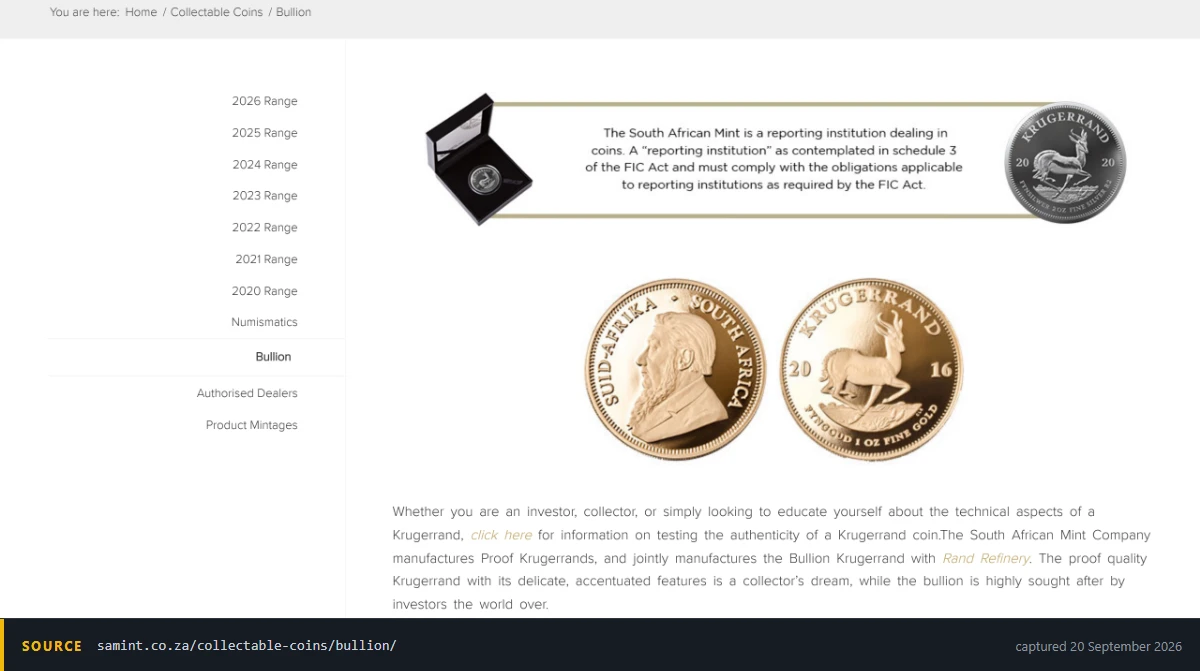
A bearer asset bought through a reporting institution: the Mint states its FIC Act obligation on the page itself, and dealers carry the same duty. The authorised dealers link in the sidebar is where a real quote starts.
Which failure are you insuring against?
Most of the time all three track the gold price and this is a cost-and-convenience decision. The differences only matter in the scenarios gold is bought for, and they point in opposite directions.
Load-shedding, banking outages, domestic infrastructure failure — The coin is unaffected. PAXG needs connectivity. The ETF needs an open market and a working broker.
Rand weakness — All three work — gold is priced in dollars. No meaningful difference.
Capital controls or needing value to cross a border — PAXG is the only one that moves. Note carefully that this cuts both ways: the property that makes it powerful is precisely the property SARB is bringing inside exchange control. Operating outside that framework is a contravention, not a strategy. This site describes it to name the risk, not to recommend it.
Issuer or platform failure — The coin is unaffected. PAXG holders are exposed. ETF holders are largely insulated.
Notice that no option dominates. Each one's weakness is another's strength, which is the actual argument for not treating this as a single choice.
Tax differs too, and needs local advice
The three are not taxed identically in South Africa, and the dimensions that vary are:
- Whether the holding is capital or trading stock: which for crypto assets SARS decides on your behaviour, not the label
- Whether VAT applies, and whether coins are treated differently from tokens
- How tokenised gold is classified: commodity claim, crypto asset, or something else
- Whether token-to-token swaps are disposals
That last one catches people: selling PAXG for USDT may be a disposal of your gold position even though no rand moved. Get advice before building a position of consequence.
Matching the route to the goal
Portfolio diversification, no strong view on crisis scenarios — Cost and convenience dominate. PAXG or the JSE ETF. PAXG wins on carrying cost; the ETF wins on not consuming your allowance and on sitting inside your existing brokerage. The Krugerrand is the wrong tool here — you would pay a premium and take on a storage problem for insurance you are not buying.
Insurance against systemic or infrastructure failure — Now the edge cases are the product. Krugerrands, in your possession, accepted as insurance rather than investment. Insurance costs money; the premium is the price.
Trading the gold price — Liquidity and round-trip cost dominate. PAXG or the ETF. The coin is disqualified by the dealer spread.
A mix is entirely reasonable, and is what most people with a considered gold position hold.
If you go the tokenised route: buy on an exchange, withdraw to your own wallet, and set up the withdrawal whitelist before you fund anything. Registration and security setup is covered here. And read PAXG vs XAUT first, the issuer differences matter more than the price differences.
Educational content, not financial or tax advice. This site is not an authorised financial services provider. Fees, tax treatment and exchange control rules change; verify current terms and take local advice.
This site earns a referral commission on accounts opened through our registration page.