
Gold & Commodities
PAXG vs XAUT: Which Tokenised Gold Can You Redeem?
Both hold allocated LBMA gold and both have the strongest legal wrapper in RWA. The differences are the regulator, the attestation cadence, where the metal sits, and what happens if you ever want it. A line-by-line comparison.
Tokenised gold is the part of this asset class that works best, and it is not close.
The reason is structural. As covered in the four legal wrappers, gold tokens use the strongest available wrapper, a bankruptcy-remote trust claim on a specific physical object. There is no share register to reconcile, no dividend to withhold tax on, no voting rights to strip out, no corporate actions. A bar either is in the vault or it is not.
So the comparison between the two dominant products comes down to details that matter rather than structural gaps. Here they are.
The comparison
| PAX Gold (PAXG) | Tether Gold (XAUT) | |
|---|---|---|
| Issuer | Paxos Trust Company | TG Commodities Limited |
| Primary regulator | NYDFS (New York) | No NYDFS-equivalent licence |
| Vault location | LBMA-approved vaults | Switzerland |
| What backs one token | One allocated LBMA bar, fractionalised | One specific LBMA-accredited bar, verifiable on-chain |
| Attestation cadence | Monthly | Quarterly |
| Attesting firm | KPMG | BDO Italia |
| Engagement type | Third-party attestation | Assurance opinion |
| On-chain transfer fee | Zero as of May 2026 (previously 0.02%) | None charged by issuer |
| Storage fee | Zero, but terms reserve the right to charge with notice | None charged by issuer |
| Direct purchase minimum | Account minimums apply | 50 fine troy ounces + 25bp |
| Physical redemption minimum | 430 PAXG plus fees | 430 XAUT |
| Physical delivery to | Via issuer or approved partners | A Swiss address only |
| Cash settlement | Yes | Yes, on request |
Regulation: the clearest difference
Paxos Trust Company is supervised by the New York State Department of Financial Services. Client assets are typically held bankruptcy-remote under US trust law; the gold is held for you rather than owned by Paxos, and is designed not to form part of the estate if the issuer fails.
Tether Gold operates without an NYDFS-equivalent licence.
This is the single largest difference between the two products and precision about what it means pays off. It is not a claim that XAUT is unbacked, the attestations and the on-chain bar verification are real. It is that PAXG's issuer operates under continuous prudential supervision by a regulator with examination powers, and XAUT's does not.
What you get from supervision is not a guarantee. It is a set of standing obligations — capital, custody segregation, reporting, examination — that exist whether or not anyone is currently suspicious. That is a different kind of protection than a periodic report, and for a long-term hold it is the thing you are actually paying for.
Attestations: monthly versus quarterly
PAXG publishes monthly third-party attestations with KPMG named as the attesting firm. Tether Gold publishes quarterly assurance opinions audited by BDO Italia.
Both are legitimate and both are performed by firms with real professional liability. The difference is the size of the gap between observations.
As verifying backing covers in detail: an attestation confirms a point in time. Between observations you are relying on controls rather than evidence. A monthly cadence means a maximum ~30-day window; quarterly means up to ~90 days. If something went wrong on day 5 of a quarter, the quarterly product would not surface it for nearly three months.
Is that likely? No. Is it the difference you are choosing between? Yes, along with the regulator.
Both issuers publish their reports rather than describing them: Paxos's attestation history and Tether's transparency page. Before you rely on either product, open the most recent one and check its effective date against today.
One genuine advantage in XAUT's favour, which deserves credit: each token is linked to a specific LBMA-accredited bar, and Tether publishes the bar lookup. Bar-level traceability is a real transparency feature and is rarer than it should be. It does not substitute for a physical inspection — an on-chain serial number is a reference to an object, not proof the object is present and unencumbered — but as a complement to periodic assurance it is meaningful.
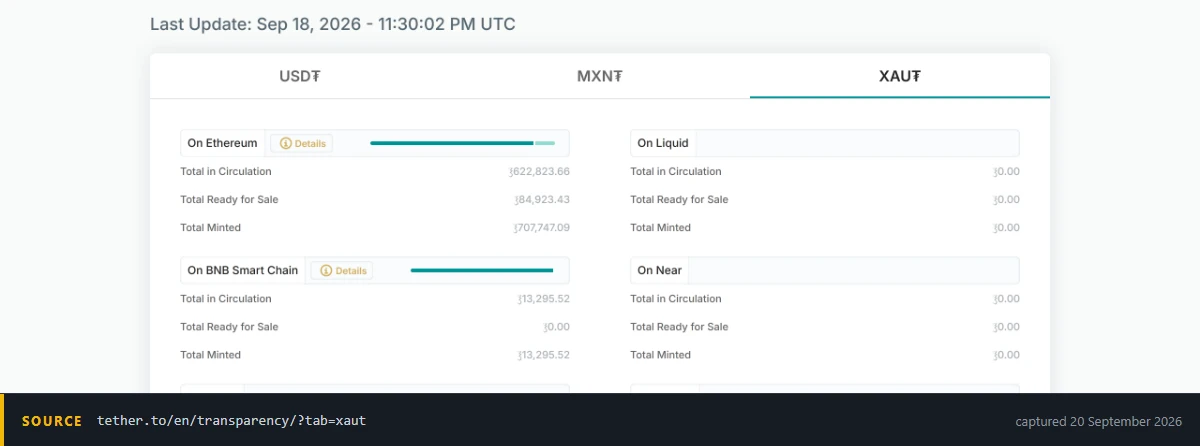
Daily circulation figures, quarterly attestation on the gold behind them. The per-chain split is the other thing to read here: almost the entire supply sits on one chain.
Fees: currently near zero, and not contractual
This has changed recently and in the holder's favour.
PAXG previously charged a 0.02% on-chain transfer fee. Paxos set it to zero, as of May 2026 it advertises zero on-chain transfer fees and zero storage fees. Moving PAXG on-chain now costs you only network gas.
The caveat is in the terms: Paxos reserves the right to impose storage fees in the future with notice. Zero today is a business decision, not a permanent contractual commitment. For a long-term hold, read the current fee schedule rather than trusting an article, including this one.
Where PAXG does charge is at the boundary: creation and destruction fees apply when you buy or sell PAXG through a Paxos account, covering conversions to or from USD, gold bars or unallocated gold. If you acquire PAXG on an exchange instead, you pay that venue's trading fee rather than the creation fee.
XAUT charges no issuer-level transfer or storage fee. Buying directly from Tether Gold requires a minimum of 50 fine troy ounces, at the cost of purchasing gold in the Swiss gold market plus a 25 basis point fee. Redemption also carries 25bp, plus delivery cost for physical.
For a retail holder buying on the secondary market and never touching the issuer, ongoing carrying costs are effectively zero for both. That is remarkable compared to gold ETFs, which typically charge annual expense ratios, a point we take up in tokenised gold vs ETF vs bullion.
Redemption: read this before assuming anything
Both products are redeemable for physical gold. For nearly every retail holder, this fact is irrelevant, and it is worth understanding exactly why.
PAXG requires a minimum of 430 PAXG plus fees to redeem into gold bars. The reason is mechanical rather than arbitrary: London Good Delivery bars range from roughly 370 to 430 troy ounces, and Paxos requires a 430 balance so your account covers the maximum possible weight of whichever bar is allocated to your delivery, plus baseline transaction fees.
XAUT physical delivery is subject to a 430 XAUT minimum, after which TG Commodities Limited arranges secure transit of the bars to a delivery address in Switzerland specified by the user.
430 troy ounces is one full LBMA Good Delivery bar. At any gold price of the last several years that is a position in the high six figures and, at more recent levels, well into seven. This is not a retail threshold and was never intended to be.
Two differences within that constraint matter:
- Delivery geography. XAUT physical delivery goes to a Swiss address. If you are not in Switzerland and cannot readily arrange receipt there, physical redemption is not practically available to you even if you clear the 430 threshold. PAXG offers pathways through the issuer or approved partners, and that partner network is what creates smaller-denomination routes.
- Cash settlement. Both offer it. This is the redemption path that actually applies to normal holders, and note that cash settlement means you are exiting at a price, which makes it economically similar to just selling on an exchange.
We work through the real arithmetic in what physical redemption actually costs.
What to check before buying either
- Current fee schedule from the issuer, not from an article. Zero fees are a current business decision.
- The most recent attestation: its date, its scope, and whether it says unencumbered.
- Token supply against reserves at the same instant, not across different dates.
- Depth on your chosen venue, because for both products your realistic exit is selling rather than redeeming.
- The live spread, which you can read without an account. Kraken's public ticker endpoint —
https://api.kraken.com/0/public/Ticker?pair=PAXGUSD— returns best bid inb, best ask inaand 24-hour volume inv; substituteXAUTUSDfor the other. On 19 September 2026 that read a 0.025% spread on PAXG against 0.011% on XAUT, on 433 and 108 ounces of daily volume respectively. Those numbers will have moved by the time you read this, which is exactly why the endpoint is more useful than the figures.
Supply is checkable too. PAX Gold is 0x45804880De22913dAFE09f4980848ECE6EcbAf78 (18 decimals) and Tether Gold is 0x68749665FF8D2d112Fa859AA293F07A622782F38 (6 decimals) on Ethereum. Reading totalSupply() on 19 September 2026 gave 431,889.66 ounces of PAXG against 707,747.09 of XAUT — XAUT is the larger of the two by ounces held, which surprises people who assume the more heavily regulated product is the bigger one. Verifying backing shows the exact call.
Both trade on the spot market at most major venues, so the venue decision is mostly about where your capital already sits and which book is deeper for your size. If you need to set up an account for this, the registration and verification walkthrough covers one route end to end.
Which one
Choose PAXG if you are holding for the long term and the wrapper is what you are buying. NYDFS supervision plus monthly KPMG attestations is the strongest combination available in tokenised gold, and for a multi-year position that difference compounds in a way that a few basis points of spread does not. The approved-partner network also gives you more realistic physical routes if that optionality matters.
Choose XAUT if you value bar-level on-chain verification, you are trading rather than holding and liquidity on your venue is better, or you have a specific reason to prefer Swiss vaulting and can use Swiss delivery.
For most readers holding gold exposure for more than a few months, PAXG is the better-constructed product, and the reason is not fees or convenience, which are close to identical. It is that a supervised trust company with monthly named-firm attestations is a materially different counterparty than one without, and counterparty quality is the entire product when you are holding a claim rather than a bar.
If you are trading in and out on a weekly basis, the difference is close to noise and you should optimise for depth on your venue instead.
No part of this is investment advice. Fees, attestation arrangements and redemption terms change; verify against the issuers' current published terms before committing funds.