
Gold & Commodities
Tokenised Gold vs Gold ETF vs Bullion Compared
Three ways to hold gold, three different things you are actually buying. A comparison across carrying cost, counterparty risk, liquidity and crisis behaviour — and the one question that settles which is right for you.
Most comparisons of these three declare a winner. That is the wrong shape of answer, because they are not substitutes; they solve different problems, and the differences only become visible in scenarios most of the time doesn't contain.
Here is the comparison, followed by the question that decides it.
The table
| Tokenised gold | Gold ETF | Physical bullion | |
|---|---|---|---|
| Annual carrying cost | Zero at present (PAXG and XAUT charge no storage fee) | Expense ratio, typically ~0.15–0.40% | Vault fees, or your own security problem |
| Upfront cost | Exchange spread | Brokerage commission, often zero | Dealer premium over spot, ~2–8% retail |
| Counterparty | Trust company or issuer SPV | Fund, trustee, custodian | None, once in your possession |
| Minimum position | Fractional: a few dollars | One share | One coin, typically ~1/10 to 1 oz |
| Trading hours | 24/7 | Exchange hours | Dealer hours |
| Settlement | Minutes | T+1 | Immediate in person, or shipping |
| Who can buy | Most jurisdictions, KYC at venue | Brokerage account required | Anyone, with cash |
| Verification | Attestations plus on-chain supply | Audited fund reporting | Your own eyes |
| Crisis behaviour | Depends on issuer and chain | Depends on market being open | Works if you can reach it |
Three rows in that table do the real work: carrying cost, counterparty, and crisis behaviour.
Carrying cost: the tokenised advantage is real
This is where tokenised gold currently wins clearly, and it is underappreciated.
PAXG and XAUT charge no ongoing storage fee. Paxos advertises zero storage and zero on-chain transfer fees as of May 2026, having previously charged 0.02% on transfers. Tether charges no issuer-level holding fee.
Gold ETFs charge an expense ratio every year, deducted continuously from the fund's assets, typically somewhere in the 0.15% to 0.40% range depending on the fund. You never see a bill; the fund's gold holdings per share simply decline over time.
Over a decade, a 0.30% annual expense ratio consumes roughly 3% of your position. That is not catastrophic, but it is a real, certain cost against an uncertain return, and it is precisely the sort of drag that compounds quietly.
Two honest caveats:
The tokenised zero is a business decision, not a contractual commitment. Paxos's terms reserve the right to introduce storage fees in the future with notice. Zero today does not guarantee zero in 2031, and a long-term holder should re-read the fee schedule periodically.
And an ETF's expense ratio buys something: a regulated fund structure, audited reporting, an authorised participant mechanism that keeps price pinned to NAV, and integration with retirement accounts and conventional portfolio infrastructure. Whether that is worth 30 basis points depends on whether you need those things.
Physical bullion's cost is front-loaded and often underestimated. The dealer premium over spot — commonly 2% to 8% at retail sizes, higher for small coins — is paid immediately, and you pay a spread again when selling. Then storage: either an ongoing vault fee, or a home security arrangement whose true cost includes insurance that may not cover the full value.
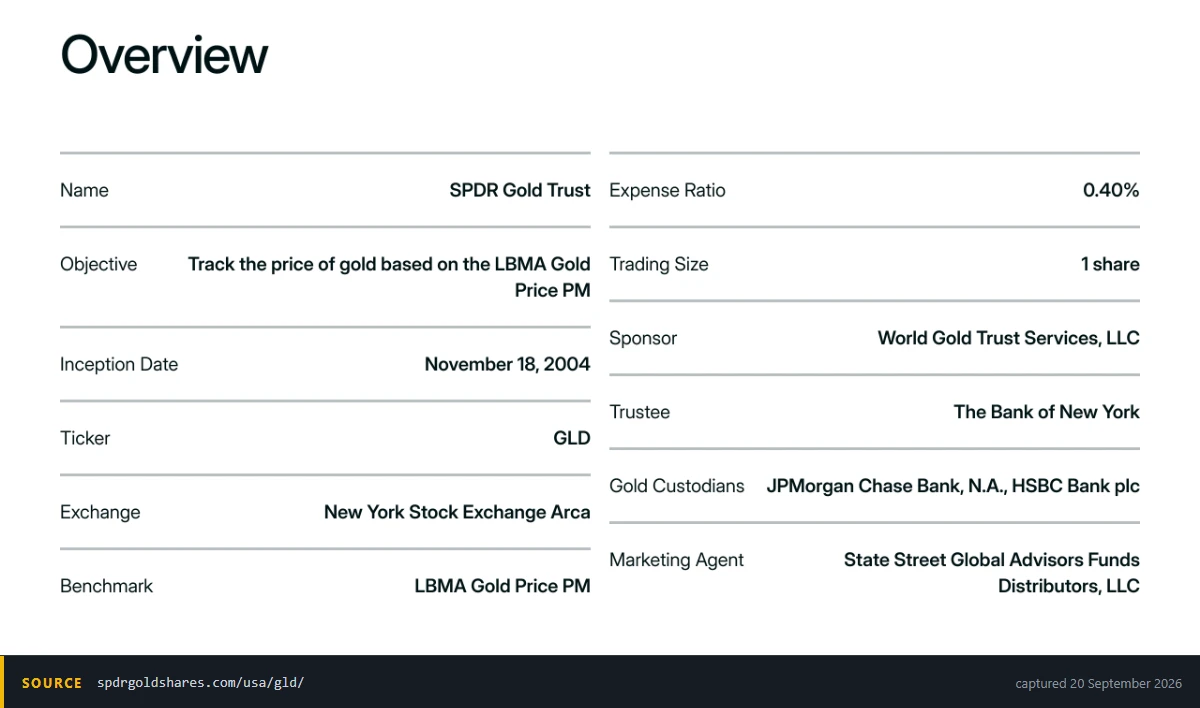
One number on this table compounds against you every year you hold. The trustee and custodian rows are the other half of the trade, because an ETF share is a claim that runs through those named institutions.
Counterparty risk: the physical advantage is also real
Tokenised gold's counterparty is the issuer. PAXG's is Paxos Trust Company, supervised by NYDFS, with client assets typically held bankruptcy-remote under US trust law. That is a strong arrangement; the gold is held for you, structured not to form part of the estate if the issuer fails. XAUT's issuer operates without an NYDFS-equivalent licence, with backing evidenced by quarterly BDO Italia assurance opinions and on-chain bar-level verification.
Tokenised gold also carries risks an ETF does not: smart contract risk, and access risk: losing your keys, or having a venue restrict your account.
An ETF's counterparty chain is longer than people assume: fund, trustee, custodian, sub-custodians. Well-regulated and heavily audited, but not zero. It also requires a functioning brokerage relationship and an open market.
Physical bullion in your own possession has no counterparty. This is its entire proposition and it is unmatched. No issuer can restrict it, no custodian can fail, no chain can halt, no exchange can suspend withdrawals. The cost is that you have taken on the security problem, and that problem is harder and more expensive than most people estimate.
Crisis behaviour: where the differences stop being academic
Most of the time, all three track the gold price and the choice is about cost and convenience. The differences matter in exactly the scenarios gold is bought for.
Market disruption, exchanges closed — ETFs stop trading. Tokenised gold keeps trading — valuable, though expect wide spreads and note that the arbitrage mechanism that keeps the price anchored (discussed here) may be impaired at precisely that moment. Physical is unaffected but you need a willing local buyer.
Banking system stress — ETFs depend on a functioning brokerage and banking chain. Tokenised gold is reachable as long as you have keys and a chain — a real advantage, provided you are not relying on a custodial exchange account, which reintroduces exactly the dependency you were trying to escape. Physical is unaffected.
Capital controls — Tokenised gold is the strongest option here by a wide margin — self-custodied, it crosses borders as data. This is not a hypothetical benefit; for readers in jurisdictions with active currency restrictions it is often the entire reason to prefer it.
Issuer-specific failure — The one scenario where tokenised gold is weakest. An issuer problem hits your position directly even if the gold price is fine. ETF and physical holders are unaffected. This is the risk you are paid to monitor via attestations — and the reason cadence and regulator matter, as compared in PAXG vs XAUT.
Chain or smart contract failure — Tokenised only. Low probability for the major products on major chains, not zero.
Notice that no option dominates. Each one's weakness is another's strength, which is the actual argument for not treating this as a single choice.
A word on tax, and why it needs local advice
Tax treatment differs enough between these three to change the ranking entirely, and it is jurisdiction-specific in ways no article can resolve.
The dimensions that vary:
- Whether gold is treated as a collectible, which in some jurisdictions carries a higher capital gains rate than ordinary investments.
- Whether investment-grade gold is VAT-exempt: common for physical bullion in many jurisdictions, and a significant factor.
- How tokenised gold is classified: as a commodity claim, as a crypto asset, or as something else. This is often unsettled, and the classification can differ from that of physical gold despite identical economic exposure.
- Whether token-to-token swaps are taxable events, which matters if you trade rather than hold.
That last one catches people. Selling PAXG for USDT may be a disposal in your jurisdiction even though you never touched fiat. Get local advice before building a position of consequential size; the tax difference will likely exceed every fee discussed above.
The question that decides it
Ask why you want gold. There are three common answers and each points somewhere different.
"Portfolio diversification — I want an allocation that behaves differently from equities." Cost and convenience dominate; crisis edge cases are not what you are buying. Either tokenised gold or an ETF works well. Tokenised wins on carrying cost and access; the ETF wins if you need it inside a tax-advantaged account or alongside conventional holdings. Physical is the wrong tool; you would pay a dealer premium and a storage problem for insurance you are not buying.
"Insurance against systemic failure: banks, currencies, capital controls." Now the edge cases are the product. Physical in your possession, or self-custodied tokenised gold, depending on which failure you are insuring against. Physical is better against digital and infrastructure failure; self-custodied tokenised gold is better against capital controls and geographic risk, because it moves and physical does not. An ETF does approximately nothing for this goal; it depends on every system you are worried about.
"Trading exposure to the gold price." Liquidity and cost per round trip dominate. Tokenised gold or an ETF, whichever has better depth on the venue you use. Physical is disqualified by the spread.
If you want a gold allocation and have no strong view on crisis scenarios: tokenised gold via a well-regulated issuer, held in self-custody, is the lowest-cost route currently available, with the important caveat that you now own a key-management responsibility you must take seriously. Practically, that means buying on an exchange and withdrawing to your own wallet: the registration and verification walkthrough covers the account side, including the withdrawal whitelist you should configure before funding.
If you specifically want crisis insurance: hold some physical, accept the premium and the storage problem, and stop thinking of it as an investment. It is insurance. Insurance costs money.
If you already have a brokerage account and want simplicity: an ETF is completely fine. The expense ratio is the price of not having to think about custody, and for many people that is a rational purchase.
And if you are holding tokenised gold as a long-term position, put a calendar reminder to re-read the issuer's fee schedule and most recent attestation once a year — Paxos publishes both on its transparency page, Tether on its own. Ten minutes, once a year. Zero fees and monthly attestations are current facts, not permanent ones.
Educational content, not investment advice. Fees, expense ratios and tax treatment vary by product and jurisdiction and change over time. Verify current terms and take local tax advice before committing funds.