
Treasuries & Yield
BUIDL Is Closed to You Unless You Have $5 Million
Tokenised treasuries are sold as democratised access to T-bill yield. Most of the large funds require qualified purchaser status — $5 million in investments — before you can hold a single token. Here are the real thresholds and where they come from.
No, unless you hold $5 million in investments. BUIDL relies on a 3(c)(7) exemption that permits 2,000 investors on condition that every one of them is a qualified purchaser, and no amount of tokenisation changes who an exemption lets in.
The story told about tokenised treasuries is democratisation: T-bill yield, previously locked behind institutional minimums, now available on-chain to anyone with a wallet. The story is mostly false, and the way it is false is worth understanding, because the same gate sits in front of most of this asset class.
BlackRock's BUIDL is the flagship product of this category and the one that appears in every RWA market-size chart. For most retail traders, BUIDL is not directly accessible. The fund carries institutional minimum investment requirements — typically around $5 million — and qualified investor restrictions.
Nobody is going to fix that, because it is the legal structure the product is built on. Understanding it tells you which doors in this asset class are open.
The two gates, precisely
US securities law has two relevant investor classifications. Crypto coverage uses them interchangeably. They are very different.
Accredited investor
The lower bar. An individual qualifies with:
- Net worth over $1 million, excluding the primary residence, alone or with a spouse; or
- Income over $200,000 in each of the last two years, or $300,000 jointly, with a reasonable expectation of the same in the current year.
Certain professional credentials also qualify a person regardless of wealth.
This threshold reaches a meaningful slice of the population, anyone with a paid-off home in an expensive city and a retirement account may clear it without thinking of themselves as wealthy.
Qualified purchaser
The higher bar, and the one that matters here. An individual or married couple qualifies with:
- $5 million or more in investments, excluding primary residence and business property.
Note the difference in kind, not just degree. Accredited status looks at net worth or income. Qualified purchaser status looks at investments you currently hold, a much harder test. A person with a $3 million house and a $200,000 salary is accredited and nowhere near a qualified purchaser.
Entities generally need $25 million in investments.
Why the funds use the higher gate
This is the part that explains everything, and it has nothing to do with blockchain.
Investment funds avoid registering as investment companies under two exemptions:
- Section 3(c)(1) funds can accept up to 100 beneficial owners (250 for smaller qualifying funds), who must generally be accredited investors.
- Section 3(c)(7) funds can accept up to 2,000 investors, but every one of them must be a qualified purchaser.
For a fund intending to scale — which is the entire point of a tokenised treasury product — 100 investors is not a viable business. So they choose 3(c)(7), and the price of that choice is that every single holder must clear the $5 million bar.
This is why the restriction cannot be tokenised away. The gate is not on the distribution technology; it is on the fund's exemption from registration. Put the fund on a blockchain and the exemption's conditions are exactly the same.
There is an additional operational layer: private offerings that advertise publicly rely on Rule 506(c), which requires the issuer to take reasonable steps to verify accredited status. Self-certification is not enough; verification means reviewing tax returns, brokerage statements, or obtaining a letter from a licensed professional. That is a real onboarding process, not a checkbox.
Which products sit behind which gate
Roughly, as of 2026:
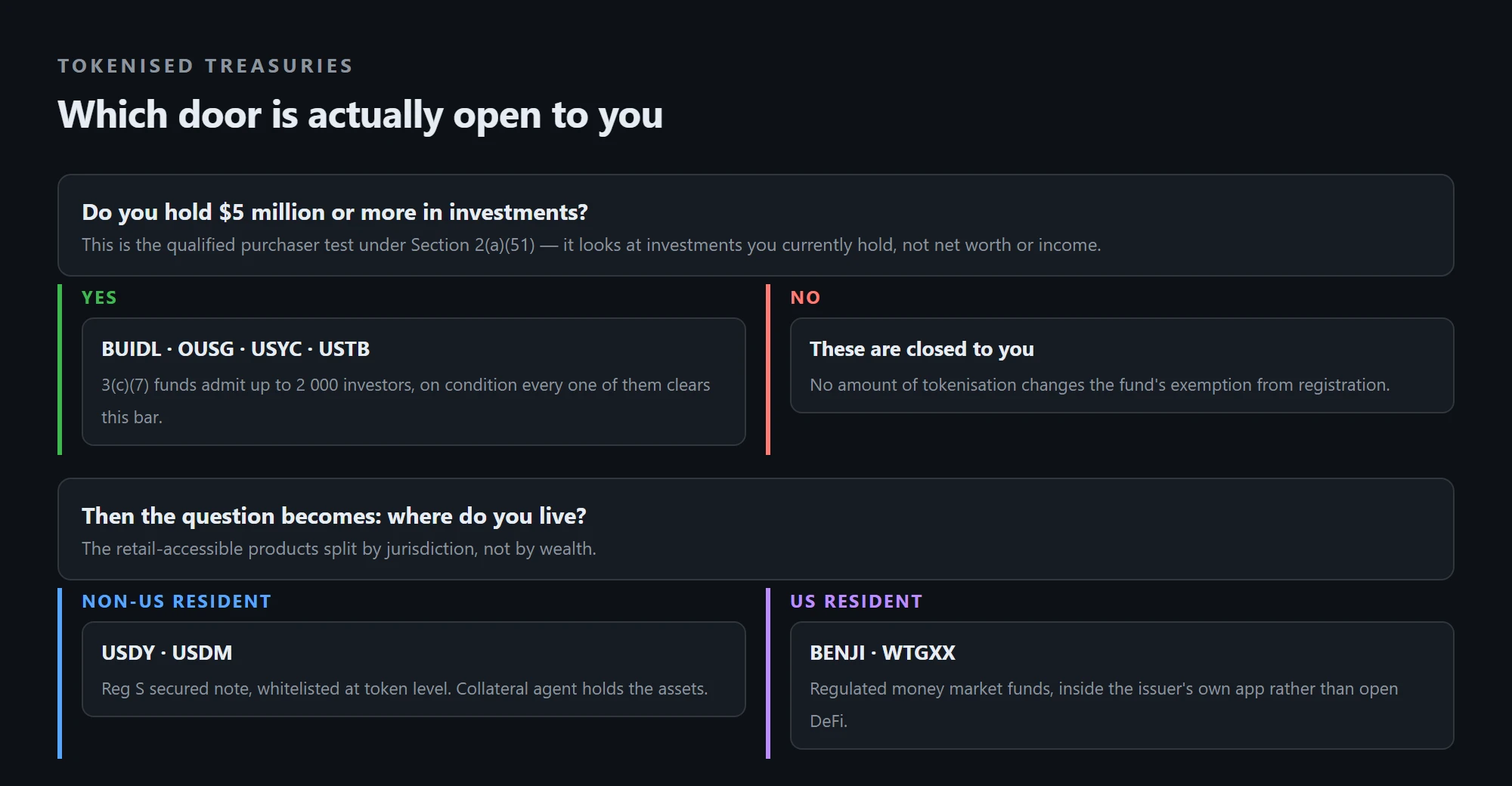
Qualified purchaser or qualified investor territory, effectively closed to retail:
- BUIDL (BlackRock, administered by Securitize): fractional ownership of a portfolio of short-duration US government securities, with institutional minimums typically around $5 million
- OUSG (Ondo)
- USYC
- USTB
- Maple Cash
Open to non-US retail, with whitelisting at the token level:
- USDY (Ondo), structured as a Reg S product specifically for non-US investors
- USDM
Open to US retail, inside the issuer's own application rather than open DeFi:
- BENJI (Franklin Templeton)
- WTGXX
That last category is small and needs stating carefully: BENJI and WTGXX are the products that take US retail directly, and they do it inside issuer apps rather than open DeFi. You are using a regulated fund's application that happens to record shares on a blockchain. That is a real product with real utility; it is just not the permissionless on-chain experience the category's marketing implies.
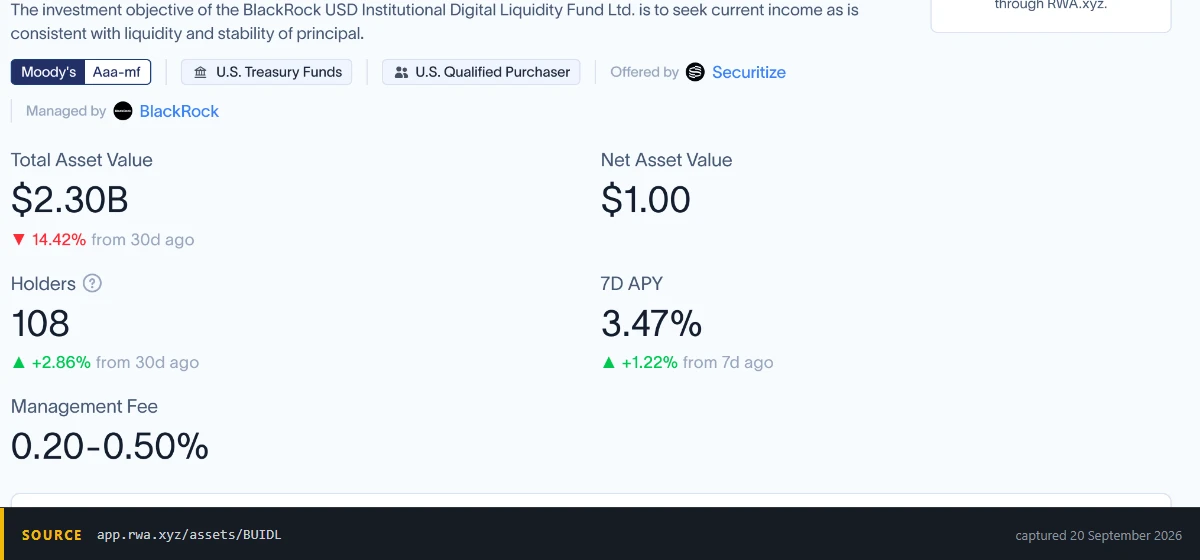
A multi-billion-dollar fund with a three-digit holder count. The eligibility tag one line above explains that number rather than contradicting it.
The pattern, again
If you have read the three tokenised stock structures, this will look familiar, because it is the same trade in a different asset class.
Legal strength and permissionless access trade off against each other. BUIDL is a genuine fund share with a transfer agent and the full protection of US fund regulation, and that protection is inseparable from the eligibility regime that keeps you out. USDY reaches non-US retail by being structured under Reg S, a different exemption with different constraints.
Nobody in this industry has escaped that trade-off. When a product appears to offer institutional-grade structure with no eligibility gate at all, the correct response is to find out which of the two it is missing. Usually it is the structure.
What you can actually do
-
Check whether you clear the bars — Some readers do. If your status sits on the line, the eligibility determination belongs to the issuer rather than to you, and they publish a way to ask: Backed's contact form for xStocks, Ondo's documentation for Ondo, Paxos support for Paxos products. Ask before you commit funds, not after. If you hold $5 million in investments, qualified purchaser products are open, and you can evaluate them on their merits.
-
Look at products built for retail from the start — Tokenised treasury products actually open to retail covers USDY, BENJI and the others in detail, including what you give up relative to BUIDL.
-
Compare against the boring alternatives honestly — A money market fund at a conventional broker, or T-bills bought directly, offer the same underlying yield without the wrapper, the eligibility question, or the smart contract risk. If the on-chain features are not doing specific work for you, the traditional route is simpler and often cheaper. This is an uncomfortable conclusion for a site about RWAs, and it is frequently the right one.
-
Stop treating market-size headlines as an opportunity set — When you read that tokenised treasuries crossed some billion-dollar milestone, most of that figure represents institutional money in products you cannot buy. It is an indicator of institutional adoption, not a menu. Reading RWA market numbers goes into what those figures count.
What tokenisation did and did not change
Worth being fair here, because the picture is not entirely cynical.
Genuinely changed:
- Settlement speed. On-chain settlement in minutes rather than T+1 or T+2. This is real and valuable for treasury operations.
- Operating hours. Transfers on weekends and holidays.
- Composability. Eligible holders can use these as collateral in ways a fund share in a conventional account cannot be used.
- Minimum sizes within the eligible population. An institution that qualifies can hold a smaller position than traditional fund minimums would have allowed.
- Transparency. On-chain supply is verifiable by anyone, whether or not they can hold it.
Did not change:
- Who is allowed to hold the security.
- The regulatory exemption the fund relies on.
- KYC and verification requirements.
- The fund's underlying economics.
The honest summary: tokenisation improved the plumbing for people who already had access. It did not widen access. For the qualifying institutional treasurer, these products are a genuine operational upgrade. For a retail investor, the category mostly reads as a headline about a market they cannot enter.
Educational content, not investment advice. Eligibility thresholds and product terms change; verify with the issuer and take professional advice on your own status before acting.