
Treasuries & Yield
Tokenised Treasuries Retail Can Buy: USDY, BENJI, WTGXX
A short list, because it is a short list. USDY for non-US holders, BENJI and WTGXX for US retail inside issuer apps — what each one legally is, how the yield reaches you, and the honest comparison against a money market fund.
Most tokenised treasury funds are closed to you. This article covers the ones that are not.
It is a short article because it is a short list. That brevity is itself the most useful information in the category.
What is actually open
Open to non-US retail, with eligibility enforced by whitelisting at the token level:
- USDY (Ondo)
- USDM
Open to US retail, inside the issuer's own application rather than open DeFi:
- BENJI (Franklin Templeton)
- WTGXX (WisdomTree)
That is essentially the field. Everything else in the tokenised treasury market — BUIDL, OUSG, USYC, USTB, Maple Cash — requires qualified purchaser or qualified investor status.
USDY in detail
USDY is the most widely accessible product in the category for non-US holders, and its structure is worth understanding precisely because it is unusually good for something retail can buy.
What it legally is: a tokenised note, secured.
USDY is a tokenised note for non-US individuals and institutions, secured by a portfolio of short-term US Treasuries and bank demand deposits, issued by a bankruptcy-remote vehicle with a trust company acting as collateral agent to safeguard holders. It was issued by Ondo USDY LLC, folded into the Ondo Stocks umbrella as of 15 December 2025.
Compare this to the tracker certificate structure behind xStocks, where you are an unsecured creditor. USDY is a secured note with a collateral agent holding the assets and a bankruptcy-remote issuing vehicle. You are still a creditor, but you are a creditor with collateral and an independent party holding it. That is a materially stronger position, and it is the main reason USDY deserves to be taken seriously rather than treating as a yield-bearing stablecoin substitute.
What backs it: as of April 2026, approximately 92% short-term Treasuries and 8% bank demand deposits at insured US banks. The deposit portion is not idle; it functions as redemption-day liquidity, which is a sensible design. A fund that is 100% invested in Treasuries has to sell something to meet redemptions; a cash buffer means routine redemptions do not force asset sales.
How yield reaches you, and this part surprises people:
USDY is not a stablecoin and does not stay at $1. It launched at $1.00 and its redemption value rises as interest accrues. Your token count stays the same; each token becomes worth more.
There is also rUSDY, a rebasing variant that delivers the same economics through balance increases instead: if you hold one rUSDY worth $1 and accrue a dollar of yield, you hold two rUSDY at $1 each.
Two practical consequences:
- Do not treat USDY as a dollar peg. Seeing it trade above $1 is the design working, not a mispricing. Anyone who "sells the premium" has simply sold their accrued interest.
- Pick the variant that matches your use. The accruing version integrates more cleanly with protocols that assume static balances. The rebasing version is easier to reason about if you want your balance to show your yield.
Eligibility: structured as a Reg S product specifically for non-US investors, with whitelisting at the token level. Reg S is the exemption for offerings made outside the United States. If you are a US person, USDY is not available to you, and the restriction is enforced in the token contract itself rather than just in terms of service.
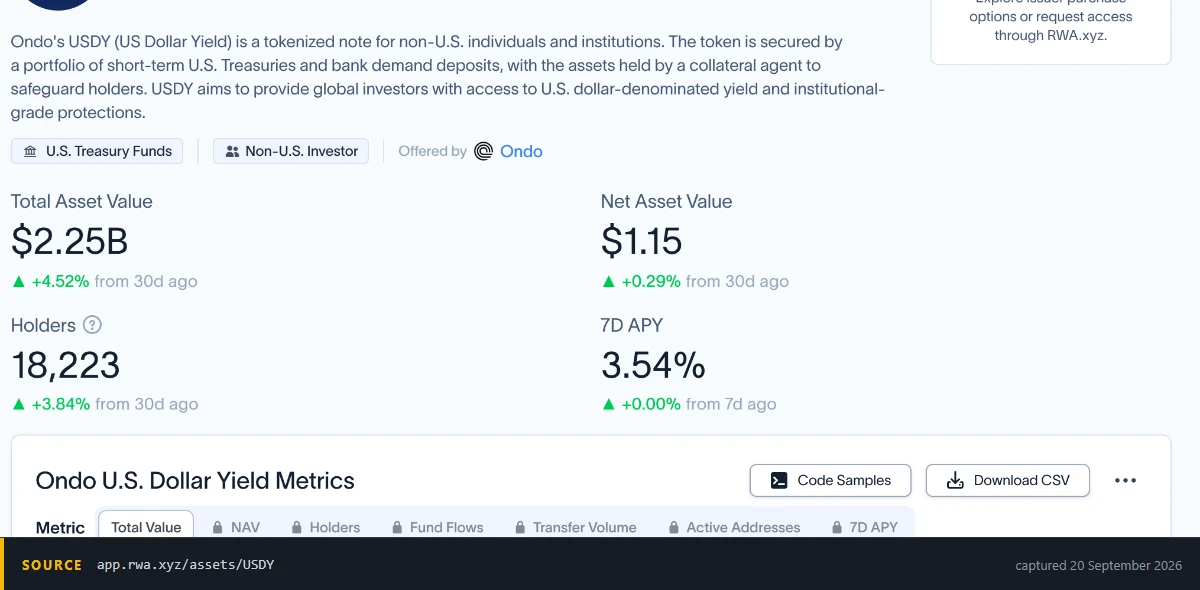
Same asset class as BUIDL, opposite eligibility tag, four orders of magnitude between the holder counts. The net asset value above a dollar is the second thing to notice: yield accrues into the price instead of arriving as a payment.
BENJI and WTGXX: the US retail route
BENJI and WTGXX are the products that take US retail directly, and they do it inside issuer apps rather than open DeFi.
This is a genuine product with real advantages: an actual regulated money market fund, with fund-level protections, where blockchain serves as the share register. Franklin Templeton and WisdomTree are established asset managers, not crypto startups.
Set expectations correctly, though. You are using a regulated fund's application that records shares on-chain. You generally are not getting a freely transferable token to move into DeFi, use as collateral, or send to a friend. The tokenisation is mostly infrastructure that benefits the issuer and gives you faster settlement; not composability you can act on.
If your goal is US-accessible T-bill yield with a modern interface, these work well. If your goal is on-chain composability, they are not that, and no amount of reading the marketing will change it.
The comparison to run
Three alternatives, honestly assessed.
Versus a stablecoin
The relevant difference: major stablecoins like USDT and USDC do not pass interest to holders. The issuer invests the reserves and keeps the yield. Holding $10,000 in USDC means the issuer earns the T-bill yield on your money.
USDY passes that yield to you. Over a year at prevailing short-term rates, on a meaningful balance, this is not a small difference; it is most of the reason to hold a yield-bearing instrument instead of a stablecoin.
What you give up:
- Liquidity and acceptance. USDT and USDC are accepted nearly everywhere in crypto. USDY is not. If you need spendable, instantly-swappable dollars, a stablecoin is the correct tool.
- Price stability. USDY's value rises. That is the point, but it means it does not function as a unit of account.
- Eligibility. Whitelisting means transfers only work between eligible addresses. You cannot send USDY to an arbitrary wallet.
The sensible split for most people: stablecoins for working capital you will spend or trade, yield-bearing instruments for balances that would otherwise sit idle for months.
Versus a money market fund at a conventional broker
The uncomfortable comparison, and the one most RWA content skips.
A money market fund at an ordinary broker holds the same underlying assets, pays a similar yield, is regulated as a fund, has decades of operating history, and carries no smart contract risk, no key management burden, and no bridging risk.
If you have easy access to a brokerage account, the conventional money market fund is usually the better instrument. That is the honest answer.
Tokenised treasuries genuinely win in specific situations:
- Your capital is already on-chain and moving it out and back is expensive, slow, or triggers taxable events
- You are in a jurisdiction where opening a US or European brokerage account is difficult
- You need 24/7 settlement, including weekends
- You want to use the position as collateral in on-chain protocols, where eligible
- You want to hold dollar-denominated yield without a banking relationship
If none of those apply to you, the tokenised version is adding complexity for no return. Be willing to reach that conclusion.
Versus buying T-bills directly
The lowest-cost option, with no fund fee and no issuer between you and the Treasury. Also the least convenient: you manage maturities, reinvestment, and settlement yourself, and access depends on your jurisdiction.
For large, patient balances this is hard to beat on cost. For anything requiring flexibility, the operational overhead is real.
What to check before buying any of these
- The current yield, net of all fees. Headline yield is the portfolio's yield. Your yield is after management fees. Find the net number, and compare it against a money market fund quoted on the same basis.
- The backing composition and where it is disclosed. USDY publishes its Treasury-versus-deposit split. Any product that will not tell you what it holds is not a candidate. Apply the backing verification checklist.
- The redemption mechanics. How fast, what minimums, which days, and what happens to redemptions during stress. The cash buffer question matters here; a product with no liquidity sleeve has to sell assets to pay you.
- The eligibility restriction, in the contract. For whitelisted tokens, know before buying which addresses you can transfer to. Discovering that a destination address is not whitelisted after you have committed funds is an avoidable and frustrating error.
- Whether the yield is taxable to you as interest, and when. Accrual-based yield may be taxable as it accrues rather than when you sell, depending on jurisdiction. This can create a tax liability before you have realised any cash. Get local advice. See the risk and tax checklist.
Where a money market fund still wins
- Non-US retail: USDY is a legitimately well-constructed product: secured note, bankruptcy-remote issuer, trust company as collateral agent, transparent backing. Worth considering for idle dollar balances that are already on-chain.
- US retail: BENJI and WTGXX are real money market funds with modern interfaces. Good products, limited composability.
- Everyone: compare against a conventional money market fund before assuming the on-chain version is better. It is better when you need on-chain properties. It is worse when you do not, and most people do not.
Nothing here recommends one product over another. Yields, backing composition, eligibility and terms change; verify against the issuer's current documentation before committing funds.