
Tokenised Stocks
bStocks vs xStocks vs Ondo Stocks Compared (2026)
These three products control roughly three quarters of the tokenised equity market and track the same shares. One makes you a shareholder, one makes you a creditor, one makes you a rights holder against an SPV. A structural comparison, not a feature list.

By August 2026, three products controlled about 77% of the tokenised single-name equity market: Ondo at roughly $957 million, Binance's bStocks at $622 million, and xStocks at $600 million. The category as a whole reached about $2 billion, or nearly 5% of the total RWA market.
Retail interest is where the growth is. BNB Chain alone went from roughly 45,000 RWA holders in April to over 1.3 million by early September.
All three products let you hold exposure to Tesla or Nvidia on-chain. All three are backed 1:1 by real shares with regulated custodians. All three show you the same price chart.
And all three make you a fundamentally different kind of claimant. This is the comparison that decides what happens when something goes wrong.
The structural comparison
| Ondo Stocks | bStocks | xStocks | |
|---|---|---|---|
| Issuing entity | Oasis Pro TA (Ondo US subsidiary) | BTech Holdings Limited | Backed Assets (JE) Limited |
| Jurisdiction / status | US, SEC-registered transfer agent | Abu Dhabi Global Market SPV | Jersey SPV, JFSC-registered |
| What you legally hold | Security entitlement | Rights token against SPV | Bearer debt instrument (tracker certificate) |
| Are you an owner? | Yes | No | No; you are a creditor |
| Voting rights | Yes, via Broadridge proxy | No | No |
| Dividend mechanism | Shareholder distributions | Rebase | Reinvested via on-chain multiplier |
| Retail redemption | Yes, if onboarded and eligible | Secondary market for most | Institutional channel only |
| Chains | Solana, Ethereum, BNB Chain | BNB Chain (BEP-20) | Solana and others |
| Breadth | 260+ stocks and ETFs | Growing US large-cap list | 100+ country distribution |
| Custody / back office | Broker-dealer custody, Broadridge | Nest Trading (broker), Alpaca Securities | Regulated custodian |
The table is the article. Everything below explains why each row matters.
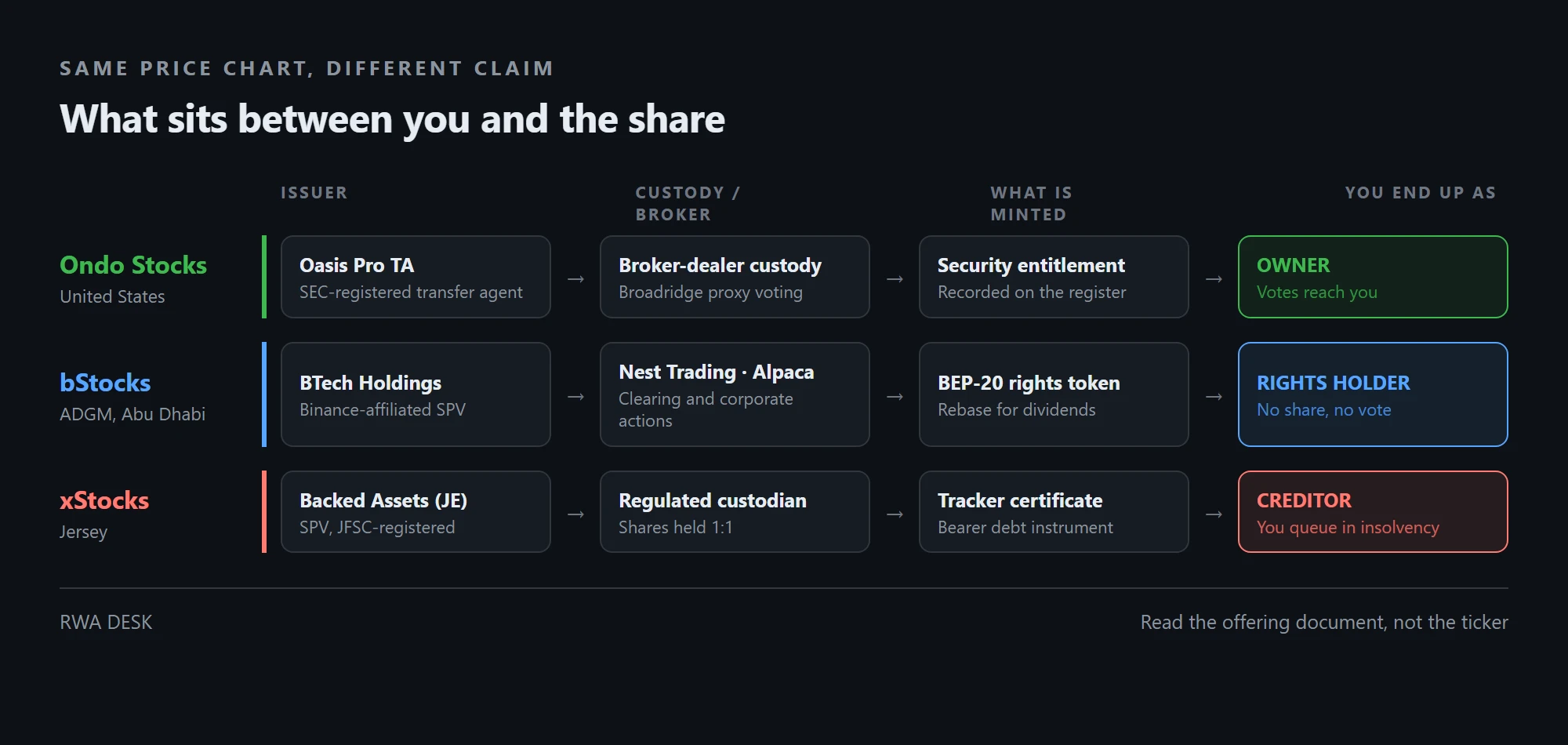
Ondo Stocks: the one where you are actually a shareholder
Ondo's US subsidiary Oasis Pro TA is an SEC-registered transfer agent. That single fact changes the product category.
A transfer agent is the entity that maintains the official register of who owns a security. It is the same role that sits behind your conventional brokerage account. By tokenising shares held in custody as security entitlements, Ondo puts token holders in the position of actual owners, with full ownership and voting rights in the underlying stock. Broadridge, a mainstream Wall Street back-office provider, handles proxy voting and shareholder communications for token holders. BlackRock's iShares Core S&P 500 ETF (IVV) and Micron were among the first securities issued under this model.
The platform passed $1 billion in TVL in under eight months and covers more than 260 tokenised US stocks and ETFs across Solana, Ethereum and BNB Chain, including SLV, IAU and QQQ alongside single names. It is distributed through crypto-native surfaces — MetaMask added tokenised US stocks, ETFs and commodities via Ondo — so eligible mobile users in supported non-US jurisdictions can access US securities without a traditional brokerage account.
The trade-off is the gate. Redemptions are processed only for holders who have completed onboarding and are eligible. If you have not onboarded, or you do not qualify, your tokens will not be redeemed on the platform; you continue holding or you sell on a secondary market where permitted.
This is the pattern that repeats across every RWA category: the legal strength comes from operating inside a securities framework, and that framework asks who you are. You cannot buy the protection without answering the question.
Choose this if you want the strongest claim available, you are willing to complete onboarding, and you want your holding to be an actual ownership interest rather than a promise from a vehicle.
bStocks: conventional brokerage plumbing, SPV wrapper
Binance's bStocks are BEP-20 tokens on BNB Chain issued by BTech Holdings Limited, a Binance Group affiliate structured as a special purpose vehicle in the Abu Dhabi Global Market.
The operational stack is thoroughly conventional, which is a point in its favour. Nest Trading Limited, an ADGM-regulated introducing broker, handles the brokerage relationship. Alpaca Securities handles clearing, custody, dividends and corporate actions. Every token is backed 1:1 by a real share held with a regulated custodian. Dividends and splits flow through a built-in rebase mechanism, so balances adjust automatically without manual airdrops.
The lineup launched with names including Microsoft, Meta, Palantir, Lumentum and the QQQ Trust, and has expanded since.
- What you hold is a rights token, not a share. The tokens represent rights tied to the underlying securities without conferring direct share ownership in the listed company. No voting. And dividends arrive net of US withholding, typically 30% for non-US holders before treaty relief.
- The jurisdictional structure deserves attention. bStocks are offered under an Approved Prospectus in the ADGM and are not publicly offered in any other jurisdiction. Outside the ADGM, availability is on a secondary-market basis only, to eligible users in permitted jurisdictions. Binance states that it may restrict, suspend, reject, cancel or unwind access or transactions where it determines these may breach applicable law, product restrictions, eligibility criteria, sanctions requirements or the offering documents.
That is standard language for this kind of product and not a red flag in itself. It is a description of a real risk you carry: your access is conditional and can change without anything about the underlying asset changing.
Choose this if you already trade on Binance, the operational convenience of holding equity exposure next to your crypto balance is worth real money to you, and you understand you are holding an SPV claim rather than a share.
xStocks: the widest distribution, the weakest claim
xStocks are issued by Backed Assets (JE) Limited, a Jersey special purpose vehicle registered with the Jersey Financial Services Commission, holding the COBO and CGPO consents required to issue security tokens.
Each xStock is legally a bearer debt instrument classified as a tracker certificate. You are a creditor of the issuer, holding an instrument that promises to track the price of the underlying equity. Backed holds the underlying shares 1:1 and reflects corporate actions through an on-chain multiplier. Dividends are not paid out to you; the custodian receives the cash, it is reinvested into more of the same stock net of applicable withholding, and the multiplier rises so every balance moves together. Voting is not included.
Redemption exists but the redemption right sits with the issuer's institutional channel. A retail xStock holder does not have a direct line to the underlying share.
What the structure buys is reach. The certificate format is precisely what allows distribution across more than 100 countries where issuing actual securities to retail would be impossible. Cumulative volume exceeded $25 billion within roughly eight months of launch, and BNB Chain listed more than 50 xStocks products in April. Kraken affiliate Payward Services has used the framework to open tokenised US IPO allocations at offering price across more than 100 countries; genuine retail access to something that was institutional-only.
That is a real achievement and both halves of it deserve a clear eye: the legal weakness is not a bug, it is the mechanism that makes the reach possible.
Choose this if you are in a jurisdiction the other two do not reach, you are sizing positions with issuer credit risk explicitly in mind, and you are trading rather than holding long-term.
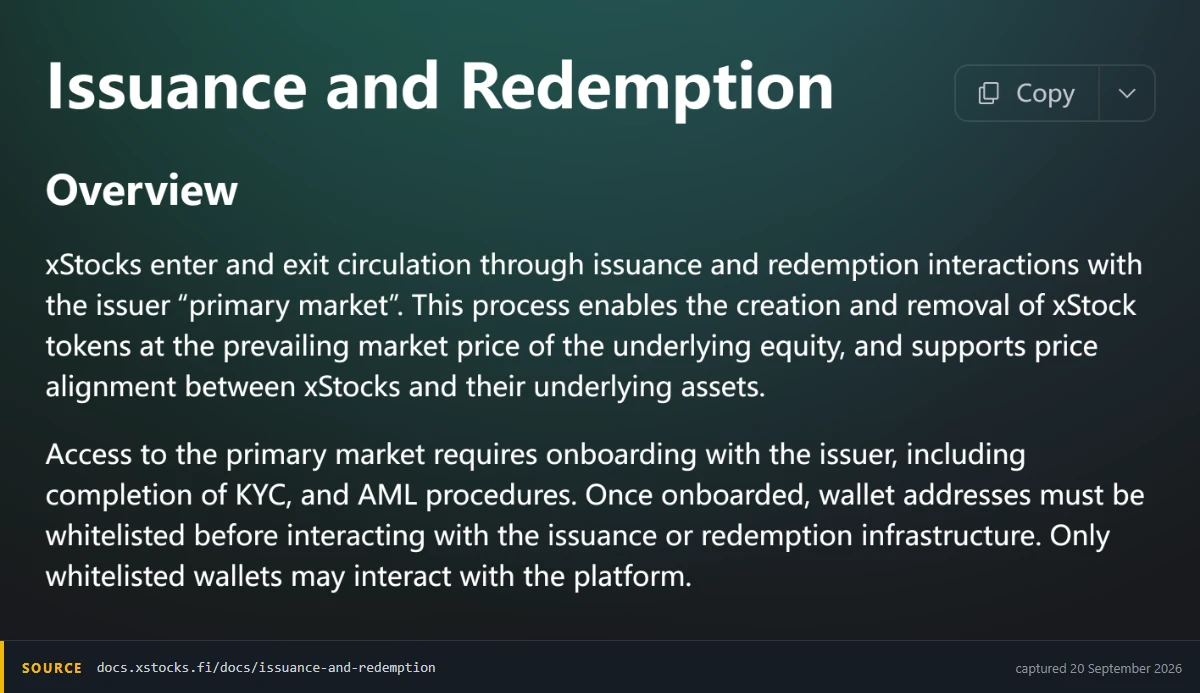
Buying an xStock on an exchange needs no permission. Redeeming one with the issuer needs onboarding, KYC, AML and a whitelisted wallet, which is the line separating the three products compared above.
How to decide
Work through these in order.
1. Which ones can you legally access? This eliminates most of the decision for most readers. Availability differs by jurisdiction and changes.
2. Do you need voting? If yes, the answer is Ondo and the comparison is over. If no — and for most retail position sizes the honest answer is no — continue.
3. Are you holding or trading?
For holding across months or years, the wrapper dominates. Issuer credit risk compounds with time, and you want to be an owner rather than a creditor. Ondo, if you can onboard.
For trading across days or weeks, liquidity dominates and the wrapper barely matters. Go where the depth is for your specific ticker at the hours you trade. Check the actual order book rather than the headline TVL — a platform can hold $900 million in total and still be thin in the specific name you want. For xStocks the per-token pooled liquidity is public: https://lite-api.jup.ag/tokens/v2/search?query=AAPLx returns a dollar liquidity figure per token. Read on 19 September 2026, the spread across names was wide — $6.2m behind SPYx and $2.1m behind NVDAx, against $337k behind METAx and $240k behind AMZNx. Same product line, same issuer, an order of magnitude apart in how easily you get out.
4. Where does your capital already sit? Moving between ecosystems has cost and friction. If your capital is on Binance, bStocks has a genuine convenience edge that is worth something real. Just price it honestly against the structural difference, rather than defaulting to it.
5. What is the dividend yield on what you are buying? On low-dividend growth names, withholding is a rounding error. On a 4% yielder, 30% withholding is 120 basis points a year, permanently. That can exceed every other cost in the decision combined.
Strength and access, ranked against each other
If you rank these three purely by the strength of what you hold, the order is unambiguous: Ondo, then bStocks, then xStocks. Owner, then rights holder against a regulated SPV with conventional brokerage plumbing, then unsecured creditor of an offshore vehicle.
If you rank them by how many people can use them, the order reverses almost exactly.
That inversion is the defining constraint of this entire asset class, and it shows up again in tokenised treasuries, where the strongest products are the ones you are least likely to be allowed to own.
The right response is not to pick the strongest structure you cannot access, or the most convenient one without reading what it is. It is to know which trade you are making, and to size the position for the wrapper you hold.
None of this is a recommendation. Market share figures reflect August 2026 reporting and move quickly. Issuer structures, product availability and terms change, verify against current offering documents before committing funds.