
Tokenised Stocks
Luno vs Binance for Tokenised US Stocks in South Africa
Luno reached 50 000 tokenised stock customers in under a year, using xStocks. Binance offers bStocks. The two routes differ in rand funding, product range and — the part nobody mentions — what you legally hold.

Luno reached 50 000 tokenised stock customers within roughly ten months of launching the product in August 2025, offering 61 tokenised US stocks and ETFs. The most-bought names by volume are TSLAx, GLDx (a gold ETF), NVDAx, MSTRx and SPYx.
That is real adoption, and it makes Luno the default route for most South Africans. Binance is the main alternative.
They differ on three things that matter, and one that almost nobody checks.
The comparison
| Luno | Binance | |
|---|---|---|
| Product | xStocks | bStocks |
| Issuer | Backed Assets (JE) Limited (Jersey) | BTech Holdings Limited (ADGM) |
| What you hold | Bearer debt instrument / tracker certificate | Rights token against an SPV |
| Range | 61 US stocks and ETFs | Growing US large-cap list |
| Rand funding | Direct ZAR deposit | Via stablecoin from a local provider |
| FSCA licensing | Licensed South African operation | Not on the approved register; application under consideration |
| Chain | Solana (xStocks) | BNB Chain (BEP-20) |
| Dividends | Reinvested via multiplier | Rebase |
| Local support | South African entity and support | Global support |
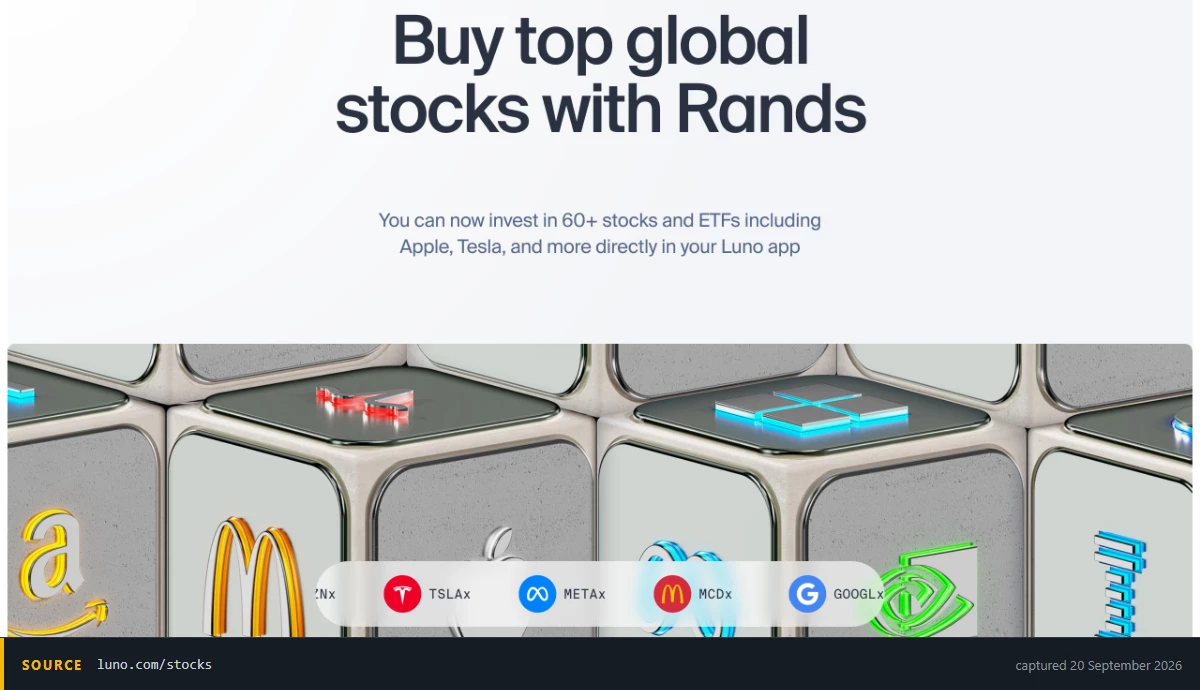
The tickers carry more information than the headline. That x suffix is xStocks, so the rand-funded local route and the offshore exchange route arrive at the same issuer and the same legal wrapper.
The thing nobody checks
Both products give you US equity price exposure. Neither gives you a share.
xStocks — what Luno sells — is legally a bearer debt instrument classified as a tracker certificate, issued by Backed Assets (JE) Limited, a Jersey special purpose vehicle. You are an unsecured creditor of that vehicle. No voting rights. Retail holders have no direct redemption line to the underlying share; redemption sits with the issuer's institutional channel.
bStocks are issued by BTech Holdings Limited, a Binance Group affiliate structured as an ADGM special purpose vehicle, with Nest Trading Limited as ADGM-regulated introducing broker and Alpaca Securities handling clearing, custody and corporate actions. You hold rights tied to the underlying securities, again without direct share ownership.
So the honest ranking on legal strength is: bStocks sits slightly ahead of xStocks — an SPV rights token backed by conventional brokerage plumbing versus unsecured paper from an offshore vehicle — and both sit well behind Ondo Stocks, which issues genuine security entitlements through an SEC-registered transfer agent and delivers voting through Broadridge. The full three-way structural comparison is here.
None of this is a reason to avoid either product. It is a reason to size the position knowing you hold issuer credit risk stacked on top of market risk, and to stop thinking of it as "owning Tesla".
Where Luno wins
- Rand in, directly. This is the decisive practical advantage and it is bigger than it sounds. SARB has blocked card purchases of crypto at offshore exchanges, so funding a foreign platform means buying a stablecoin locally and transferring it out. With Luno you deposit rand and buy. Fewer steps, fewer conversion spreads, no chain-selection risk.
- It is a licensed local operation, with a South African entity, local support, and local regulatory accountability. Binance is not on the FSCA's approved register; its application remains under consideration while it continues to serve South African users. That is a risk you carry, and the European Union is the cautionary example: Binance operated there unlicensed and withdrew entirely in July 2026.
- Range, for now. 61 tokenised stocks and ETFs, including gold and index exposure, is broader than what most South Africans can access elsewhere on crypto rails.
Where Binance wins
- If your capital is already there. Moving between ecosystems costs spread and friction, and for a South African, every cross-border movement also draws on your discretionary allowance. If your funds already sit on Binance, keeping them there has real value.
- Slightly stronger wrapper, as above.
- Depth on the largest names. Check the actual order book for the specific ticker at the hour you trade rather than relying on platform-level figures. Where the token trades on Solana you can read pooled liquidity per name from
https://lite-api.jup.ag/tokens/v2/search?query=TSLAxwithout an account, and the differences between names are large enough to affect which ones are sensible to hold in size.
What both get you, and what neither does
Both: price exposure, dividends net of 30% US withholding for non-US holders, 24/7 trading, fractional sizes, no US brokerage account.
Neither: voting rights, share ownership, a retail redemption path, or escape from the price gaps that open when US markets are closed, which for South Africans means most of our waking day, since US hours run roughly 15:30 to 22:00 SAST.
The allowance question applies either way
Buying tokenised stocks offshore draws on your single discretionary allowance (R2 million per calendar year since April 2026) or your foreign investment allowance (R10 million, TCS PIN required).
With Luno's rand funding the exchange control position is simpler, but it does not disappear — SARB's draft Crypto Asset Manual defines cross-border movement to include transfers from a local authorised provider to an offshore provider or to a non-custodial wallet. If you withdraw tokens out of Luno to your own wallet, take advice on how that is treated.
Keep records on both the calendar year and the tax year. SARS and your tokenised stocks covers what the February side needs.
Which route fits which situation
Luno if you are starting from rand, you want a licensed local operation with local support, and you value fewer moving parts. For most South African readers this is the sensible default.
Binance if your capital already sits there, you want the slightly stronger wrapper, or you need something in the bStocks range that Luno does not list, and you have priced the unlicensed status. Registration and verification is covered here.
Ondo Stocks if you intend to hold for years and want to be an actual owner rather than a creditor. It is the strongest structure available and the reason it is not the default here is access, not quality.
Whichever you pick: limit orders, record the issuer alongside the ticker, and check the book at an awkward hour before you size up.
Educational content, not financial advice. This site is not an authorised financial services provider. Platform availability, product ranges and licensing status change, verify current terms with each provider.
This site earns a referral commission on accounts opened through our registration page.