
Tokenised Stocks
Your Token Balance Changed and You Did Not Trade
You open your wallet and the number of tokens is different from the number you bought. In most cases this is a rebase doing its job, but four different things can produce it and they have different consequences. How to work out which one happened, and what to record before the evidence is gone.

You bought 12 tokens. Your wallet now says 12.031, or 36, or 11.94. You did not trade.
Most of the time this is the product working exactly as designed, and the correct response is to write down what happened before you forget. Occasionally it is not, and the difference is worth ten minutes. This page is a way of working out which of four things you are looking at.
Start with the direction and the size of the change, because that narrows it immediately.
Case 1: a small increase, and a dividend was due
A balance that rises by a fraction of a percent — 12 becoming 12.031 — is almost always a dividend rebase. Binance's bStocks handle dividends and splits by adjusting your token balance rather than paying you separately, so the distribution arrives as more tokens instead of as cash.
Confirming it takes one page. Find the underlying company's dividend calendar on its investor relations site and check the payment date against the date your balance moved. They should line up, give or take the issuer's processing time.
For your money, immediately, this changes roughly nothing: you hold more tokens, each worth slightly less. What it does change is your cost basis per token. Your total cost is unchanged but it is now spread across a larger number of units, and after two dividends, reconstructing what you paid per token becomes difficult if you did not write it down at the time.
There is one deduction you will never see as a line item. The dividend reached you already net of withholding — US dividends are typically paid net of 30% for non-US holders before any treaty relief — and that comes off before the rebase is calculated. What tokenised stocks actually pay you covers the full picture.
Case 2: a large, round multiple
When 12 becomes 36, or 120, or 6, you are looking at a stock split or a reverse split passed through to the token. Both bStocks and xStocks reflect corporate actions on-chain by adjusting balances.
The investor relations page that carries the dividend calendar will also have announced the split, with a ratio and an effective date. Compute the ratio from your own balances and compare:
| Event | Before | After | Ratio | Price per token |
|---|---|---|---|---|
| 3-for-1 split | 12 | 36 | ×3 | falls to a third |
| 1-for-2 reverse | 12 | 6 | ×0.5 | doubles |
If your computed ratio matches the announced one, you are done. Record the before and after quantities and the effective date, because a split moves your per-unit basis further than a dividend does.
This is the case that catches people out, and it catches them through the price chart rather than the balance. A 3-for-1 split takes the quoted price down by two-thirds on the day. Look at price alone, without looking at quantity, and you will conclude you have lost 67%. Check your balance before you conclude anything from a price move that large.
Case 3: it moved at 00:30 UTC and you hold an xStock
The tell here is the timestamp. The change landed shortly after midnight UTC, you were asleep, and nothing about the size of it looks like a split.
That is the multiplier activating. Backed publishes a new multiplier on-chain before each corporate event, and activation is set for 00:30 UTC on the day immediately following the ex-date. Venues are advised to pause interactions around that window, so you may also have seen the product briefly unavailable. Compare the timestamp against the ex-date on the company's investor relations page and the two will match. Backed documents the whole mechanism on its dividends and stock splits page, including worked examples of a dividend, a split and a reverse split.
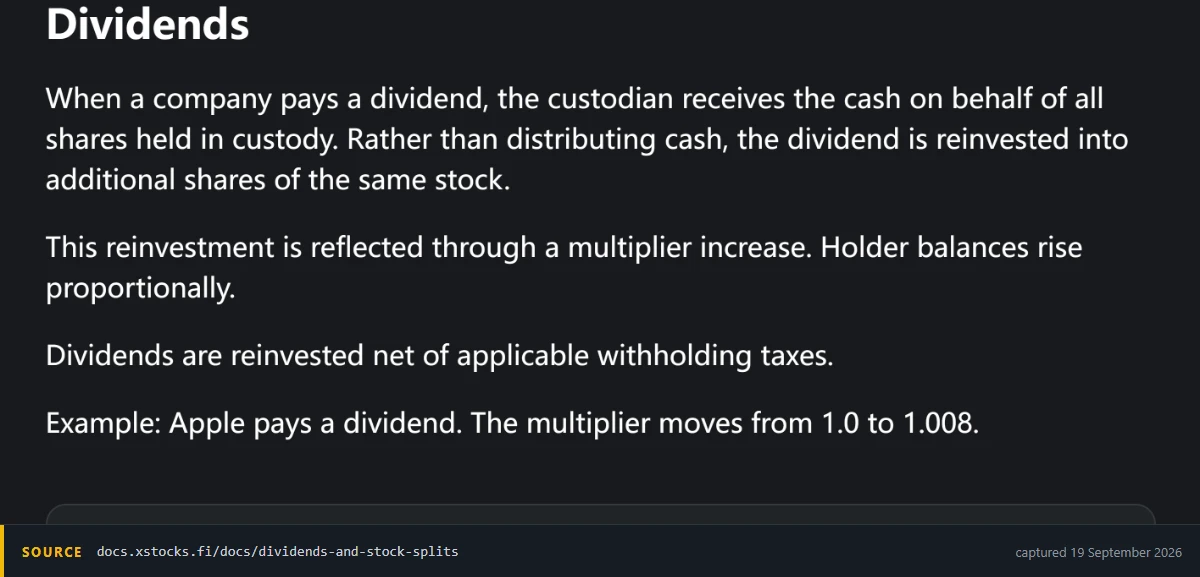
No cash reaches your wallet. The dividend buys more of the same stock and your balance rises because the multiplier does, so if you are waiting for a distribution to arrive, you are waiting for something that is not coming.
What surprises people about this one is that with xStocks the dividend never arrives as cash at all. The custodian receives it, reinvests it into additional shares of the same stock net of withholding, and the multiplier rises. There is no payout to spend, no election to take cash instead, and your exposure to that one company grows a little every time it pays. If your jurisdiction treats the accrual as income when it happens, you can owe tax in a year you received no money. Tax mechanics for RWA positions covers how accruals and rebases diverge; South African readers have the extra wrinkle of two different year-ends, in how SARS taxes tokenised stocks.
Case 4: none of the above fits
If the change is not a dividend-sized increase, not a clean split ratio, and there is no corresponding distribution, work through these in order.
- Check you are looking at the same token. On Solana several tokens share each xStocks symbol — sixteen of them used
TSLAxon 19 September 2026 — and a wallet that groups by symbol can show you a balance that belongs to something else entirely. Compare the mint address, not the ticker. Checking whether your xStock is the genuine one walks through it. - Check the decimals. A balance that looks wrong by a factor of a thousand or a million is usually a display issue rather than a movement. Tokens carry different decimal precision, and interfaces occasionally render one token's raw balance with another's decimals.
- Check the transaction history for the account. Every balance change on a public chain has a transaction behind it. If your balance fell and there is a transfer out that you did not authorise, you are no longer reading about corporate actions. Treat it as a compromised key, move anything remaining to a new wallet first, and investigate afterwards.
- Check whether the venue moved it. If you hold through an exchange rather than a self-custodied wallet, a balance change can be a fee, a conversion, or a product action taken by the platform. Issuers reserve the right to restrict, suspend or unwind positions where they determine a transaction may breach applicable law, product restrictions or eligibility criteria, and that reservation is in the terms you accepted. The place to look is the account statement, not the chain.
What to record, today
Whatever the cause, the record is the part that expires. Balances are current-state; the history of how they got there is easy to lose and tedious to reconstruct.
For this event:
- Date and time the balance changed, in UTC
- Quantity before and quantity after, to full precision
- The cause, as best you can establish it, and what you checked to establish it
- Anything received separately: amount, date, and the rate to your home currency on that date
- The mint or contract address of the token involved
Keep it in the same place as your purchase records. The reason this matters is narrow and specific: your cost basis per token is no longer the price you paid, and after two or three of these events nobody — not you, not a tax practitioner, not the platform — can rebuild it from balances alone.
Your holding is not a fixed quantity. That quietly breaks the assumption most people bring from ordinary share ownership, and it breaks any protocol that assumed a static balance. Hold a small position through one dividend and one weekend before you size up, and this stops being a surprise.
For information only. Corporate action handling differs by issuer and changes over time; verify against the issuer's current documentation and your own account records.