
Tokenised Stocks
Tokenised Stocks Pay Dividends. They Do Not Give You a Vote.
You get price exposure and usually dividends. Depending on the issuer you may not get voting rights, share ownership, redemption, or the same tax treatment. Here is the full inventory of what transfers to a tokenised stock and what stays behind.

A tokenised stock is the most intuitive RWA product, which is exactly why it is the easiest to misread. It has a ticker you recognise, a chart that matches the one on your broker's app, and a price that moves when the company reports earnings. Everything looks familiar.
The unfamiliar parts are the ones nobody puts on the buy button. This article is the complete inventory: what transfers to the token, what stays behind with the custodian, and which of the gaps costs you money.
If you have not read the four legal wrappers, start there; the answers below vary by issuer, and the wrapper is why.
What you reliably get
-
Price exposure. This is the core product and it works. All major structures hold the real share 1:1 with a regulated custodian, and the token tracks it. Tracking is not perfect — see price drift — but the mechanism is sound and the exposure is genuine.
-
Dividends, in some form, net of tax. Every major issuer passes dividends through. The delivery mechanism differs:
-
Rebase: your token balance increases to reflect the distribution. Binance's bStocks use a built-in rebase mechanism for dividends and splits, which also handles corporate actions without manual airdrops or broken balances.
-
Reinvestment: xStocks do not pay you cash. The custodian receives the dividend, and Backed reinvests it into additional shares of the same stock net of applicable withholding, raising an on-chain multiplier so every holder's balance rises proportionally. Backed documents the mechanism on its dividends and stock splits page.
This distinction is not cosmetic. With a reinvesting structure you have no dividend income to spend, no ability to take the cash, and a position that quietly grows your exposure to the same company every quarter whether that suits your allocation or not. In jurisdictions that treat the accrual as income at the moment it happens, you can also owe tax on money you never received.
Both work. The rebase approach has a wrinkle to know about: your token count changes over time, which complicates your own cost-basis tracking and can surprise any DeFi protocol that assumed a static balance.
- Trading hours that traditional markets do not offer. This is a real advantage rather than a marketing line. Tokenised equities trade around the clock, including weekends and traditional market holidays. If news breaks on a Saturday, you can act. The cost is that off-hours liquidity is much thinner, which is precisely when drift is worst.
- Fractional access without a brokerage account. Eligible users in supported non-US jurisdictions can hold exposure to US securities without opening a traditional retail brokerage account, staying entirely on crypto rails. For readers in markets where access to US equities is difficult or expensive, this is the actual value proposition, and it is a substantial one.
What you usually don't get
Voting rights
Under the two most widely distributed structures, you do not vote.
xStocks do not confer shareholder voting rights; you hold a tracker certificate, and the custodian is on the share register. bStocks represent rights tied to the underlying securities without conferring direct share ownership, with the same consequence.
The exception is real and has a name: Ondo Stocks tokenises shares as security entitlements through Oasis Pro TA, an SEC-registered transfer agent, giving token holders full ownership and voting rights, with Broadridge running proxy voting and shareholder communications. That is conventional shareholder infrastructure, not an approximation of it.
Whether this matters depends entirely on you. For a position sized at a few thousand dollars in a mega-cap, voting is a rounding error and pretending otherwise is theatre. It matters if you hold a meaningful stake, if you care about governance outcomes, or if you are in a contested situation where the vote has real value.
Share ownership itself
This is the one that is consistently underweighted.
Under wrapper 1 and wrapper 2 structures, you do not own a share. You hold a claim against an issuing vehicle: a Jersey SPV for xStocks, an ADGM SPV for bStocks. The share exists and is held by a regulated custodian, but it is held against the issuer's obligations, not registered to you.
In practice this is a credit exposure to the issuer stacked on top of your market exposure to the company. You have taken two risks and are being compensated for one. Under normal conditions the second is invisible. It stops being invisible exactly when you would least like it to.
Redemption
Most retail holders cannot redeem, under any structure.
- xStocks: redemption is available to qualified investors through the issuer's institutional channel. A retail holder does not have a direct line to the underlying share.
- Ondo Stocks: redemptions are processed only for holders who have completed onboarding and are eligible. If you have not onboarded, your options are to keep holding or sell on a secondary market where permitted.
The consequence is structural: your exit is the order book, not the issuer. That makes liquidity your primary practical risk. A token with thin depth and no retail redemption path can trade meaningfully below the value of the share backing it, and there is no arbitrage mechanism available to you to close the gap; only to the institutions who can redeem.
Favourable tax treatment
Dividends from US companies are paid net of US withholding tax, typically 30% for non-US holders before any treaty relief.
Read that again if you hold dividend-paying US stocks. On a 3% dividend yield, a 30% withholding costs you 90 basis points a year. That is not a trading fee you can shop around for; it is US tax law applied at the custodian level.
The harder problem is reclaiming it. In a conventional brokerage relationship, a non-US investor in a treaty country files a W-8BEN and often receives a reduced rate at source — 15% under many treaties. Whether an equivalent mechanism is available to you through a tokenised wrapper depends on the issuer's arrangements, and it is frequently either unavailable or operationally impractical for retail-sized positions. Verify with the specific issuer before assuming treaty relief applies. We go through this in the risk and tax checklist.
Standard corporate action handling
Dividends and splits are handled well by mature issuers. The tail events are where structures differ and documentation gets thin:
- Mergers and acquisitions, especially cash-and-stock deals
- Spin-offs, where you should receive shares in a newly created entity
- Delistings and bankruptcies of the underlying company
- Rights issues, which require a holder decision within a deadline
Before holding a tokenised position in a company with a pending corporate action, find the issuer's stated policy for that specific event type. For xStocks that policy lives in Backed's corporate-actions documentation, which covers dividends, splits and reverse splits explicitly, and, just as usefully, shows you what it does not cover. Ondo publishes its own documentation; for bStocks the product terms are inside your Binance account. If there isn't a policy in writing for the event type you care about, you are relying on discretion at exactly the moment discretion is expensive.
One timing detail to know, because it explains balance movements that otherwise look like errors: Backed publishes the new multiplier on-chain before a corporate event takes effect, and activation is set for 00:30 UTC on the day immediately following the ex-date. Venues are advised to pause interactions around that moment. If your balance moves at an odd hour with no trade behind it, that is the first thing to check against.
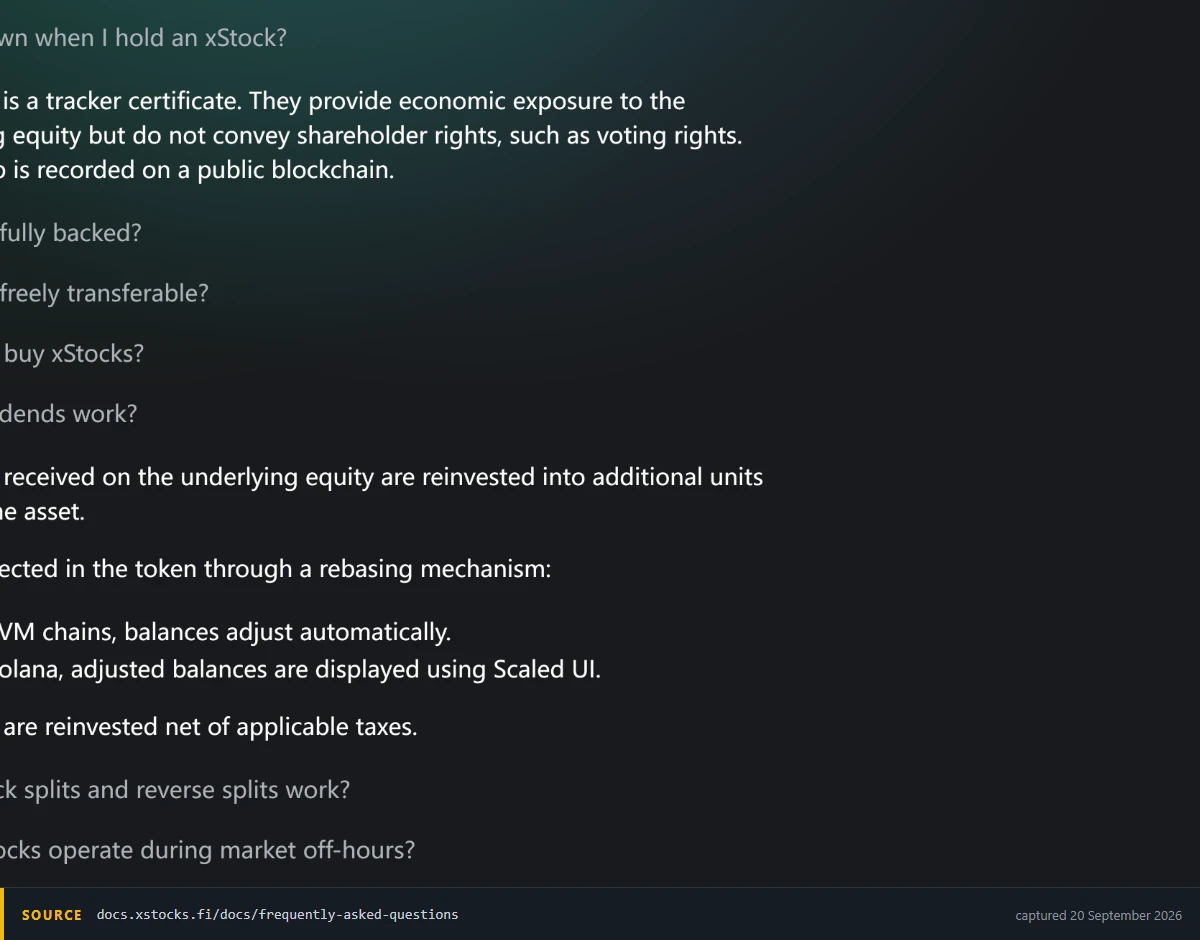
No vote, and no cash dividend either. The two answers sit four questions apart on the same page; on Solana the reinvestment surfaces as a Scaled UI balance rather than as a payment into your wallet.
The three questions to answer before buying
- Which wrapper is this? Creditor, SPV rights holder, or registered owner. This determines everything downstream.
- What is the dividend yield, and what is the withholding? Multiply them. If the product is a 4% yielder and 30% is withheld, you are giving up 1.2% a year versus holding the share directly through a broker with treaty relief. Decide whether the access is worth that.
- What is the actual order-book depth at my position size, at the hour I would likely need to sell? On a centralised venue that is the book on your screen; for xStocks on Solana,
https://lite-api.jup.ag/tokens/v2/search?query=TSLAxreturns a dollarliquidityfigure per token without an account. Check it at 3am on a Sunday, not at 3pm on a Wednesday. That's the number that matters, because the only reason you would be trading then is that something went wrong.
Answer those three before you buy and you will know what you are holding, rather than only what it tracks.
What this is good for
The gaps above are real, and none of them make tokenised stocks a bad product. They make it a specific product, appropriate for some purposes and not others.
Strong fit:
- You are in a jurisdiction where opening a US brokerage account is difficult, slow, or expensive, and this is your realistic route to US equity exposure.
- You want weekend and overnight access to react to news, and you accept wider spreads as the price.
- You hold non-dividend or low-dividend growth names, where the withholding drag is small.
- You want US equity exposure without moving capital out of the crypto ecosystem and back.
Weak fit:
- You already have easy access to a conventional broker. You are adding issuer credit risk and withholding drag to something you could hold directly. There is no upside to compensate.
- You are building a high-dividend income position. The withholding is a permanent, compounding drag.
- Governance matters to your thesis, and you are not using a structure that delivers votes.
- You need a guaranteed exit at fair value in size. You do not have redemption; you have an order book.
That last point deserves emphasis because it inverts a common assumption. People reach for tokenised equities expecting better liquidity than traditional markets, since trading is continuous. What you get is more hours of worse depth. For small positions this is irrelevant. For large ones it is the dominant consideration.
Written to explain, not to recommend. Issuer terms, dividend mechanics and tax treatment change; confirm against current offering documents before committing funds.