
Tokenised Stocks
Sixteen Tokens Called TSLAx. One of Them Is Real.
On Solana a token's symbol is metadata that anyone can set, and sixteen different tokens currently call themselves TSLAx. Here are the verified mint addresses for the main xStocks, how to check what you are actually holding, and what your options are if you already bought the wrong one.
If you searched for a tokenised stock in a wallet or on a decentralised exchange and more than one result came back, that is not a display bug. It is the normal state of the Solana token list.
A token's symbol and name are metadata. Whoever creates the token writes them, and nothing stops two tokens from writing the same thing. On 19 September 2026, a search for TSLAx returned twenty tokens, sixteen of which used that symbol exactly. One of them is issued by Backed. The rest are not.
This article is about telling them apart in under a minute, and about what your realistic options are if you have already bought one of the others.
What the impostors actually look like
Reading the same search, the four runners-up to the genuine Tesla xStock were:
| Mint address | Name as displayed | Pooled liquidity |
|---|---|---|
XsDoVfqeBukxuZHWhdvWHBhgEHjGNst4MLodqsJHzoB |
Tesla xStock | $1,245,668 |
HMMxrskwSnXrMwX4xG6MTAnQ9BG3LPcJCeE2tsjtpump |
Tesla xStock | $2,953 |
E4XqSKpaFRSyNojqxQupZUWH1K1YDHKvLjy5YCvDpump |
xStocks Tesla | $2,487 |
4jvXxT9HxBB2WhQZB23kxYZcTfd8J9QQNqZgyGefVvX4 |
Tesla xStock | $45 |
68vXTJmzKHgKjJpkrPWPtsXYm36uJi3tRLbSrQRtpump |
TSLAx | $0 |
The first row is the real one. Note what is doing the work in that table and what is not.
The name is not doing the work. Three of these display as "Tesla xStock", and one of them is not even the same string: the second row carries an invisible Unicode word joiner (U+2060) after the final "k", so it renders identically to the genuine name while being a different sequence of characters. You cannot see that in a wallet. You cannot catch it by reading carefully.
The liquidity is doing some work. A gap between $1.2 million and $2,953 is not subtle, and if your interface shows you pooled liquidity you have most of your answer already. But a token with $2,953 behind it is not obviously empty at a glance, and the $45 and $0 rows will happily let you buy in.
The mint address is doing all of the reliable work. It is the only field nobody else can copy.
The verified mints
These are the Backed-issued xStocks as read on 19 September 2026, with the dollar liquidity pooled behind each at that moment:
| Ticker | Mint address | Liquidity |
|---|---|---|
| SPYx | XsoCS1TfEyfFhfvj8EtZ528L3CaKBDBRqRapnBbDF2W |
$6,210,544 |
| CRCLx | XsueG8BtpquVJX9LVLLEGuViXUungE6WmK5YZ3p3bd1 |
$3,005,363 |
| NVDAx | Xsc9qvGR1efVDFGLrVsmkzv3qi45LTBjeUKSPmx9qEh |
$2,081,573 |
| QQQx | Xs8S1uUs1zvS2p7iwtsG3b6fkhpvmwz4GYU3gWAmWHZ |
$1,886,672 |
| COINx | Xs7ZdzSHLU9ftNJsii5fCeJhoRWSC32SQGzGQtePxNu |
$1,365,947 |
| TSLAx | XsDoVfqeBukxuZHWhdvWHBhgEHjGNst4MLodqsJHzoB |
$1,245,668 |
| HOODx | XsvNBAYkrDRNhA7wPHQfX3ZUXZyZLdnCQDfHZ56bzpg |
$1,181,397 |
| MSTRx | XsP7xzNPvEHS1m6qfanPUGjNmdnmsLKEoNAnHjdxxyZ |
$1,094,710 |
| AAPLx | XsbEhLAtcf6HdfpFZ5xEMdqW8nfAvcsP5bdudRLJzJp |
$588,479 |
| GOOGLx | XsCPL9dNWBMvFtTmwcCA5v3xWPSMEBCszbQdiLLq6aN |
$391,830 |
| METAx | Xsa62P5mvPszXL1krVUnU5ar38bBSVcWAB6fmPCo5Zu |
$337,332 |
| AMZNx | Xs3eBt7uRfJX8QUs4suhyU8p2M6DoUDrJyWBa8LLZsg |
$240,110 |
Two things to take from the right-hand column, separate from the impostor question. The liquidity range across one product line is roughly 26 to 1. SPYx and AMZNx are the same issuer, the same wrapper and the same legal claim, but they are not remotely the same position to exit in a hurry. And $240,110 of pooled liquidity is a real constraint on position size; think about what a $20,000 sell does to that pool before you buy $20,000 of it.
Confirm these against the issuer rather than against this page. Backed publishes its own token addresses, and that is the authority. A list on a third-party site — this one included — is a convenience, and convenience is exactly what an attacker would want to compromise.
Checking one yourself, in about thirty seconds
The search endpoint behind most Solana wallets is public and needs no account or key:
https://lite-api.jup.ag/tokens/v2/search?query=TSLAx
Paste it into a browser. For each result, read three fields:
id; this is the mint address. Compare it character by character against the issuer's published address. Not the first four characters. The whole string.isVerified, the genuine Tesla xStock returnstrue. None of the impostors return it.liquidityandholderCount: the real TSLAx showed 38,693 holders. A token with the same symbol and forty of them is telling you what it is.
The genuine ones also carry a tags array containing xstocks, rwa and token-2022, the last of which refers to the Solana token program Backed issues under. Tags are a useful confirmation and a poor primary test: they are assigned by the list maintainer, not by the chain.
The strongest single check is the authority addresses. Every genuine xStock in the table above is issued under the Solana Token-2022 program with the same mint authority, 7pt9tkctJPK7PPNQJ77GKg8ZffSF6QxoMiCFYHxrtaCj, and the same freeze authority, JDq14BWvqCRFNu1krb12bcRpbGtJZ1FLEakMw6FdxJNs. One issuer, one pair of authority addresses, across the whole product line. A token claiming to be an xStock with different authorities is not one.
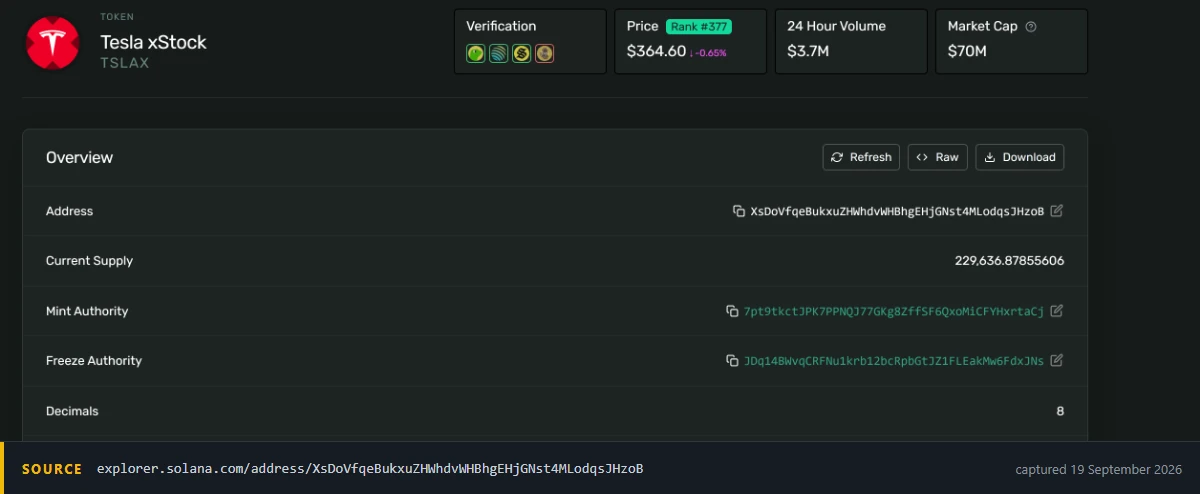
Both authority addresses are readable by anyone, on any block explorer, without an account. Note what the freeze authority means: the issuer can freeze your token account on-chain, and holding your own keys does not override that.
Two more fields settle most remaining cases. firstPool.createdAt for the genuine tokens reads 27 June 2025, the date the product line launched. The best-funded TSLAx impostor showed a first pool created 2 September 2026 with two holders and an organicScoreLabel of low, against 38,691 holders on the real one. A token pretending to be a year-old product with a two-week-old pool is answering the question for you.
A pattern to know, and not to trust on its own. Every genuine xStock mint in the table above begins with Xs. Backed evidently generates vanity addresses so its tokens are recognisable at a glance. This is a good first-pass filter and a bad final check, because anyone else can grind an address starting with Xs too. Use it to spot something obviously wrong, never to conclude something is right.
What the freeze authority means, once you have found the real one
Worth sitting with, because it is the same fact read in the other direction. That freeze authority address is not a formality; on Solana it is the on-chain power to freeze a token account, meaning the holder of that key can stop your tokens from moving.
For a regulated issuer holding real shares against sanctions and eligibility obligations, having that power is expected and arguably necessary. But it converts a line in the terms — the issuer may restrict, suspend or unwind access — from a contractual promise into a capability that exists on-chain right now and does not require your cooperation. Self-custody does not remove it. Holding the private key to your wallet does not remove it.
That is not an argument against the product. It is an argument for knowing which risk you have actually taken: with these tokens, "not your keys, not your coins" is the wrong frame, because the keys were never the binding constraint. Access risk in the RWA checklist puts it alongside the other five.
If you already bought one
Start by establishing what you hold, because the answer changes everything that follows.
- Find the mint address of the token in your wallet. Most wallets show it under the token's detail view, often labelled "mint", "token address" or "contract". Failing that, open the transaction in a block explorer and read the mint from the transfer instruction. Then compare it against the issuer's published address.
- If it matches, you are fine and can stop here. The duplicate symbols in the search results are not your problem.
If it does not match, be realistic about what you are holding. You own a token somebody created that references Tesla in its name. It has no relationship with Backed, no share behind it, and no claim on anything. Its price is whatever its own pool says, which for the rows above means somewhere between $45 and nothing.
What helps:
- Check whether it can be sold at all. Request a quote for a small amount first. Some tokens are built so that buying works and selling does not, and you would rather discover that on a test amount.
- Take the exit you can get, if there is one, and treat it as a loss rather than a position to hold. There is no mechanism by which a token like this converges to the share price, because nothing connects it to the share.
- Record the transaction: date, amount paid, mint address, what you received. In most jurisdictions a realised loss on a disposal is a fact your tax return has a place for, and the record is the only evidence you will have. Tax mechanics for RWA positions covers what to keep.
- Check what else that same wallet approved. If you reached the token through a link rather than a search, the swap may not have been the only thing you signed.
What does not: paying anyone who offers to recover it. There is no recovery process for a voluntary swap into a token you chose, and services advertising one are a second transaction at your expense, not a remedy.
The habit that prevents this
Record the mint or contract address alongside the ticker every time you buy; the execution walkthrough makes this step six for exactly this reason. It takes ten seconds and it makes the question answerable forever afterwards, including at tax time when "TSLAx" on its own will not tell you or anyone else what you held.
A ticker is a label. What you own is defined by the issuer and the document behind it, and on a public chain the only part of that label nobody else can duplicate is the address. What you actually own when you buy an RWA token starts from the same place and works through the legal side of it.
Written to help you check something, not to recommend anything. Token addresses, liquidity and listings change; verify current addresses against the issuer's own published documentation before transacting.