
Tokenised Stocks
How to Buy Tokenised Stocks: The 4 Checks to Run First
A complete walkthrough from eligibility check to exit plan — including the four checks to run before funding anything, why your first order should be a limit order, and the record-keeping that saves you at tax time.

This is the execution guide. It assumes you have decided tokenised equity exposure makes sense for you; if you have not, what you own and what you don't is the article that answers that question first.
Work through these in order. Steps 1 and 2 will take longer than you expect and are the ones that matter.
Step 1: Establish whether you are eligible
Before anything else, before opening an account anywhere, resolve this. Eligibility for tokenised equities is narrower and more conditional than for ordinary crypto, and the constraint is not the same one you are used to.
Three separate questions, often confused:
- Is the product publicly offered where I live? Usually no. bStocks, for instance, are offered under an Approved Prospectus in the Abu Dhabi Global Market and are not publicly offered in any other jurisdiction.
- Can I access it on a secondary-market basis? Often yes; this is how most people outside a product's home jurisdiction hold these tokens. It means you buy from other holders rather than from the issuer.
- Will my access persist? Issuers reserve the right to restrict, suspend, reject, cancel or unwind access where they determine a transaction may breach applicable law, product restrictions, eligibility criteria or sanctions requirements.
How to check, rather than guessing:
- Open the product's own terms page and find the restricted-jurisdictions list. It exists on every legitimate product, and it is published: Backed's site for xStocks, Ondo's for Ondo Stocks, and the product terms inside your account for bStocks. Read the list itself rather than a summary of it.
- Check whether the venue you plan to use offers the product to accounts in your country of residence; venue availability and issuer eligibility are separate gates and you need to pass both.
- If you intend to hold long-term through a structure with real redemption rights, check the onboarding requirements now. Ondo processes redemptions only for holders who have completed onboarding and are eligible; discovering that after you buy is the wrong order.
US residents: most of these products are explicitly not for you, and attempting to access them through a VPN is a straightforward way to have funds frozen with no recourse. The domestic regulated routes are different products; do not treat this guide as applying to you.
Step 2: Pick your structure, then your venue
Most people do this backwards; they pick the venue they already use and accept whatever structure it offers. That is a defensible choice if you make it deliberately.
The decision tree from the three-structure comparison, compressed:
- Holding for months or years, and can complete onboarding? Ondo Stocks gives you actual ownership and voting through an SEC-registered transfer agent. Strongest claim available.
- Already have capital on Binance and want operational simplicity? bStocks sits next to your crypto balance with conventional brokerage plumbing behind it — Nest Trading as broker, Alpaca Securities for clearing, custody and corporate actions.
- In a jurisdiction the other two do not reach? xStocks has the widest distribution, and you accept holding a tracker certificate rather than a share.
Then check one venue-level thing before committing: the actual order book for the specific ticker you want. Platform-level TVL tells you nothing about depth in your name at your hour.
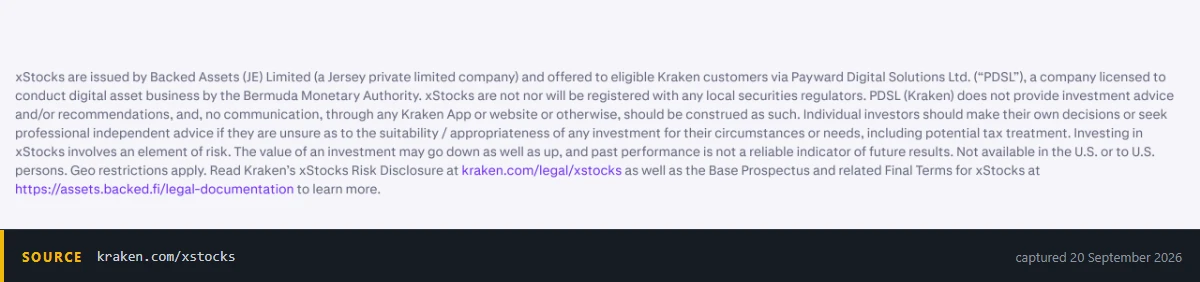
The venue is not the issuer. Kraken sells a Backed Assets instrument through a Bermuda-licensed entity, and that sentence about local securities regulators is what determines your recourse if something goes wrong.
Step 3: Open and verify the account
Whichever venue you choose, you will complete identity verification. This is not optional and not a formality: for tokenised securities the KYC requirement flows from securities regulation, not from exchange policy.
Have ready:
- Government photo ID matching your country of residence
- Proof of address, typically dated within three months
- Possibly a source-of-funds declaration, depending on venue and amount
If your route is Binance, the account registration and verification walkthrough covers the full process including the verification steps that trip people up.
One thing to get right at this stage: register with your genuine country of residence. Residence mismatches surface later during withdrawal or when a product's eligibility is rechecked, and the resolution is invariably worse than the inconvenience of doing it correctly now.
Step 4: Fund the account
Tokenised equities are priced and settled in stablecoins, typically USDT or USDC depending on the venue and the product.
Two routes:
- Fiat on-ramp. Bank transfer or card into the venue, converted to stablecoin. Simpler, usually cheaper for larger amounts via bank transfer, slower on first use.
- Transfer existing crypto. Faster if you already hold assets. Verify the network before sending; sending on the wrong chain is the most common way to lose funds in this entire process, and it is unrecoverable.
Two things to check before you fund:
- Which stablecoin does the product actually trade against? If a bStock pairs against USDT and you funded with USDC, you will convert and pay a spread. Check first.
- Fund slightly more than your intended position. Being short a few dollars on fees and having to make a second deposit mid-execution is a small, avoidable annoyance.
Step 5: Place the order, as a limit order
Your first order should be a limit order. Not a market order. This matters more than any other execution decision you will make here.
Tokenised equity books are thinner than the crypto books you are used to, and thinnest exactly when volatility makes you want to trade. A market order into a thin book routinely costs multiples of the spread you were expecting.
The sequence:
- Check the underlying's last real price and its timestamp. If US markets are closed, know how stale it is.
- Look at the token's bid-ask spread and depth on both sides. If your order is a visible fraction of the book, split it. On Solana, where xStocks trade against pools rather than a book,
https://lite-api.jup.ag/tokens/v2/search?query=NVDAxreturns aliquidityfigure in dollars for each token. Read it before sizing, and know that a few hundred thousand dollars of pooled liquidity behaves very differently from a few million when you try to exit in a hurry. - Compute the current drift, token mid-price versus the underlying's last print. Is it in the normal band for this name, or unusual? Price drift explains how to read an unusual reading.
- Set your limit at or inside the current spread. If it does not fill, reconsider rather than chasing.
- Prefer hours when the underlying market is open. Tighter spreads, live arbitrage, a real reference price.
If you are new to this, start deliberately small. Not because the products are dangerous, but because you want to observe one full cycle — a dividend or rebase, a weekend, a spread at an awkward hour — before sizing up. That observation is worth more than any article, including this one.
Step 6: Record what you bought
Do this the same day. Recovering it later is painful and sometimes impossible.
Record:
- Date and time (UTC) of the fill
- Token quantity and price paid, in both stablecoin and your home currency at that day's rate
- The issuer and product, not just the ticker — "TSLA" is ambiguous across three structures with different tax characteristics, and on Solana the symbol
TSLAxalone is ambiguous across sixteen different tokens. Record the contract or mint address - Fees paid, all of them
- Your opening token balance
That last one matters specifically because of rebasing. bStocks handle dividends and splits through a built-in rebase; xStocks reflect corporate actions through on-chain rebasing as well. Your token count will change without you trading. If you do not have the starting balance recorded, reconstructing your cost basis after two dividends and a split is difficult.
Keep a simple running log of every balance change and its cause. Ten minutes of discipline now, and tax time is arithmetic instead of archaeology. Tax basics for RWA positions covers what your jurisdiction likely wants to see.
Step 7: Know your exit before you need it
You almost certainly cannot redeem. For most holders across most structures, the exit is selling on the secondary market.
So decide now:
- What order-book depth do you need to exit your position without moving the price materially? Check it at an unfavourable hour — a Sunday night — because that is when you would be forced to act.
- What would make you exit? Write it down. Include issuer-level triggers, not just price: a line-wide discount across all of an issuer's tokens, a change in attestation cadence, a regulatory action against the issuer.
- Do you have a fallback venue? If the same exposure trades on more than one chain or venue, know the alternative in advance.
The five mistakes that cost real money
- Market orders in thin books. Repeated because it is the most common and most avoidable.
- Assuming the dividend arrives whole. US dividends are paid net of withholding, typically 30% for non-US holders before treaty relief. On a 4% yielder that is 120 basis points a year, permanently. Model it before buying income names.
- Not recording the opening balance before a rebase. Cost-basis reconstruction after multiple corporate actions is miserable.
- Treating weekend prices as prices. They are forecasts made in thin conditions.
- Buying a line-wide discount. When every token from one issuer is cheap simultaneously, the market is pricing the issuer, not the stocks. That is the moment to reduce exposure, not to add.
A realistic first transaction
Check eligibility properly (an hour of reading). Open and verify an account (a day, sometimes more). Fund a small amount. Buy a large, liquid name with a limit order during US market hours. Record everything. Hold through a dividend and a weekend. Watch what the spread does at 3am on a Sunday.
Then decide whether this product is right for your situation, with evidence instead of marketing copy.
Educational content, not investment advice. Eligibility, venue availability and product terms change; verify current terms with the issuer and venue before committing funds.