
Access, Risk & Tax
You Cannot Redeem a Token for 0.003% of a Building
Fractional property tokens solve a real problem badly. The structural flaw is the missing redemption anchor — you cannot redeem a token for half a building, so nothing connects the price to the asset. An honest assessment, and when a listed REIT is simply better.
Tokenised real estate is the most intuitively appealing RWA category and the one that has delivered least.
The pitch is excellent: property is the world's largest asset class, it is illiquid and inaccessible, minimum investments run to six figures, and tokenisation fixes all three. Own $500 of an apartment building. Collect rent on-chain. Sell whenever you like.
Almost every part of that works except the last clause, and the last clause turns out to be the whole thing.
This article explains why the problem is structural rather than a matter of immature execution, and where that leaves you if you want property exposure.
The missing redemption anchor
Start with what makes the better RWA categories work.
As established in what redemption actually costs, a gold token tracks gold because somebody can always redeem tokens for metal. If the token trades below the gold's value, an arbitrageur buys tokens, redeems, sells the metal, and pockets the difference. That possibility keeps the price honest whether or not anyone exercises it.
The same mechanism, weaker but present, operates in tokenised treasuries and tokenised equities.
Property has no equivalent, and cannot.
You cannot redeem a token for a proportional slice of a building. There is no such thing as 0.003% of an apartment block delivered to you. The asset is indivisible in a way gold bars and share certificates are not.
So what connects the token price to the property value? Only the expectation that the property will eventually be sold and proceeds distributed: an event that may be years away, may be at the platform's discretion, and may never happen.
Without an arbitrage anchor, the token price is whatever the secondary market says, and the secondary market is thin. Persistent discounts to stated value are not anomalies to be arbitraged away. They are the normal condition, because there is no mechanism to close them.
This is not a problem better technology or more liquidity fixes. It follows from the asset being indivisible and illiquid.
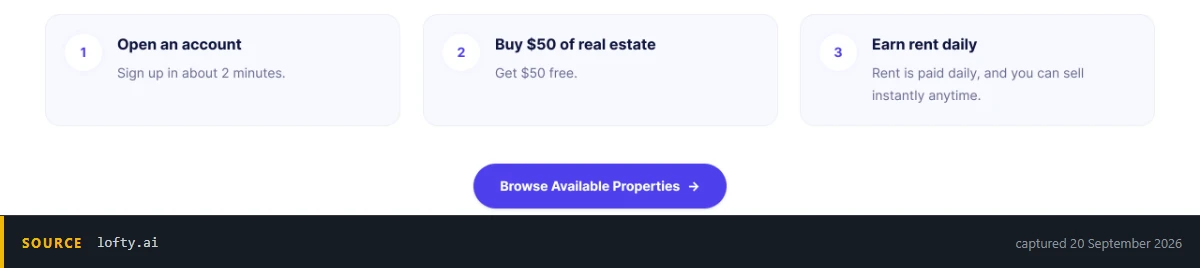
Card three is the claim to test. Selling instantly means finding a buyer on the platform's own market; it is not a redemption against the building, and nobody is obliged to be on the other side.
The four practical problems
1. Eligibility, again
The familiar pattern. Fractional property offerings in the US typically rely on private-placement exemptions, which generally restrict them to accredited investors: net worth over $1 million excluding primary residence, or income over $200,000 individually or $300,000 jointly, as detailed in the eligibility gates article.
Non-US platforms have varying rules, often with their own restrictions.
The result is that the democratisation story frequently fails at the first step. The people for whom $500 fractional property access would be most valuable are often precisely the people not permitted to buy it.
2. Secondary markets that barely exist
Even where you can buy, selling is the problem.
Order books on property token platforms are typically extremely thin. Often the only buyers are other users of the same platform, and platforms sometimes restrict transfers to verified users, shrinking the pool further.
Compare against the alternative: a listed REIT trades on a public exchange with market makers, continuous pricing and millions of participants. You can exit a position in seconds at a known price.
"Tokenisation makes illiquid assets liquid" is the category's core claim. In practice it more often converts a genuinely illiquid asset into a differently illiquid asset with an additional layer of platform dependency.
3. Valuations that are opinions
Property tokens are usually priced against a stated net asset value derived from appraisal, not from market transactions.
Appraisals are professional estimates. They are updated periodically — often annually — they lag actual market conditions, and they are commissioned by the party with an interest in the number.
This produces a specific trap. A token trading at a 30% discount to stated NAV looks like an obvious opportunity. But if the appraisal is twelve months stale and the local market has softened, the "discount" may simply be the market being more current than the appraisal. You are not buying a dollar for seventy cents; you may be buying seventy cents for seventy cents.
With no redemption mechanism to force convergence, you cannot resolve this. You are taking a view on an appraisal.
4. Platform insolvency
The property sits in a special purpose vehicle. The platform manages the SPV, collects rent, handles maintenance, maintains the token register and arranges eventual sale.
If the platform fails, the property presumably still exists and the SPV presumably still owns it. But:
- Who collects rent and distributes it?
- Who maintains the building?
- Who decides when to sell?
- How do token holders coordinate to appoint a replacement?
- Does the token register survive in a legally recognised form?
Well-structured platforms have answers in the documentation. Read them before investing, because this is the scenario that determines your outcome, and it is not hypothetical.
If you are already holding when a platform fails, the sequence is the same one that applies to any failed issuer: find out which entity entered insolvency and in which jurisdiction, find whether an office-holder has been appointed and whether a claim date has been set, and file within it. Those windows are short and they are advertised in official publications rather than sent to you — what a token holder does when the issuer fails sets out the sequence and the evidence you will be asked for. In a tokenised property structure there is one extra question to answer early, because it changes who you even are in the process: whether the failed entity is the platform or the SPV that owns the building. If the SPV survives its manager, the asset is still there and the problem is control rather than ownership.
RealT is the worked example. It tokenised over 700 US properties worth around $130 million, with tokens starting near $81. It exited the US market in 2023 under Regulation D pressure and has since gone into liquidation. Investors in a listed REIT do not face this category of event; independent trustees and exchange oversight exist precisely to prevent it.
The platforms still operating split along a clear line. Lofty AI remains blockchain-native and open to non-accredited US investors, with minimums around $50. Arrived Homes serves retail on a similar fractional model. On the other side, institutional platforms such as RedSwan and Securitize tokenise commercial portfolios and restrict access to accredited investors, with minimums from roughly $1,000 to $10,000 and up.
That split is the category in miniature: the offerings open to you are the smallest and least protected, and the ones with institutional-grade structure ask whether you are accredited before letting you in.
The comparison: listed REITs
For most people who want property exposure, this is what you are choosing against.
| Tokenised property | Listed REIT | |
|---|---|---|
| Minimum | Often $50–500 | Price of one share |
| Who can buy | Often accredited only | Anyone with a brokerage account |
| Liquidity | Thin, platform-dependent | Continuous exchange trading |
| Pricing | Appraisal-based NAV | Live market price |
| Redemption anchor | None | None, but exchange liquidity substitutes |
| Diversification | Often a single property | Dozens to hundreds of properties |
| Regulation | Varies, often private placement | Full public-market disclosure |
| Fees | Platform fees, often opaque | Published expense ratios |
| Governance | Platform discretion | Board, independent trustees, shareholder votes |
The REIT wins on nearly every dimension that affects outcomes. It loses on two: minimum investment — though fractional share trading has largely erased that — and the ability to choose a specific individual property.
That second one is the entire honest case for tokenised real estate. If you want exposure to one particular building in one particular city because you have a specific view about it, a REIT cannot give you that. Nothing else can either.
Whether that specificity is worth the illiquidity, valuation opacity and platform risk is a real question with a real answer, and for most people the answer is no.
When it does make sense
Three narrow cases:
You have genuine local knowledge. You know a specific market well enough to have an edge on a specific property. The token is a vehicle for a view you hold. This is legitimate, and note it requires a view, not just a desire for property exposure.
You are in a jurisdiction where property investment is otherwise blocked. Capital controls, foreign ownership restrictions, or the absence of a functioning local REIT market can make a tokenised route the only route. Here the comparison is not against a REIT but against nothing, and that changes the calculus entirely.
You are buying a cash flow stream and can hold indefinitely. If you genuinely do not need to sell, illiquidity costs you less. Focus your diligence on the rent distribution mechanism and the platform's operational durability rather than on exit liquidity.
Outside those cases, a listed REIT does the job better.
Screening questions, if you proceed
- What legal entity owns the property, and what does my token entitle me to within it? Equity in the SPV? A debt claim? A revenue-sharing contract? Apply the wrapper framework, the answers differ wildly across platforms.
- What is the actual secondary market? Look at real trade history for tokens on that platform, not the platform's description of its marketplace. If there are no trades, there is no market.
- How is NAV determined, by whom, and how often? Who commissions the appraisal, and when was the last one?
- What happens if the platform fails? Find the answer in the documents. "The SPV owns the property" is not an answer; the question is who operates it and how holders coordinate.
- What are all the fees? Acquisition, management, performance, disposition. Total them across a realistic holding period. They are frequently far higher than a REIT's expense ratio.
- How and when do I get out? If the answer is "when the property is sold," ask who decides that and on what timeline.
If a platform cannot answer these clearly in writing, that is the answer.
For most people wanting property exposure, a listed REIT is the better instrument on every axis that usually matters: more liquid, more diversified, better regulated, cheaper, available to anyone. Tokenisation can divide ownership; it cannot make a building divisible, and that is the constraint the whole category runs into.
Educational content, not investment advice. Platform structures, eligibility and fees vary considerably; review all offering documents and take local advice before investing in any property token.