
Access, Risk & Tax
Undeclared Crypto and SARS: The VDP Route
Most guidance on crypto tax in South Africa tells you what to declare from now on, which is no help if you have already filed returns that left it out. SARS runs a permanent Voluntary Disclosure Programme with six qualifying requirements and one hard timing condition — here is what it covers, what it does not, and what to gather first.

Guidance on crypto tax in South Africa almost always starts from the same place: here is what to record, starting now. That is useful if you are starting now. It is no use at all if you have been trading tokenised stocks or crypto for three years and the returns you already filed did not mention any of it.
There is a specific route for that situation, it is permanent rather than an amnesty window, and the thing that decides whether you can still use it is timing.
What the VDP is
SARS operates a Voluntary Disclosure Programme provided for in the Tax Administration Act No. 28 of 2011. It is permanently available — not a periodic amnesty — to a qualifying individual, company or trust that wants to disclose and regularise a tax default.
A default here is broad: submitting inaccurate or incomplete information, or failing to submit information SARS requested, in relation to any tax type SARS administers. Customs and excise duties under the Customs and Excise Act 91 of 1964 sit outside it.
What a successful application gets you is relief from penalties and the avoidance of possible criminal prosecution. What it does not get you is the tax. A successful VDP ends in an agreement that sets out the material facts of the default, the amount payable with the understatement penalty reflected separately, the relief SARS is granting, and the payment arrangements and dates. You are regularising a liability, not erasing it.
The condition that decides everything: it has to be voluntary
SARS is explicit that where it discovers non-compliance through its own investigative processes, it will not make this route available and will deal with the non-compliance under the law instead.
Read that as a deadline you cannot see. The programme is open until SARS opens an enquiry into you, and you will not be told in advance which day that is. Every month of deliberation is a month of exposure to the possibility that the choice is taken away, and unlike most tax decisions, this one does not improve by waiting for more clarity.
This is the whole reason the question "should I deal with this or hope it goes unnoticed" has a different shape than people assume. Hoping is not a neutral option that preserves your alternatives. It spends them.
The six requirements
SARS grants relief where the application meets all of the following:
- The disclosure must be voluntary.
- It must be full and complete in all material respects. Partial disclosure is the common way these fail, and the agreement can be withdrawn later if SARS determines the disclosure was not complete.
- The default must not have occurred within five years of the disclosure of a similar default. One bite, broadly.
- It must involve a behaviour referred to in the understatement penalty table in Section 223 of the Tax Administration Act.
- It must not result in a refund due by SARS.
- It must be made in the prescribed form and manner.
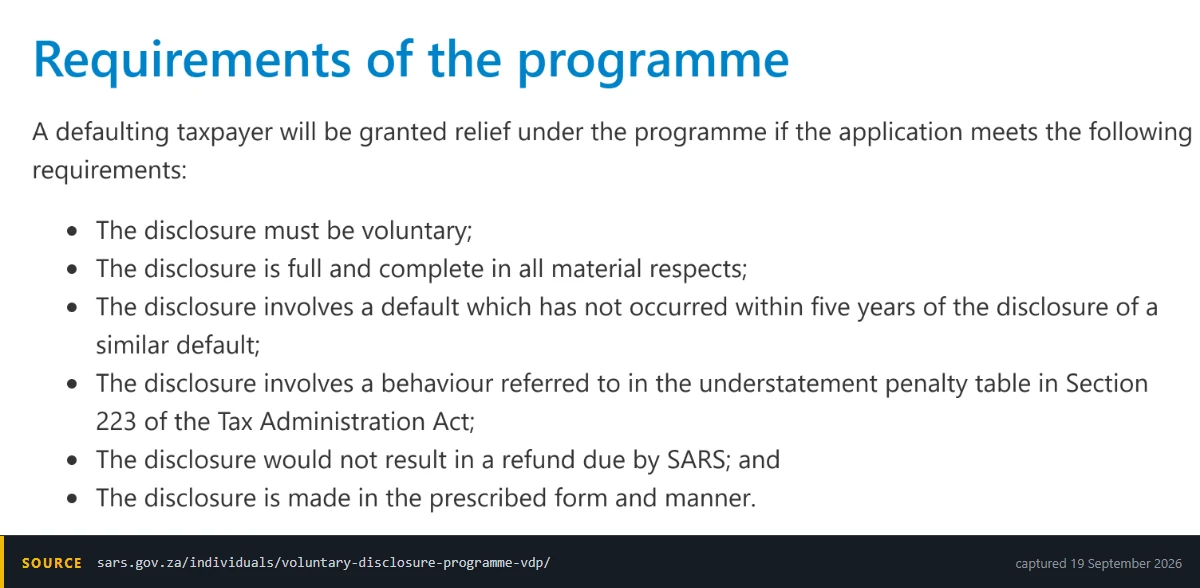
The six requirements as SARS states them, so the list above can be checked against the source. Note the date on the page: the wording is theirs to change.
Applications are made through SARS eFiling. The current requirements and process are published on the SARS voluntary disclosure page, and SARS's general position on crypto assets is at Crypto Assets and Tax. Check both against the version of this page you are reading, because the process is theirs to change.
What to do first
- Pull your data before anything else. Exchange export functions, block explorer histories for every address you have used, and bank statements for the fiat legs. Do this even if you are undecided, because the data gets harder to retrieve over time and having it is what makes the decision informed rather than hypothetical.
- Work out the rough size of the exposure. Whether this is a matter of a few thousand rand or a few hundred thousand changes what a sensible process looks like.
- Get a practitioner who has done both sides. This is one of the places where paying for advice is straightforwardly worth it: a VDP application is a formal disclosure with legal consequences, requirement 2 is unforgiving, and the person preparing it should have handled both crypto assets and conventional offshore securities. Bring the data, the issuer documentation for whatever you hold, and specific questions rather than a general request for help — the three questions worth paying for sets out the ones that matter for tokenised equities.
- Do not file a corrected return as a substitute for understanding which route you are on. Whether an ordinary correction or a VDP application is appropriate depends on the facts, and that determination is exactly what you are engaging a practitioner to make.
Note what the ordering here implies. The useful next action is not to decide today whether to apply; it is to pull the records this week, so that whenever you do decide, the option is still there.
Requirement 2 is the hard one, and it is a records problem
"Full and complete in all material respects" is where a crypto disclosure gets difficult, because the underlying records are usually scattered across venues, wallets and years, and some of them no longer exist.
What you are trying to reconstruct, per position and per year:
- Every disposal, with the date and the rand value at that date. In South Africa a swap of one crypto asset for another is generally a disposal in its own right, so the count of taxable events is usually far higher than the count of times you moved money in or out.
- Base cost for each, with the exchange rate you used and where it came from.
- Whether each position was capital or revenue in nature. This is not a label you choose; it follows from your conduct, and it is the first question in how SARS taxes tokenised stocks.
- Dividends received, including the portion withheld before it reached you; for tokenised US equities that is typically 30% before treaty relief, and it is already gone by the time you see anything.
- Balance changes that were not trades. Rebases move your token count without a disposal; why your balance changes without a trade explains why your per-unit base cost stops matching what you paid.
- Year-end balances, which the ITR12 asks for.
The two-year-end trap applies here too. Your tax year ran 1 March to 28 February; your exchange control allowances run on the calendar year. A reconstruction organised on one basis will not answer questions asked on the other, and you will be answering both. The single discretionary allowance and crypto covers the second one.
Where records are genuinely gone — an exchange that no longer operates, a wallet whose history you cannot export — the answer is not to guess quietly. Document the gap, document the method you used to estimate around it, and let it be visible in the disclosure. A reasoned estimate disclosed as an estimate is a very different thing from a number that turns out to be wrong.
Educational content, not tax or financial advice. This site is not a registered financial services provider and does not provide advice as defined in the FAIS Act. Tax outcomes depend on your own facts and the VDP process is SARS's to change, verify current requirements at sars.gov.za and take professional advice before making a disclosure.