
Access, Risk & Tax
Tokenised Property vs a JSE-Listed REIT
South Africa has a deep, liquid, well-regulated listed property market. That raises the bar for tokenised property considerably — and for most local investors the token has to answer a question the REIT already answers better.
In many countries, tokenised property is pitched against a genuine gap: no accessible listed property market, high minimums, foreign ownership restrictions.
South Africa is not one of those countries. We have a deep, liquid, well-regulated listed property sector on the JSE, accessible to anyone with a brokerage account, at the price of a single unit. That raises the bar for tokenised property considerably.
This article is about whether anything clears it.
The gap it is sold into does not exist here
The structural objection to tokenised property is the same everywhere: nobody can redeem a token for 0.003% of a building, so nothing anchors the token's price to the building's value. That argument is set out in why tokenised real estate mostly doesn't work, and this article takes it as read.
What changes locally is the alternative you are comparing against. Fractional share trading has erased the minimum-investment gap, and the listed sector is mature enough that "tokenisation democratises property" lands differently here than it does in a country with no REIT market. So the South African question is narrower: not whether tokenised property is a good idea, but what a token does that a JSE REIT does not.
| Tokenised property, offshore platform | JSE-listed REIT | |
|---|---|---|
| Allowance used | SDA or FIA | None |
| Tax | Unsettled, and foreign income besides | Established REIT distribution regime |
| Who may buy | Often accredited or qualified investors only | Anyone with a brokerage account |
| Price comes from | An appraiser's number, updated annually | What buyers and sellers paid this morning |
| Exit | The platform's own marketplace | The JSE, plus A2X for some units |
What a JSE listing actually puts behind the instrument
To use the REIT tax treatment in South Africa, a property company has to be listed on the JSE or on AltX. It is not a label a company gives itself.
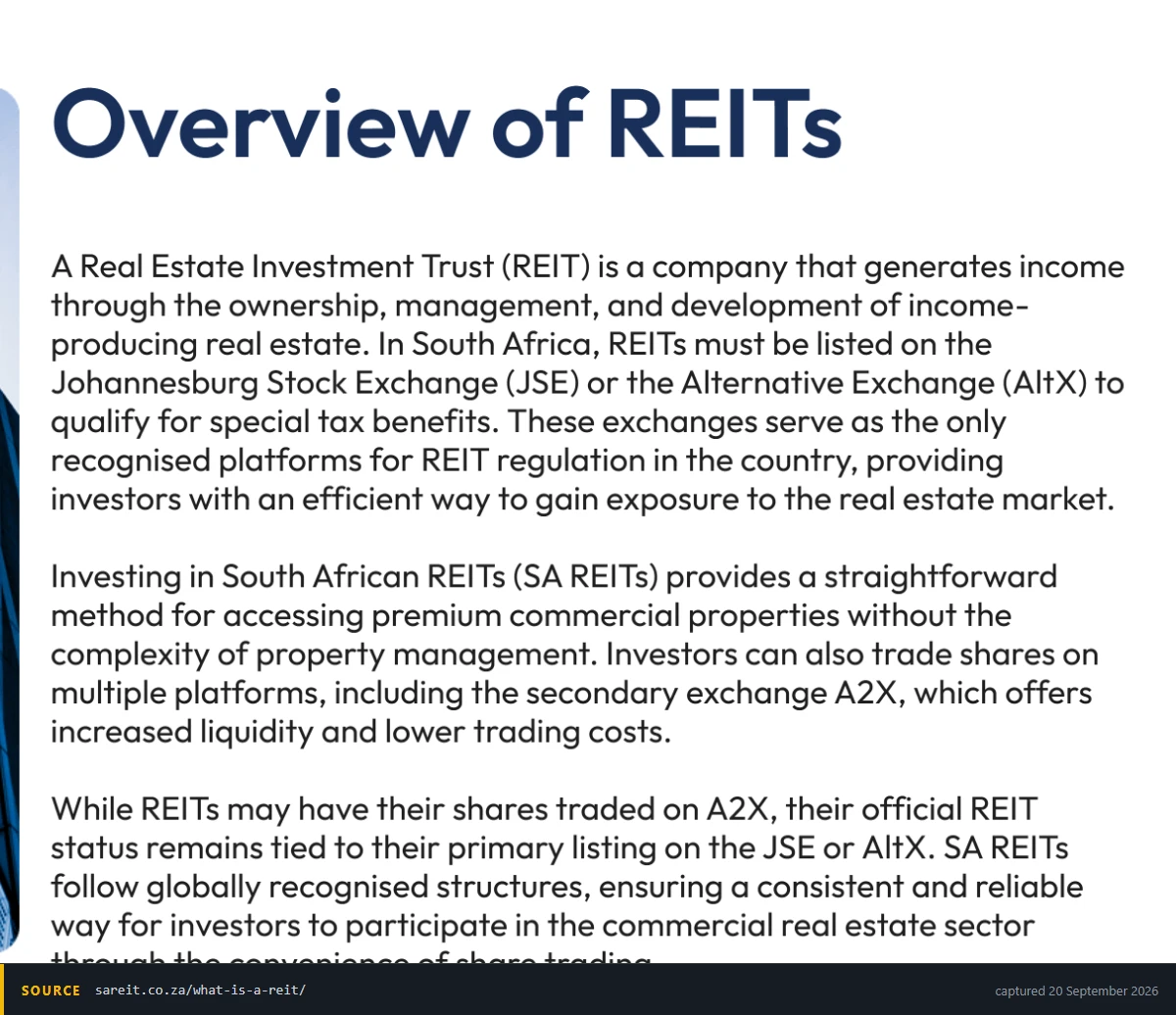
Listing on the JSE or AltX is a condition of REIT status, not a description of where the share trades. That one requirement is what puts a regulator, an exchange and a reporting calendar behind the instrument.
That requirement drags in a set of things a token platform supplies voluntarily or not at all: audited financials on a published calendar, a board and independent trustees, pricing set continuously by buyers and sellers rather than periodically by an appraiser, and cost ratios you can look up. Units may also trade on A2X, but the REIT status stays attached to the primary listing.
A property token platform, by contrast, is usually the issuer, the manager, the valuer's client, the register and the marketplace at the same time. None of those roles has an independent check on it.
Exchange control settles most of this before the structural arguments start
A JSE-listed REIT is a domestic transaction. It uses none of your discretionary allowance.
An offshore tokenised property platform is a cross-border investment. It draws on the R2 million SDA, or on the R10 million FIA with the SARS approval that requires. If your allowance is already committed elsewhere this settles the question before you reach any argument about NAV or liquidity.
The same fact is also the honest case for looking offshore at all: a JSE REIT gives you mostly South African buildings and entirely rand exposure. Diversifying out of both is a real objective. It just costs allowance whichever instrument you use to do it.
Tax is settled on one side and not on the other
REIT distributions have an established treatment that your accountant already applies routinely.
Tokenised property income and gains do not. As SARS's approach to crypto assets shows, characterisation tends to follow the instrument's legal form and your own behaviour rather than what the product feels like economically. Distributions from an offshore SPV are foreign income as well, with the credits and disclosures that brings.
One settled column against one unsettled column is not a small difference over a holding period measured in years.
The two cases where a token still does something a REIT cannot
One specific building. A REIT is a portfolio by construction. If you know a suburb or a node well enough to hold a view on one property, no listed instrument gives you concentrated exposure to it. That case requires an actual view, not a general wish for property exposure.
Foreign property in small size. Offshore-listed REITs do this too, usually better, and draw on the same allowance. The token's narrow edge is size: a foreign REIT position is bounded by the price of a unit and by whatever offshore access your broker offers, while a platform token can be a few thousand rand.
Outside those two, the local listed sector wins on liquidity, diversification, regulation, cost, tax and allowance, which between them account for most of the reasons anyone buys property at all. Tokenisation can divide ownership. It cannot make a building divisible, and that is the wall the category keeps running into.
Educational content, not financial or tax advice. This site is not an authorised financial services provider. Platform structures, fees and eligibility vary considerably; review all offering documents and take local advice.