
Access, Risk & Tax
The Issuer Went Under. You Have 40 Days to File.
Being an unsecured creditor sounds abstract until there is a deadline attached to it. In Jersey, where the largest tokenised stock issuer sits, creditors get roughly forty days from the declaration to file a claim, the notice goes in a government gazette, and missing it ends your claim entirely. Here is the sequence, the evidence you need, and what to do before any of it happens.
This site keeps telling you what you are in a bankruptcy: an unsecured creditor, an SPV rights holder, a beneficiary of a trust. That is the right question to ask before you buy. It is not much use on the day it happens.
So: the issuer has failed. What do you actually do?
The short answer is that there is a deadline, it is shorter than you expect, the notice appears somewhere you do not read, and missing it does not reduce your recovery; it ends it. Everything else here is detail around that one fact.
Start with the honest expectation
Ordinary unsecured creditors are paid last. Secured creditors take the proceeds of whatever they hold security over; priority creditors — employee wages within limits, certain statutory claims — come next; ordinary creditors divide whatever remains.
For a token issuer that has failed, "whatever remains" is frequently very little, and the process takes years rather than months. Filing a claim is still the right move, because the cost is an afternoon and the alternative is a guaranteed zero. But if you are reading this while holding a large position and hoping for a procedural rescue, that is not what this is.
The recovery you get is decided long before the insolvency, by which wrapper you chose. The four legal wrappers is the article about that decision, and it is the one that matters.
The Jersey sequence, because that is where the biggest issuer sits
Backed Assets (JE) Limited, the issuer behind xStocks, is a Jersey company. Jersey's personal and corporate insolvency route is called désastre, it is administered by an officer of the Royal Court called the Viscount, and the Viscount's Department publishes its own guide for people in exactly your position — Guide for Unsecured Ordinary Creditors.
The sequence, from that guide:
-
A désastre is declared. The debtor, a director, or any creditor with a claim greater than £3,000 can apply to the Court for one. That threshold matters: if you hold more than about £3,000 of an issuer's paper and you believe it is insolvent, you are not a bystander in this process.
-
The Viscount advertises for claims in the Jersey Gazette. This is the step that catches people. The notice goes into a Jersey government publication. It is not emailed to token holders, because the issuer does not know who the token holders are: your position lives in a wallet, not on a register.
-
Claims must be filed by a set date, usually forty days from the declaration. The guide is blunt about what happens otherwise: a creditor who fails to file within the period "effectively loses the right to claim and gets nothing."
-
You write to the Viscount with full details of your claim and copies of supporting documentation. If you believe any part of your claim ranks ahead of ordinary debts, or you are claiming return of specific goods, you have to say so in the statement of claim itself.
-
The Viscount adjudicates: admitting or rejecting each claim in whole or in part, with reasons given in writing for a rejection.
-
If you are rejected and disagree, you have 21 days to notify the Viscount that you want the Royal Court to review the decision.
-
At the end, all creditors get a report and account, and any dividend is paid at the same time.
For bStocks the structure sits in the Abu Dhabi Global Market instead, under the ADGM Insolvency Regulations 2022, with the company searchable on the ADGM public register. Different jurisdiction, same shape: an appointed office-holder, a published notice, a window for claims, and priority rules that put you last.
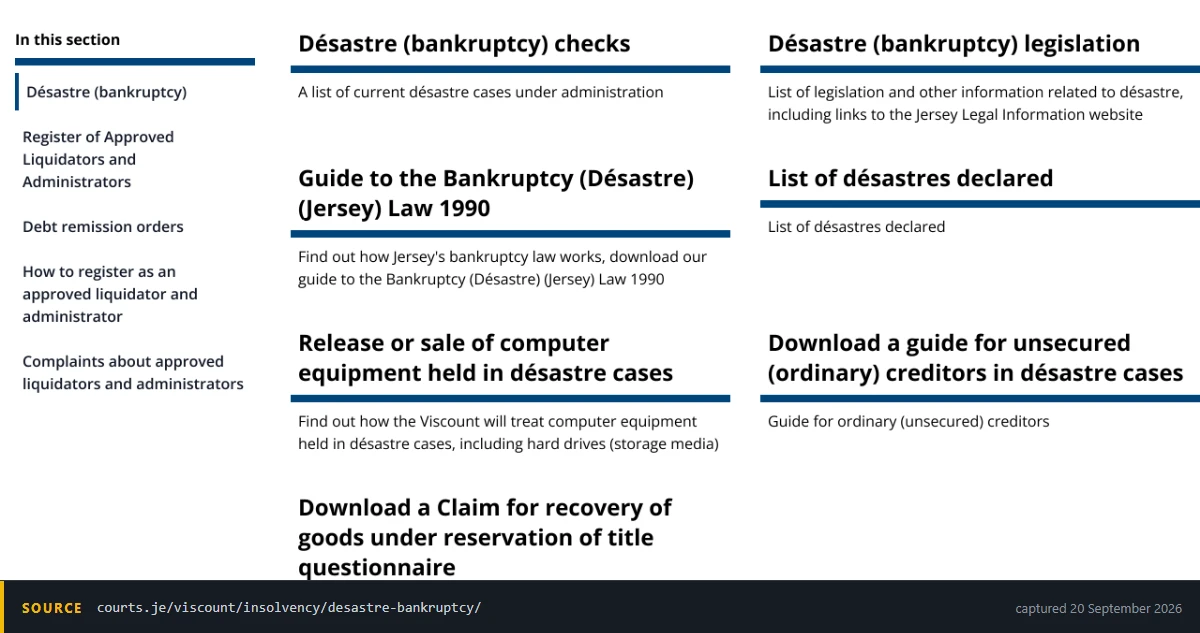
Four of the things this article sends you looking for are on this one page. Bookmark the register of approved liquidators now rather than later; it is how you tell a real appointee from someone who emails claiming to be one.
What you will be asked to prove, and why you need it now
Your claim is a claim in debt. To make it you have to show that you hold the instrument, what you paid, and when.
That is straightforward if you kept records and close to impossible if you did not, and the thing that makes it hard is specific: the entity that fails is the entity whose records you would have relied on. A collapsed issuer's dashboard is not a place you can log into for a statement, and an exchange that suspends a product does not owe you an export afterwards.
Assemble and keep, per position:
- The mint or contract address, not the ticker. "TSLAx" identifies at least sixteen different tokens on Solana. See checking that your xStock is genuine.
- Every acquisition: date and time in UTC, quantity, price paid, the venue, and the transaction hash where one exists.
- Every balance change that was not a trade, with its cause, a multiplier moving your balance changes your holding without a transaction of your own. Why your balance changes without a trade covers reading those.
- Your current holding, with a wallet address or account statement showing it.
- The issuer's own documentation as it stood when you bought, the terms or prospectus establishing that the token is a debt claim against that entity. That is what makes you a creditor rather than someone holding an unexplained token.
The on-chain half of this survives the issuer. The off-chain half does not. Export from your venue on a schedule, not when you need it.
While it is still a rumour rather than a declaration
By the time a désastre is declared, your position is a claim rather than an asset, and claims trade at a fraction of face value if they trade at all. The window in which you have choices is earlier, and it has a visible signature.
A discount across an issuer's entire product line, all at once, is a credit signal. One ticker cheap is a liquidity story. Every ticker from the same issuer cheap simultaneously is the market pricing the issuer, and the correct response to that is to reduce rather than to buy the dip — reading a discount correctly sets out how to tell them apart.
Other things to watch, in rough order of how much they should move you: a change or lapse in attestation cadence, a regulator action against the issuer or its custodian, redemption being suspended for the institutional channel that normally keeps the price anchored, and the issuer going quiet about any of it.
Your exit is the order book, so an exit decision has to be made while there is still a book. That is the whole practical argument for sizing positions against the wrapper rather than against the asset.
Where to look, concretely
- The Jersey Gazette, where claim notices are advertised.
- The Viscount's list of declared désastres; a public list you can check against an issuer's name.
- The register of approved liquidators and administrators, for confirming that whoever contacts you claiming to administer an estate actually does.
That last one deserves its own line. An insolvency is an excellent cover story for a fraud, and "the liquidator has emailed asking you to verify your holdings" is a message you should expect. The register is how you check.
Two things that will not help
- Paying a recovery service. There is no mechanism by which a third party retrieves value from an insolvent estate on your behalf faster or more completely than filing your own claim. Services advertising otherwise are a second loss.
- Waiting to see whether it resolves. The forty-day window runs from the declaration, not from when you notice. If you learn that an issuer whose tokens you hold has entered insolvency, the first action is to find out whether a claim date has been set, before you do anything else about the position.
Educational content, not legal or investment advice. Insolvency procedures differ by jurisdiction and change; the summaries here are of published guidance as at 19 September 2026 and are not a substitute for advice on your own claim.