Access, Risk & Tax
Can You Use Your R2 Million SDA to Buy Crypto?
Yes — and the allowance doubled to R2 million in April 2026. But SARB is bringing crypto formally inside exchange control, only individuals will be permitted to externalise, and it must go through an authorised provider. What the draft rules say.
The short answer is yes. Individuals may buy crypto assets from abroad using their single discretionary allowance and/or their foreign investment allowance.
The longer answer is the one that matters, because this area is being rewritten right now, and the direction of travel is toward more reporting rather than less.
What changed in 2026
On 25 February 2026 the Finance Minister announced that the single discretionary allowance would double. The South African Reserve Bank gave it legal effect through exchange control circulars issued on 8 April 2026, with the increase applying from the date of the circular.
The SDA moved from R1 million to R2 million per adult resident per calendar year. It is the largest adjustment in close to fifteen years.
Two allowances are relevant, and they work differently:
| Single discretionary allowance (SDA) | Foreign investment allowance (FIA) | |
|---|---|---|
| Annual limit | R2 million | R10 million |
| Who | Residents 18 and older | Residents 18 and older |
| Prior approval | None needed | TCS PIN from SARS required |
| Covers | Travel, gifts, remittances, donations, offshore investment | Offshore investment |
| Period | Calendar year | Calendar year |
The SDA is the one most people will use. No application, no PIN, no waiting; you instruct your bank and it goes.
Crypto is not a way around exchange control
This is the misconception to kill early.
Individuals may purchase crypto assets from abroad using the SDA and/or the FIA. That sentence cuts both ways: it confirms you are allowed to do it, and it confirms that doing it draws on the same allowances as any other offshore investment.
Crypto is not a parallel channel. The Exchange Control Regulations apply on the basis of your residence, not on the basis of where an asset sits or what technology records it. A self-custodied token does not change your status as a South African resident.
What SARB is proposing
The 2026 Budget signalled that crypto assets will be brought formally inside the exchange control framework. SARB's draft Crypto Asset Manual is still open for public comment and has not been finalised.
What the draft proposes:
- Only individuals — not companies or other entities — will be permitted to externalise crypto assets.
- It must go through an Authorised CASP (a licensed crypto asset service provider).
- It draws on your existing SDA or FIA.
- A transaction counts as cross-border when assets move between a South African authorised CASP and an offshore CASP, or from a local authorised CASP to a non-custodial wallet.
- Once amended, cross-border crypto transfers may require prior approval.
Read those last two points against what you do. If you buy a stablecoin locally in rand and send it to an offshore platform to buy tokenised stocks, that is — under the proposed definition — a cross-border transaction counting against your allowance.
The practical instruction: keep records as though the rules already apply. It costs nothing if they are never finalised, and it saves you if they are.
Your card will not work, and that is deliberate
SARB has blocked credit and debit card purchases of crypto at offshore exchanges.
If you try your South African bank card on a foreign platform, it will most likely fail. That is not a fault on your side and support cannot fix it.
The working route is:
- Buy a stablecoin with rand at an FSCA-licensed local provider.
- Send it to the platform where you want to trade.
- Record the rand amount, the date, the provider, and which allowance you drew on.
This is also the route that fits SARB's proposed framework, because step 1 goes through an authorised provider. Doing it this way is not just compliant today; it is compliant in the direction the rules are heading.
Two year-ends, again
Your allowances reset on 1 January. Your tax year ends on 28/29 February.
These are two different cycles and your records need to satisfy both. A December purchase and a January purchase fall in the same tax year but different allowance years. If you are sizing a large position near year-end, plan around that distinction; splitting across 1 January gives you two allowance years instead of one.
How SARS taxes the resulting position is a separate question with its own traps.
What actually consumes your allowance
People underestimate this. The SDA covers a wide range of purposes, and ordinary spending eats into the same pool:
- Overseas travel and accommodation
- Foreign-currency online subscriptions and purchases
- Gifts and remittances to family abroad
- Offshore investments, including crypto
If you have been paying for foreign services all year, you may have less headroom than you assume. Check the balance with your bank before planning a large transfer; the limit is enforced at the banking layer and a declined instruction at the wrong moment is avoidable.
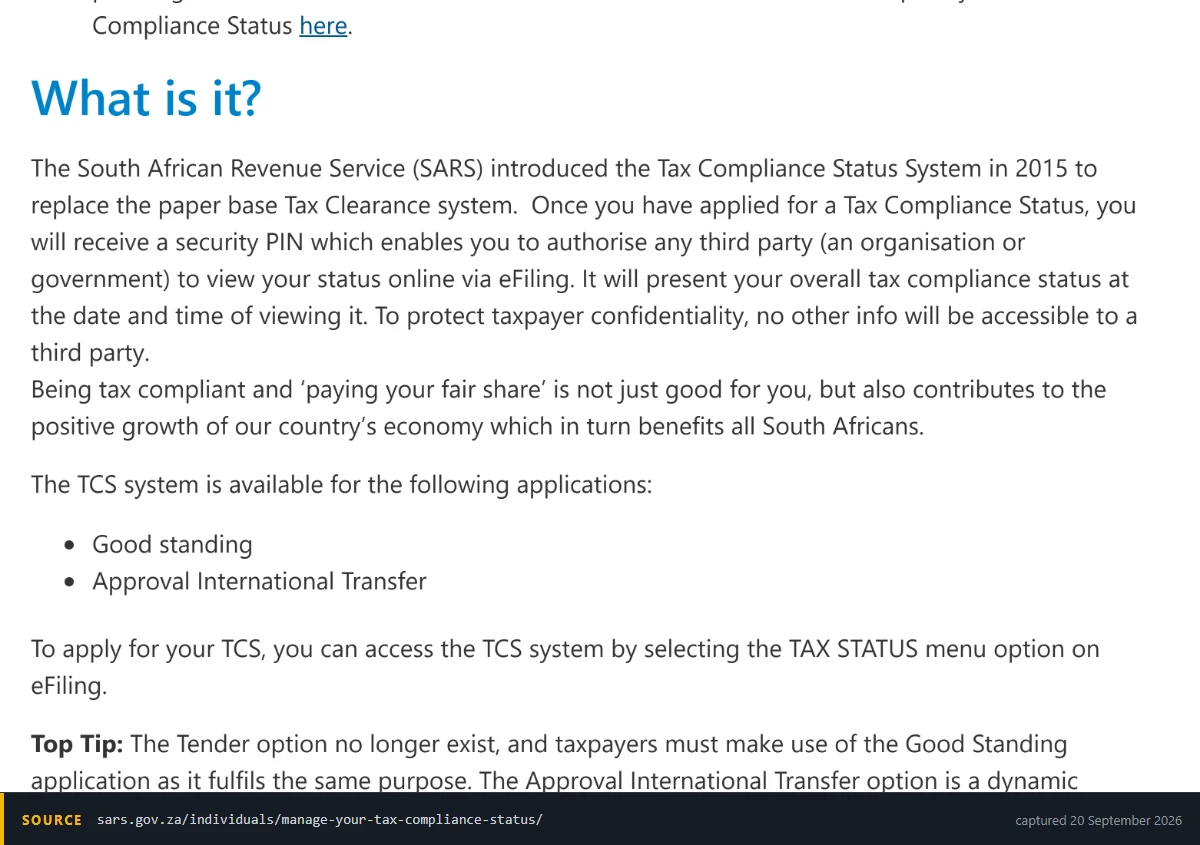
Two application types, and they are not interchangeable: the foreign investment allowance needs the Approval International Transfer one. The PIN is what lets your bank read the outcome without seeing the rest of your tax affairs.
A realistic sequence
- Check your remaining allowance for this calendar year with your bank.
- Decide SDA or FIA. Under R2 million and no PIN needed: SDA. Above that you need a tax compliance status PIN, which is applied for through SARS eFiling rather than through your bank — SARS publishes the walkthrough in its guide to the tax compliance status functionality on eFiling. Start it before you need the money to move, because your tax affairs have to be in order first and fixing an outstanding return is what takes the time.
- Buy the stablecoin locally at an FSCA-licensed provider, with rand.
- Send to your chosen platform, verifying the network first; wrong-chain transfers are unrecoverable.
- Record everything: amount in rand, date, local provider, destination, allowance used.
- Buy with a limit order, not a market order. The four checks covers execution.
Using your SDA to buy crypto and tokenised assets is permitted, the allowance just doubled, and the mechanics are straightforward once you accept that your bank card is not part of them.
What you should not do is treat crypto as a way to move value offshore outside the framework. The regulations bind you as a resident, SARB is actively closing the definitional gaps, and the penalty for getting this wrong is not a fee; contravention of the Exchange Control Regulations is an offence.
Stay inside the allowance, go through a licensed provider, keep records on both the calendar year and the tax year, and this is an ordinary, legal, well-trodden route.
Educational content, not financial or tax advice. This site is not an authorised financial services provider. Exchange control rules for crypto assets are in draft and subject to change, confirm current limits and procedures with your bank's exchange control desk or SARB before moving funds of consequence.