
Access, Risk & Tax
Tokenised Stocks and SARS: How South Africa Taxes xStocks
SARS treats crypto assets as either capital or revenue depending on how you behave, not what you call it. What that means for tokenised stocks, why rebased dividends are the trap, and the two different year-ends your records must satisfy.
Around 50 000 South Africans now hold tokenised US stocks through Luno alone, a number reached within roughly ten months of launch. Almost none of them have a clear answer to a simple question: what does SARS want from me at the end of the year?
There is no SARS guidance written specifically for tokenised equities. What exists is the crypto-asset framework, the ordinary capital-versus-revenue test, and the normal rules on foreign dividends. This article puts those three together and shows you where the edges are.
Nothing here is tax advice. It is a map of the questions, so that an hour with a tax practitioner costs you less.
Start here: capital or revenue?
This is the question that moves the most money, and it is decided by your behaviour, not by the label on the product.
SARS recognises crypto assets in the ITR12 and has confirmed that gains may be taxable either as capital gains or as revenue, depending on the nature of the activity and your intention. Trading for profit is typically treated as revenue. Long-term investment falls under the capital gains regime.
The difference:
| Capital (CGT) | Revenue (income) | |
|---|---|---|
| Annual exclusion | R40 000 | None |
| Inclusion rate | 40% of the gain | 100% |
| Effective top rate | 18% | Up to 45% |
On a R200 000 gain, that gap is roughly R30 000 versus up to R90 000. Understand it before you start, not after.
What pushes you toward revenue treatment: frequent trading, short holding periods, borrowed funds, a pattern of buying with the intent to resell rather than to hold. What supports capital treatment: long holding periods, a stated investment intention, consistency over time.
A South African buying TSLAx and holding it for three years looks very different to SARS than one flipping SPYx weekly, even though both hold identical instruments.
The declaration sits on you
The onus is on the taxpayer to declare crypto-asset gains or losses in the year of assessment in which they are received or accrued.
SARS also expects you to list year-end wallet balances in the "Investments and assets" section of the ITR12. That means you need, for the last day of the tax year, the quantity of each token held and its rand value on that date.
If you hold tokenised stocks across an exchange account and a self-custody wallet, both belong in that figure.
The trap nobody warns you about: two different year-ends
This is the single most practical thing on this page, and it catches nearly everyone.
- The South African tax year runs 1 March to the end of February. The 2026 tax year covers 1 March 2025 to 28 February 2026.
- Your exchange control allowances run on the calendar year — 1 January to 31 December.
So your records have to be sliceable two different ways. If you only keep one set of totals per tax year, you cannot later demonstrate that you stayed inside your calendar-year single discretionary allowance.
Record the date of every transaction and let the spreadsheet do both cuts. This costs nothing if you do it from day one and is painful to reconstruct later.
Dividends: the money is gone before you see it
Tokenised US stocks pay dividends net of US withholding tax, typically 30% for non-US holders before any treaty relief.
South Africa has a tax treaty with the United States, and in a conventional brokerage relationship a South African investor files a W-8BEN and often receives a reduced rate at source. Whether an equivalent mechanism reaches you through a tokenised wrapper depends entirely on the issuer's arrangements, and for retail-sized positions it is frequently unavailable in practice.
Two questions for your practitioner:
- Is the withheld US tax creditable against your South African liability as a foreign tax credit?
- Does the foreign dividend exemption apply to a distribution that arrives through a tracker certificate rather than as a dividend on a share you own?
That second question is not rhetorical, and it leads directly to the next section.
What you legally hold changes the tax question
Most South Africans buying tokenised stocks are buying xStocks; that is the product behind Luno's tokenised offering. And as covered in what you actually own, an xStock is legally a bearer debt instrument classified as a tracker certificate, issued by Backed Assets (JE) Limited in Jersey.
You are a creditor of a Jersey company holding an instrument that tracks a share price. You are not a shareholder of Tesla.
That distinction may matter to SARS in ways it does not matter to your screen:
- A distribution on a debt instrument is not obviously the same thing as a foreign dividend.
- The instrument is issued by a Jersey entity, not a US one: which may affect which treaty, if any, is in play.
- If your exposure is via a token that tracks a share rather than the share itself, the characterisation of any gain may follow the legal form.
Compare with Ondo Stocks, where holders receive genuine security entitlements through an SEC-registered transfer agent, and bStocks, issued by an ADGM special purpose vehicle. Three structures, three different answers, and potentially three different tax characterisations for identical price exposure.
Practical instruction: record the issuer, not just the ticker. "TSLA" is ambiguous across three legal structures. "TSLAx, xStocks, Backed Assets (JE) Limited" is not.
Rebases: your balance changes without a trade
bStocks adjust your token balance to pass on dividends and splits; xStocks do the same thing through an on-chain multiplier. Either way the number of tokens you hold moves while you sit still, and two things follow from that for a South African return.
The first is arithmetic. After two distributions and a split, working out what you paid per token requires the full history of balance changes, not just your purchase record. Write down the opening balance and every subsequent change, with the date and the cause, on the day it happens.
The second is timing. The increase may count as income on receipt, before you have sold anything and before you have any cash. Whether SARS treats a rebase as an accrual in the year it occurs is exactly the kind of question to put to a practitioner in advance.
Swaps are probably disposals
Selling PAXG for USDT may be a disposal of your gold position even though you never touched rand. Moving between stablecoins may be a disposal. Converting an accruing token to its rebasing variant may be a disposal.
An active trader can accumulate a substantial number of taxable events in a year without ever withdrawing to a bank account, and without ever seeing a rand figure on a statement.
What to record, from day one
For every position:
- Date and time (UTC), quantity, price paid
- Rand value on that date, and the exchange rate you used
- Issuer and product, not just the ticker
- All fees
- Opening balance before any rebase
- Every balance change, with date and cause
- Every distribution, gross and net of withholding
- On disposal: date, quantity, proceeds, rand value
Plus, for exchange control: which allowance you drew on, the rand amount that left the country, and the Authorised CASP it went through.
A spreadsheet is enough. Ten minutes per transaction turns February into arithmetic instead of archaeology.
Three questions worth paying for
A practitioner must be registered with both SARS and a Recognised Controlling Body to charge you for tax services, and SARS publishes a practitioner lookup. The lookup takes a practitioner number in the form PR-0000000, not a name, so ask for the number at the first meeting and check it before the first invoice.
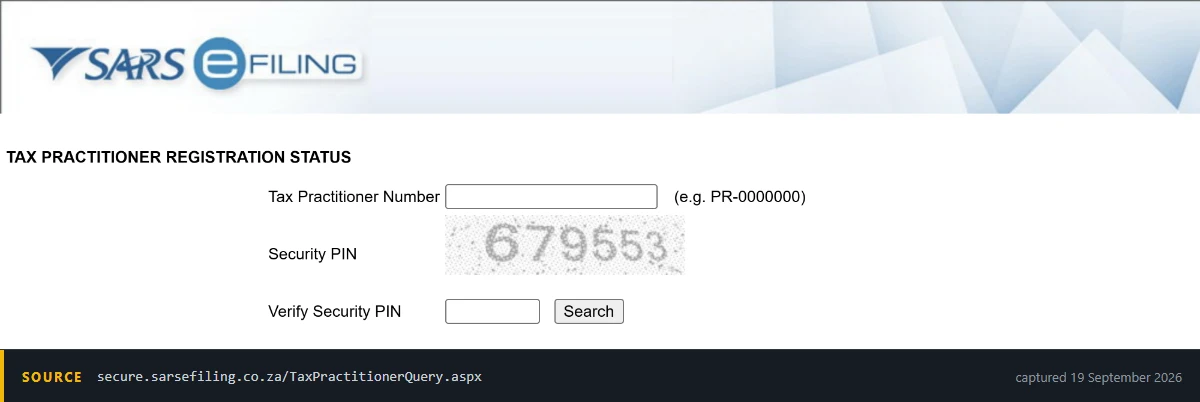
No login and no eFiling profile are needed; the page is public. It asks for the PR number and the security code shown on screen.
When you see a practitioner, bring the issuer's documentation and your transaction record, and ask:
- Capital or revenue for my specific pattern of activity? Get it in writing.
- Is the 30% US withholding creditable for me, and does the foreign dividend exemption apply to distributions on a tracker certificate?
- Are rebases accruals in the year they occur?
Find someone who handles both crypto assets and conventional offshore securities. Tokenised stocks sit exactly on that boundary, and specialists in one side routinely misclassify the other.
Educational content, not tax advice. This site is not an authorised financial services provider. Tax treatment depends on your circumstances and intention; consult a registered tax practitioner.