
Access, Risk & Tax
Bank Declined or Returned Your Transfer to Luno or VALR? What South African Banks Allow
Capitec and Absa customers cannot pay Luno by EFT, and exchanges return deposits from accounts not in your name. How to tell a bank decline from a reversal, and what to do next.
You tried to send rand from your bank to Luno or VALR and it failed. Either your banking app refused the payment, or the money left your account and came back a few days later. These are two different problems with two different fixes, so work out which one you have before you call anyone.
This guide covers South African bank accounts paying local crypto exchanges. If your problem is a card payment to an offshore platform, that is a separate block, explained in why South African cards fail on foreign crypto exchanges.
First, work out who stopped the payment
Your bank stopped it if the money never left your account. You see an error in the app, the beneficiary cannot be added, or the payment shows as declined or unsuccessful. The exchange never saw the money, so its support team cannot help.
The exchange sent it back if the money left your account and returned days later, sometimes smaller than you sent. The bank processed the payment normally; the exchange received it, could not accept it, and reversed it.
A third case looks similar but is not a rejection: the money left and simply has not appeared yet. Luno says bank deposits can take up to 2 business days, and VALR says up to 48 business hours for deposits from banks other than Standard Bank. Wait out that window before treating it as a failure.
Which South African banks block EFT payments to crypto exchanges?
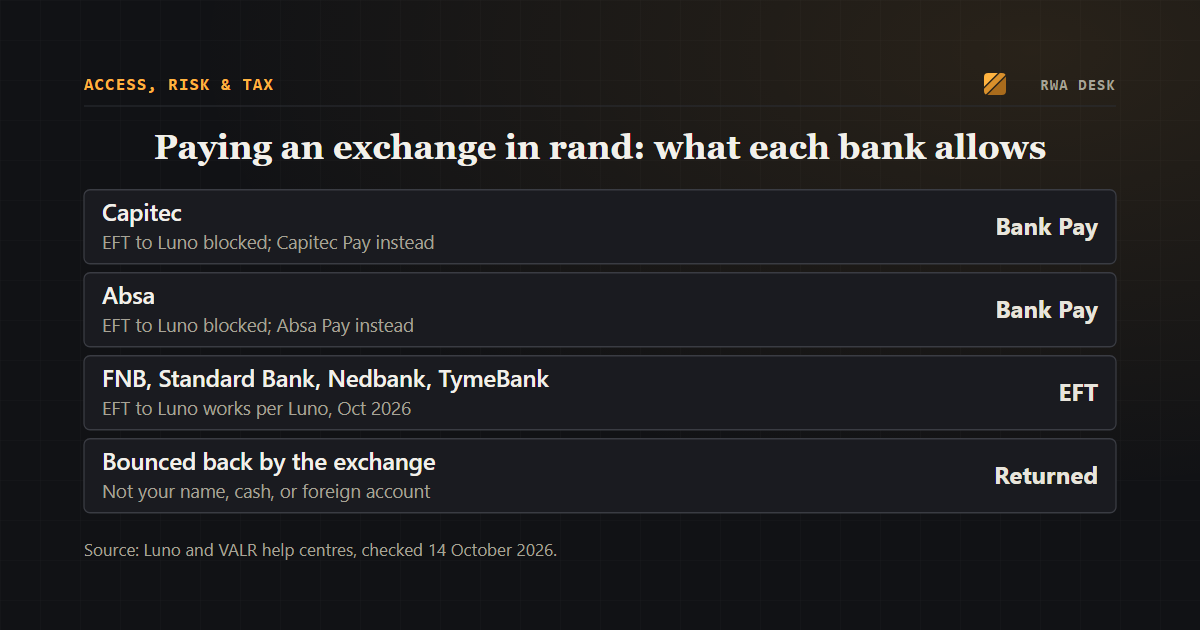
As of October 2026, Luno's help centre names two banks whose customers cannot pay Luno by EFT at all: Capitec and Absa.
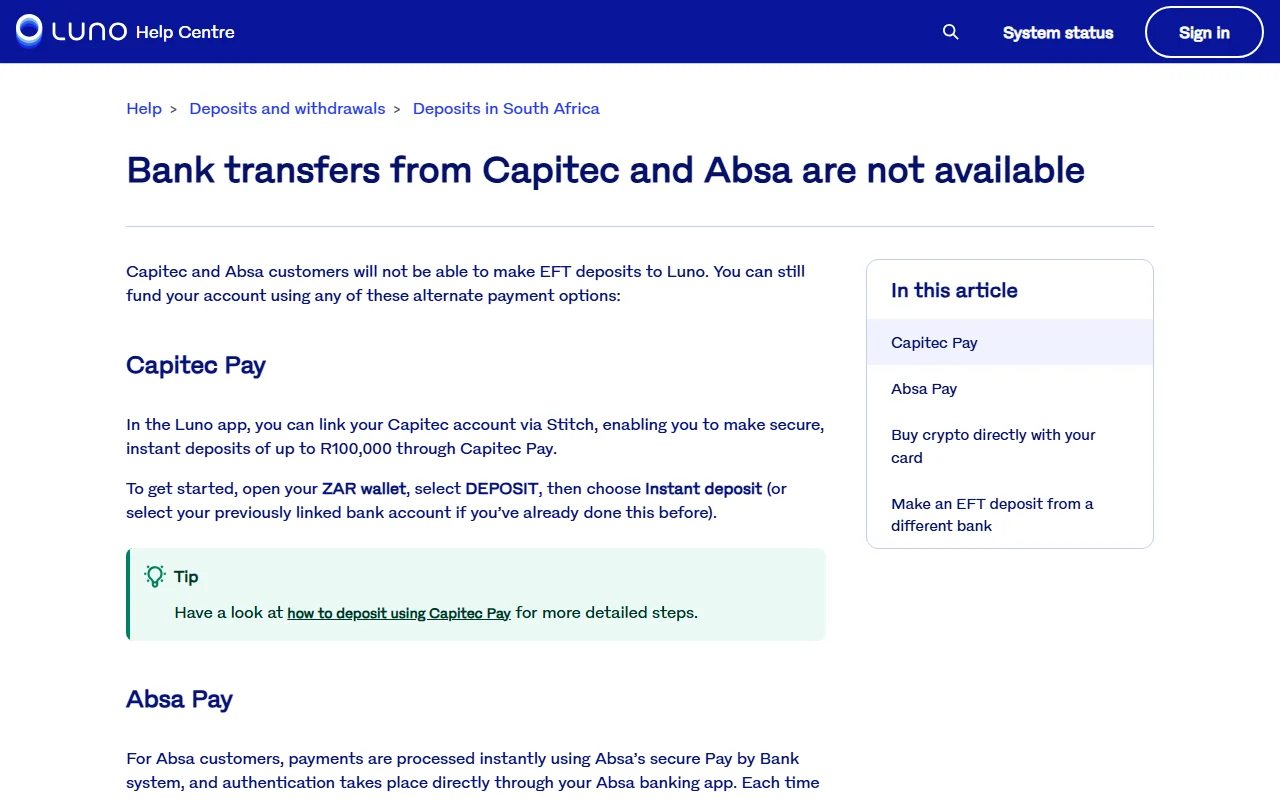 Luno help centre, "Bank transfers from Capitec and Absa are not available", viewed 14 October 2026.
What that means for each bank, according to Luno's own pages:
| Your bank | EFT to Luno | What Luno offers instead | Luno's stated fee |
|---|---|---|---|
| Capitec | Not available | Capitec Pay, approved in the Capitec app | 1.25% up to R1,000; R9 per deposit above R1,000 |
| Absa | Not available | Absa Pay, approved in the Absa app | 1.4% |
| Standard Bank, Nedbank, TymeBank | Works | Pick "Luno" from the bank's approved beneficiaries | None stated for EFT |
| FNB | Works | Add Luno manually with its banking details | None stated for EFT |
Both instant options are capped at R100,000 per transaction. Capitec Pay also needs a Luno account verified to Level 2 or higher, a South African ID number, and a once-off R1 linking fee.
On Absa, Luno says the bank "has restricted crypto-related payments made via third-party open banking services (like Stitch LinkPay) and cards", so Absa customers also cannot buy on Luno with an Absa card. Capitec described its block as a fraud-prevention measure when it introduced it in 2024, as reported at the time. Phoning the branch will not lift either block.
VALR does not publish a bank-by-bank list. Its deposit page says VALR sets no limits on EFT deposits, "however, deposit limits may be imposed by your bank". Capitec's reported block covered payments to crypto exchanges in general, not just Luno, so Capitec customers should expect the same result at VALR. Check the bank options VALR shows on its Deposit ZAR screen before you send.
Why your bank declined it even though it allows crypto payments
If you bank with FNB, Standard Bank or Nedbank and the payment still failed, the usual causes sit on the bank's side:
- Daily or per-payment limits. EFT and instant-payment limits are set on your banking profile. Raise the limit in the app and retry, rather than splitting one payment into several identical ones (see the VALR point below).
- A new beneficiary. Banks often add extra checks to the first payment to a newly added recipient. Using the exchange's listed bank-approved beneficiary avoids typing account details yourself and removes one source of error.
- A fraud check. A large, first-time payment to a crypto exchange can trigger a fraud hold. The app or the bank will usually ask you to confirm it. Answer that before you resend anything.
Why the exchange sent your money back
Luno and VALR state the same core rules. Expect a deposit to be returned or stuck when:
- The bank account is not in your name. Luno: "Do not deposit money using a friend or family member's bank account." VALR asks you to "always ensure to transfer funds from a bank account registered in your name."
- It was a cash deposit. Luno does not accept cash deposits; it wants an online bank transfer.
- The account is outside South Africa. Luno reverses international deposits and warns that a reversal fee may apply, which can reduce the amount you get back. VALR says EFTs to and from Namibian, Eswatini and Lesotho bank accounts through the South African EFT system are no longer possible.
- A company account paid into a personal profile. Luno asks business users to open a company account instead.
A wrong or missing reference is usually a delay rather than a bounce. Luno and VALR both ask you to send proof of payment so they can match the deposit by hand.
VALR adds one more detail: deposits of the same amount within 24 hours are flagged for review. Changing the amount by one cent avoids that.
What to do next, in order
- Check your bank statement. If the money did not leave, it is a bank decline. If it left and came back, it is a reversal.
- Bank decline at Capitec or Absa: stop retrying EFT. Use Capitec Pay or Absa Pay from inside the Luno app, or pay from an account you hold at another South African bank.
- Bank decline at another bank: check your limits and any fraud notice in the app, then contact the bank's payments or fraud line.
- Reversal: compare the returned amount with what you sent, then fix the cause — your own account, a South African account, an online transfer.
- Money left and never arrived after the exchange's waiting window: send the exchange proof of payment. Luno wants your name, the date, the amount and the reference used, and does not accept SMS notices or bank statements as proof.
Can you complain if your bank refuses crypto payments?
You can, but set expectations. Which merchants a bank will pay is largely its own decision. A complaint is more realistic when the bank took your money and did not return it, charged fees it cannot explain, or ignored your query.
Complain to the bank in writing first and keep the reference number. If that does not resolve it, the National Financial Ombud Scheme, which now handles banking complaints, is free for complainants. It requires that you raise the problem with the provider first.
Before moving larger amounts, confirm the exchange itself is authorised: our guide on how to check a crypto platform's FSCA licence shows where to look. If you are funding an account to buy tokenised shares, the Luno and Binance comparison for tokenised US stocks covers what you can buy once the rand arrives.
Sources: Luno help centre — Bank transfers from Capitec and Absa are not available, How do I deposit using Capitec Pay?, How do I deposit using Absa Pay?, EFT deposit tips for South African customers, Things you need to know about Luno deposits, My deposit is missing. VALR support — How to deposit Rand (ZAR) using a bank account, How long does it take for my Rand deposit to reflect. All viewed 14 October 2026. Bank policies change, so check the exchange's page again before a large transfer.