
Access, Risk & Tax
How to Cash Out Tokenised US Stocks to Rand: Luno, VALR and Binance Compared
Sold your xStocks or bStocks and want rand in the bank? The three South African routes compared: what each costs, how long withdrawals take, and when the offshore allowance comes into it.
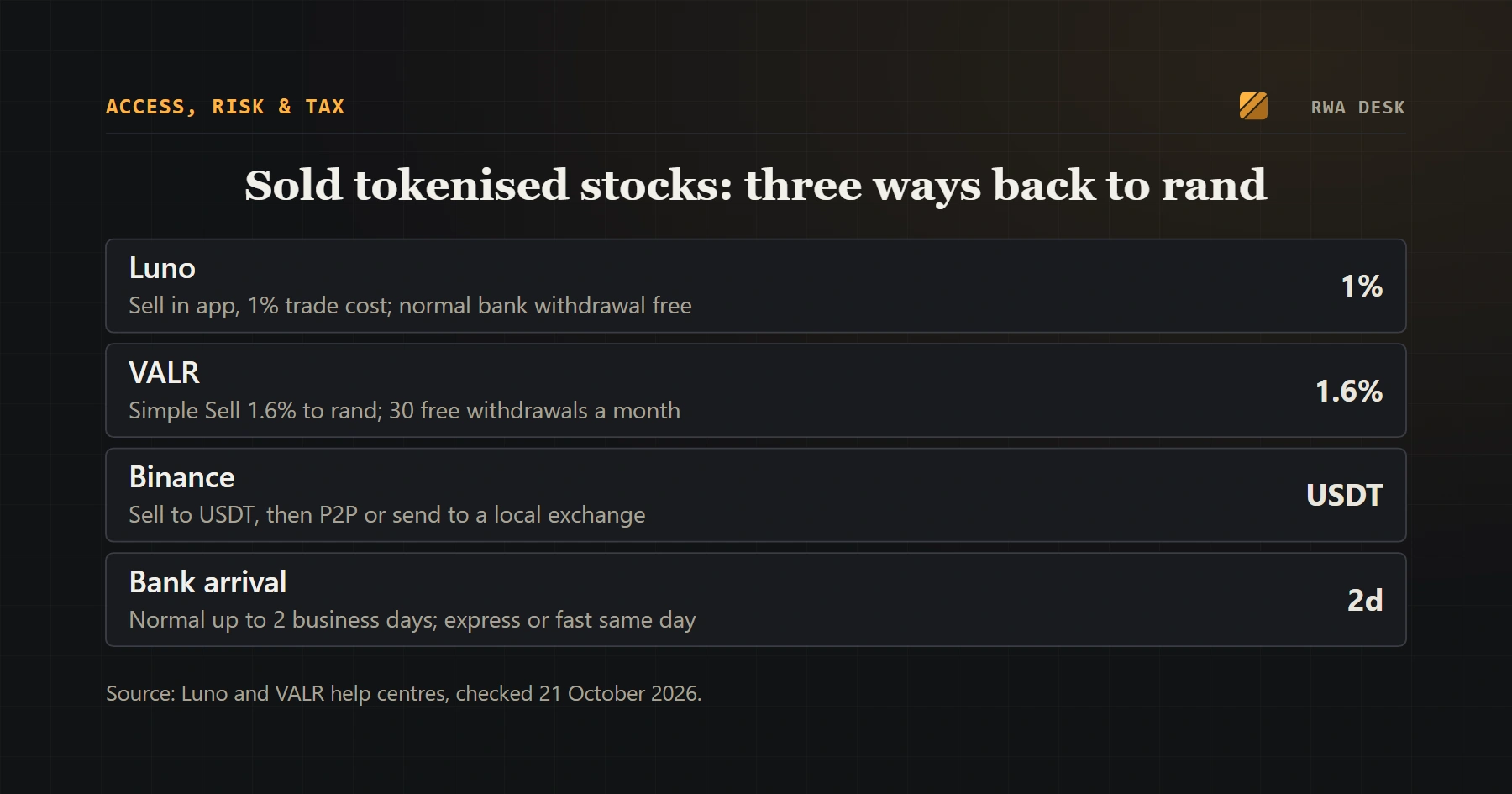
Selling the token is the easy part. Getting the rand into your bank account is where people get stuck, and what's involved depends on which platform you bought on. In South Africa there are three realistic routes: Luno, VALR and Binance. They differ in what you pay, how long the money takes and whether anything touches your exchange control allowance.
Everything below comes from the platforms' own help centres as they read on 21 October 2026. Fees change, so check the confirmation screen before you tap confirm.
First, a deadline if you hold HDx, MAx or WMTx on Luno
Luno is dropping three xStocks for customers registered in South Africa and Nigeria: HDx (Home Depot), MAx (Mastercard) and WMTx (Walmart). Buying stopped on 1 October 2026. You can sell them yourself until 2 November 2026. Anything still in your account on 11 November 2026 is converted to rand automatically at the market rate, and the wallet then disappears from your app.
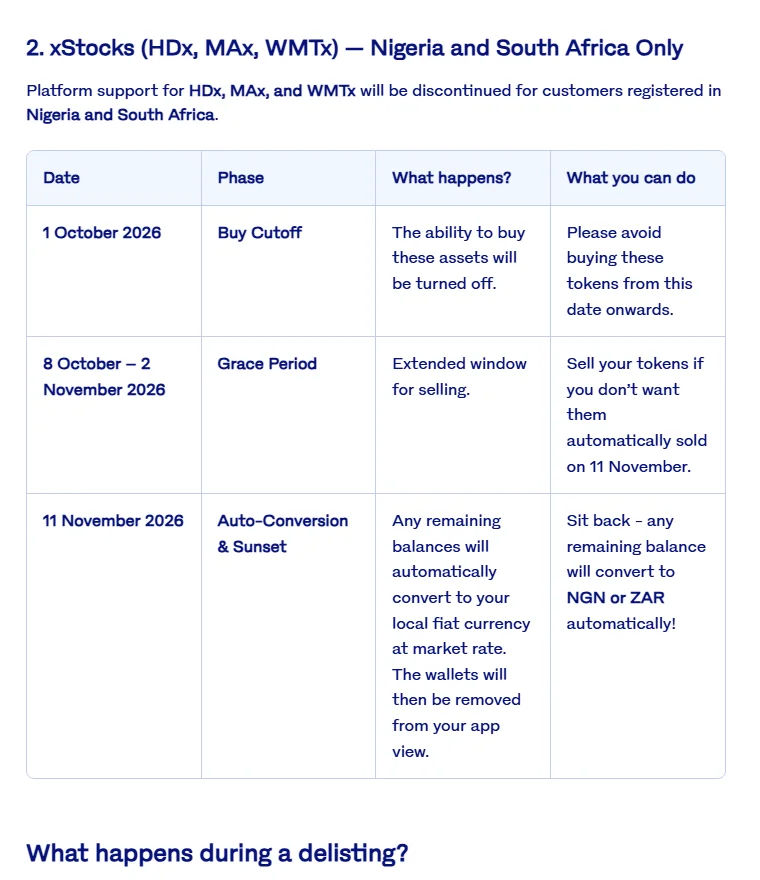
Luno's notice of regional asset delistings, captured 21 October 2026.
If you do nothing, you still end up with rand. You just give up the choice of when to sell. Either way, the conversion is a disposal for tax purposes, the same as a sale you make yourself.
Route 1: Luno, where you sell in the app and withdraw rand
Luno is the simplest route, because it is also the only one open to you if you bought on Luno. Its help centre says tokenised stocks bought there can only be traded and managed inside Luno and cannot be sent on-chain to an external wallet or another exchange. Selling on Luno is your exit.
Steps: Sell, choose the stock, enter the amount, review and confirm. The rand lands in your ZAR wallet. Then go to your ZAR wallet, choose Withdraw, and send it to your linked bank account.
Cost: Luno charges a 1% trade cost on each tokenised stock transaction. A normal withdrawal is free. An express withdrawal costs R20 if your bank is a real-time clearing (RTC) participant, or R80 if it is not. The RTC list includes Absa, Capitec, FNB, Nedbank, Standard Bank, Discovery, Investec, TymeBank and others. Postbank does not support express withdrawals.
Timing:
| Withdrawal type | When it is processed | When it should reach you |
|---|---|---|
| Normal, to Standard Bank | 08:00–17:45, Monday to Saturday | Within 24 hours of processing |
| Normal, to other banks | 08:00–15:45 weekdays, 08:00–09:45 Saturdays | Within 48 hours of processing |
| Express, under R250,000 | 24/7, including weekends and public holidays | Same day |
| Express, over R250,000 | Weekdays 00:00–15:45 | Same day if requested in time |
Luno does not offer express withdrawals to Standard Bank accounts. You don't need them there, because normal withdrawals usually reflect in about 15 minutes during processing hours, since Luno banks with Standard Bank too.
Limits that catch people: your verification level caps withdrawals. Level 1 accounts are limited to R15,000 in withdrawals over the life of the account, Level 2 to R50,000 per month, and fully verified accounts have no limit. A single express withdrawal can be at most R5 million. If your sale is bigger than your level allows, upgrade your verification before you sell, not after.
Route 2: VALR, where you sell to rand directly or through USDT
VALR lists xStocks on Solana for customers who live in South Africa. Two ways out:
- Simple Sell lets you sell xStocks straight to ZAR (also to USDT, USDC or BTC). The fee is 1.6%.
- On the exchange, xStocks trade against USDT, so you sell to USDT and then sell USDT for rand on the USDT/ZAR pair. You pay VALR's tiered spot fees on both trades. That's two trades instead of one, and whether it is cheaper than 1.6% depends on your tier and the spread at the time. Compare both quotes on screen.
Withdrawing rand: the account must be in your own name. VALR will not pay out to anyone else's account, and you link the account first with an email confirmation and a one-time PIN or 2FA. Individual clients get 30 free normal ZAR withdrawals per calendar month, then R8.50 each. A fast withdrawal costs R30.
Timing: normal withdrawals arrive the next business day if requested by 16:10 on a weekday (09:35 on Saturday), otherwise in two business days. Fast withdrawals under R250,000 to RTC banks are near-instant. VALR processes nothing on Sundays and public holidays, which is different from Luno's express option. Selling on a Sunday is fine. The rand just won't move until Monday.
Unlike Luno, VALR lets you deposit and withdraw xStocks on the Solana network. That matters if your tokens are sitting in your own Solana wallet. You can send them to VALR, sell there and withdraw rand, as long as the specific token is listed on VALR.
Route 3: Binance, where you sell to USDT and then bring the rand home
On Binance you sell your tokenised stock for USDT. From there, two options:
a) Send the USDT to a South African exchange and sell it there. Withdraw USDT from Binance to your VALR or Luno USDT address, sell it for rand, then withdraw as above. You pay Binance's withdrawal fee for the network you choose, which is shown before you confirm and varies a lot between networks, plus the local exchange's trading fee. Always send a small test amount first, and match the network on both sides.
b) Sell USDT for rand on Binance P2P. Another user pays rand into your bank account and you release the USDT. When we checked on 21 October 2026, there were 129 live ads for selling USDT for ZAR, mostly paid by bank transfer through FNB, Absa, Nedbank, Capitec and others. The risks are real:
- Only release the USDT after the rand has cleared in your account. A payment notification or screenshot is not enough.
- Turn down buyers who want to pay from an account that isn't in their name, or by cash deposit. If the money turns out to be stolen, your bank may freeze your account while it investigates.
- The ad price is the exchange rate you get. Compare it with the USDT/ZAR price on VALR or Luno before accepting.
For most people, option (a) is easier to trace, because the rand comes from a regulated local platform into your own account.
Does bringing money home use up your offshore allowance?
Selling on Luno or VALR and withdrawing rand doesn't move anything across the border, so the single discretionary allowance (SDA) doesn't come into it.
The Binance route is different. Under the draft cross-border crypto rules published by SARB and National Treasury in August 2026, moving crypto from an offshore platform to a South African authorised provider is treated as repatriation. It is allowed at any time and the local provider reports it to SARB as an inward flow. The draft does not make you spend allowance to bring crypto home. Allowance applies to money and crypto going out. If you later send those assets offshore again, the draft says the local provider must first see evidence that they were brought in and reported. Keep your Binance withdrawal records.
These rules are still a draft. How the SDA and the draft fit together is covered in our guide to using your R2 million SDA for crypto.
Side by side
| Luno | VALR | Binance | |
|---|---|---|---|
| What you sell | xStocks bought on Luno | xStocks listed on VALR | bStocks and other listings |
| Sale cost | 1% | 1.6% Simple Sell, or tiered spot fees twice | Binance trading fee, then a network fee or P2P spread |
| Rand withdrawal fee | Free normal; R20 or R80 express | 30 free a month then R8.50; R30 fast | Paid by the local exchange you move to, or none on P2P |
| Fastest arrival | Same day, 7 days a week (express) | Near-instant, but not Sundays or public holidays | Depends on the second leg |
| Allowance impact | None | None | Repatriation, reported inward flow under the draft rules |
If you're still deciding where to hold tokenised stocks in the first place, our Luno vs Binance comparison covers what you legally own on each.
Before you sell: tax and records
Every sale is a disposal for SARS, whether you sell yourself or Luno converts a delisted token for you. A swap into USDT on Binance is likely a disposal too, even though no rand changed hands yet. Before you cash out, save the trade confirmation showing the date, quantity, rand value and fee. Our SARS guide to tokenised stocks explains the capital versus revenue question and where these sales go on your ITR12.
If the rand hasn't arrived
- Check the window: up to two business days for a normal withdrawal, and nothing moves on Sundays or public holidays at VALR.
- Check the withdrawal status in the app. If it says processed, the delay is on the bank's side, and Luno's status page lists known banking problems.
- Check you withdrew to the right linked account, in your own name.
- If it's still missing after the window, contact the exchange with the withdrawal ID, amount and time. They can give you the payment reference to show your bank.
Sources: Luno help centre ("Luno fees and limits in South Africa", "Express withdrawals for South African customers", "How long until my withdrawal is processed?", "Frequently asked questions about tokenised stocks", "Notice of regional asset delistings"); VALR support ("What are VALR's charges?", "Blitz Processing of Rand (ZAR) Withdrawals", "Fast Withdrawals on VALR", "What are xStocks?"); Binance P2P public ad listing; SARB/National Treasury draft Crypto Asset Manual for cross-border activities (August 2026). All checked 21 October 2026.