
Access, Risk & Tax
Is Swapping One RWA Token for Another a Taxable Event?
Six risk categories specific to tokenised real-world assets, with the concrete check for each — plus the tax mechanics that catch people out, including withholding, rebases and why swapping one token for another may be a disposal.
This is the article that pulls the rest of the site together. Two parts: a risk framework specific to tokenised real-world assets, and the tax mechanics that reliably surprise people.
Neither is a substitute for professional advice on your own situation. Both will make that advice cheaper, because you will arrive knowing what to ask.
Part one: six risks, and the check for each
Ordinary crypto risk analysis does not transfer cleanly here. An RWA token carries the risks of the underlying asset plus a stack of wrapper-specific risks that do not exist when you hold the asset directly. Those are what this covers.
1. Wrapper risk: what are you in a bankruptcy?
The foundational question, covered in the four legal wrappers.
Are you an owner, a secured creditor, or an unsecured creditor? An xStocks holder is an unsecured creditor of a Jersey SPV. A USDY holder is a secured creditor with a trust company as collateral agent. An Ondo Stocks holder owns a security entitlement. A PAXG holder has a bankruptcy-remote trust claim.
These are radically different positions that look identical on a price chart.
Name the issuing entity, find its jurisdiction, and locate the sentence in the offering document describing what the instrument legally is. If you cannot do this in ten minutes, do not buy.
What you do with that answer depends on your horizon. Issuer credit risk compounds over years, so prefer the stronger wrappers for long holds and accept weaker wrappers for short-term trading, where it barely matters. Size positions against the wrapper, not the asset; a 5% allocation to gold is not the same decision as a 5% allocation to one issuer's unsecured paper.
2. Backing risk: is the asset there, unencumbered?
The reserve report answers this, if you ask five things of it: who signed it, what was the effective date, what was the scope, does it say unencumbered, and does it state reserves against token supply at the same instant? Verifying backing has the full method.
Monthly beats quarterly, a named audit firm beats an unnamed "verification partner," and full scope beats partial. None of those is a permanent attribute of a product, so re-check them once a year on anything you hold for years.
3. Access risk: can you be locked out?
Underweighted because it feels remote until it happens. Issuers routinely reserve the right to restrict, suspend, reject, cancel or unwind access where they determine a transaction may breach applicable law, product restrictions, eligibility criteria or sanctions requirements. Binance states this explicitly for bStocks; it is standard across the industry.
Separately, whitelisted tokens like USDY only transfer between eligible addresses.
Before buying, read the restricted-jurisdiction list and the eligibility clause. Confirm your residence is genuinely permitted, not merely unblocked today. For whitelisted tokens, confirm which addresses you can transfer to before buying.
Register with your real residence. Do not use a VPN to access a restricted product; it is the fastest route to frozen funds with no recourse. Avoid concentrating your RWA holdings on a single venue or issuer.
If it has already happened, the order of operations is narrow, and you want to know it before you need it. Read the notice you were given and identify which of three things occurred, because they have different remedies: trading in a product has been suspended (your holding is intact, your exit is closed), your account has been restricted (the venue is the counterparty, and its support process is the only channel), or your token account has been frozen on-chain (the issuer did it, and no venue can undo it). Take a dated screenshot of the balance and the notice before anything else, evidence of what you held at the moment access stopped is what every later step depends on. Then ask the venue in writing what specifically triggered it and what would resolve it, because a residence or verification mismatch is often fixable and a sanctions or eligibility determination generally is not. If the issuer itself has failed rather than restricted you, that is a different process with a hard deadline: what a token holder does when the issuer fails.
4. Liquidity risk: your exit is an order book
Most retail holders cannot redeem anything. The exit is selling to someone else.
Depth is what to look at: actual order-book depth for your specific token at your intended size, at an unfavourable hour: a Sunday night, not a Wednesday afternoon. That is the number that matters, because that is when you would be forced to act. On a centralised venue it is the book on your screen. For tokens trading on Solana, https://lite-api.jup.ag/tokens/v2/search?query=TSLAx returns a dollar liquidity figure per token without an account; on 19 September 2026 that ranged from $6.2m behind SPYx to $240k behind AMZNx within the same product line. For PAXG, XAUT and ONDO, https://api.kraken.com/0/public/Ticker?pair=PAXGUSD gives best bid, best ask and 24-hour volume.
Size positions to the depth you observe, not the platform's total AUM. Always use limit orders. Know a fallback venue. Understand price drift so you can distinguish a liquidity gap from a credit signal.
5. Operational risk: custody, contracts, keys
Three distinct failure modes: smart contract bugs, custodial exchange failure, and your own key management.
Note the tension. Self-custody removes exchange risk and adds key risk. Exchange custody removes key risk and adds counterparty risk. There is no option without one of them, and pretending otherwise leads to sloppy decisions in both directions.
Three questions cover it. How long has the contract been live, who can still act on it, and — if you are self-custodying — has your backup been tested by restoring it?
The first two are readable without trusting anyone. The same Jupiter search returns firstPool.createdAt (the genuine xStocks line reads 27 June 2025), holderCount, and an audit object with topHoldersPercentage — 55% of the real TSLAx sits in the top holders, which is useful before you assume a deep, dispersed market. It also returns mintAuthority and freezeAuthority. Those last two are the ones people skip. Every genuine xStock carries a live freeze authority, which means the issuer can freeze your token account on-chain regardless of who holds your private key. That is not a defect — a regulated issuer needs it — but it means self-custody does not buy you what you may think it buys. Checking the mint address walks through reading all of these.
Match the choice to size and horizon. Small trading positions on a reputable exchange are fine. Long-term core holdings justify self-custody and the discipline it requires. Concentration in the plumbing — one custodian, one chain, one venue across all your holdings — is a risk that no individual product page will surface for you.
6. Regulatory risk: the rules are young
Tokenised securities operate under exemptions and approvals that are recent and evolving. A product legal in your jurisdiction today may not be next year. A regulatory action against an issuer affects every token it has issued simultaneously.
Ask who regulates the issuer, by name. Paxos under NYDFS, Backed under the JFSC, BTech under ADGM rules, Oasis Pro TA as an SEC-registered transfer agent. Unregulated issuers are not automatically disqualified, but they should be priced differently.
Diversifying across issuers and regulatory regimes is the obvious response. Watch for line-wide discounts across an issuer's products: as noted in the drift article, that pattern is a credit or regulatory signal, and the right response is to reduce rather than to buy the dip.
The one-page version
Before any RWA purchase:
- Issuing entity named, jurisdiction identified
- Legal nature of the instrument confirmed in writing
- Most recent reserve report checked: signer, date, scope, unencumbered
- Reserves compared against token supply at the same instant
- Eligibility confirmed for my actual residence
- Redemption clause read, and I know whether it applies to me
- Order-book depth checked at my size, at a bad hour: with a number, not an impression
- Mint or contract address recorded, and authorities checked (who can freeze or mint)
- Custody decision made deliberately
- Position sized for the wrapper, not just the asset
- Tax treatment understood, or professional advice scheduled
Part two: tax mechanics that catch people out
Tax treatment of RWA tokens varies enormously by jurisdiction and is unsettled in many. What follows is a map of the questions, not answers, the answers depend on where you live.
Withholding happens before you see the money
The most common and most quantifiable surprise.
Dividends from US companies are paid net of US withholding tax, typically 30% for non-US holders before any treaty relief. This applies to tokenised equities and is deducted at the custodian level. It is not a platform fee and it does not appear in any price chart you compare against.
On a 4% dividend yield, 30% withholding is 120 basis points a year, permanently.
In a conventional brokerage relationship, an investor in a treaty country typically files a W-8BEN and receives a reduced rate at source, often 15%. Whether an equivalent mechanism is available through a tokenised wrapper depends entirely on the issuer's arrangements, and it is frequently either unavailable or impractical at retail position sizes.
Ask the issuer directly, before buying dividend-paying names — Backed, Ondo and Paxos each publish a channel for it. Ask two things in one message: whether any treaty-relief mechanism is available to holders in your country of residence, and what the product does with the dividend once withholding is applied. For xStocks the second answer is already published — it is reinvested rather than paid out, so there is no cash distribution to apply relief to in the first place. If treaty relief is not available, model the full 30% and decide whether the access is still worth it.
Rebases change your balance without a trade
bStocks handle dividends and splits by rebase. xStocks reflect corporate actions through on-chain rebasing. rUSDY delivers yield as balance increases.
Your token count changes without you transacting. Two consequences:
Cost basis becomes difficult. After two dividends and a split, reconstructing what you paid per token requires the full history of balance changes. Record your opening balance and every subsequent change, with dates and causes, on the day it happens.
The balance increase may be taxable income at the moment of receipt, depending on jurisdiction, even though you received no cash and sold nothing. This can create a liability before you have any proceeds to pay it with.
Accrual versus rebase are taxed differently
USDY accrues by rising in redemption value. rUSDY delivers the same economics by increasing your balance.
Identical returns, potentially very different tax treatment. A rising token value might be an unrealised capital gain taxed only on disposal. An increasing balance might be income taxed as it accrues.
If both variants are available to you, the choice may have real tax consequences. Ask before choosing, not after a year of accrual.
Token-to-token swaps may be disposals
In many jurisdictions, exchanging one asset for another is a disposal of the first, triggering a taxable event, even though you never touched fiat.
Selling PAXG for USDT may be a taxable disposal of your gold position. Moving between stablecoins may be a disposal. Converting an accruing token to its rebasing variant may be a disposal.
Traders can accumulate substantial taxable events over a year without ever withdrawing to a bank account.
Classification is often unsettled
Is tokenised gold treated as gold, as a security, or as a crypto asset? The three may carry different rates and different rules in your jurisdiction. Is a tokenised equity treated as the underlying share, or as a derivative or debt instrument reflecting its actual legal form?
For tracker certificates this question is particularly live: the instrument legally is a debt instrument, whatever it tracks, and some tax authorities will follow the legal form rather than the economic substance.
Where classification is unsettled, documentation is your protection. Keep records that let you support whichever treatment you and your adviser adopt.
What to record, from day one
For every position:
- Acquisition date and time (UTC), quantity, price paid
- Value in your home currency at the time, with the rate used
- Issuer and product, not just ticker — "TSLA" is ambiguous across three structures
- All fees
- Opening balance, before any rebase
- Every balance change, with date and cause
- Every distribution received, gross and net of withholding
- Disposal date, quantity, proceeds, home-currency value
A spreadsheet is sufficient. Ten minutes of discipline per transaction turns tax time into arithmetic instead of archaeology, and if your jurisdiction's treatment is unsettled, good records are what let your adviser take a defensible position.
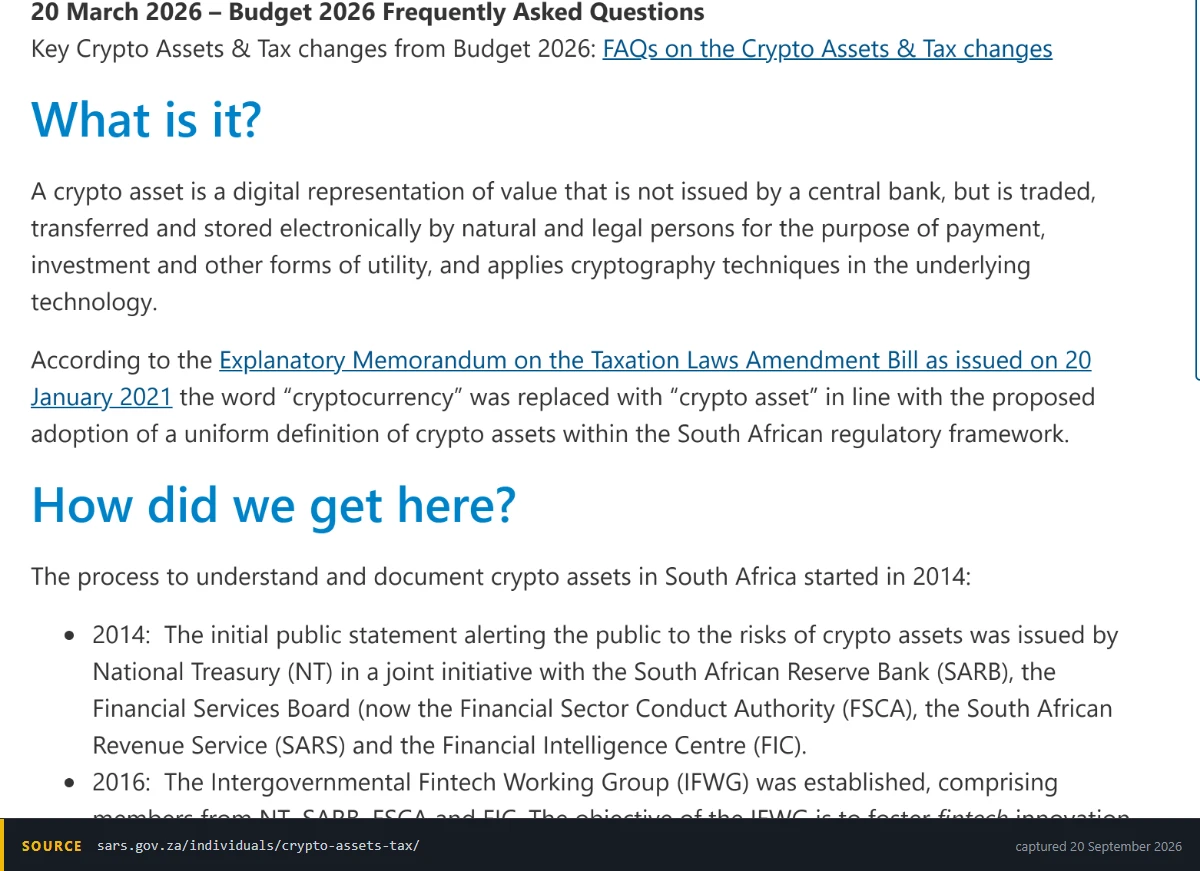
The definition SARS works from, with a date on it. Budget changes are announced here first, so this is a page to open before you file rather than after.
Finding someone who covers both sides
Find someone who handles both crypto assets and traditional securities. RWA tokens sit precisely at the intersection, and specialists in one side frequently misclassify the other.
Check that they are registered before you pay for anything. In South Africa a tax practitioner must be registered with both SARS and a Recognised Controlling Body, and SARS publishes a practitioner lookup and the list of recognised controlling bodies. Most jurisdictions have an equivalent register; find yours and use it, because the people most willing to take on an unusual crypto tax question are not always the people licensed to answer it.
Bring: the issuer's legal documentation, your complete transaction record, and specific questions about withholding, rebase treatment, and whether swaps are disposals in your jurisdiction.
That preparation typically costs less in professional fees than a single misclassified year costs in tax.
Educational content, not investment or tax advice. Tax treatment of tokenised assets varies by jurisdiction and is unsettled in many. Consult a qualified professional about your own circumstances.