
RWA Tokens & Market
The ONDO Token and the Fee Switch That Has Not Happened
Buying ONDO is not buying tokenised treasury exposure, and it is not buying equity in Ondo Finance either. The three-layer distinction that most RWA investors miss, and the one mechanism that determines whether a sector token captures anything at all.
Someone reads that tokenised real-world assets are the fastest-growing segment in crypto, decides they want exposure, and buys ONDO.
It is an entirely reasonable-looking decision that misunderstands what is being bought, and the misunderstanding is structural rather than careless. The RWA space has three distinct layers that all get called "RWA investing," and they have almost nothing to do with each other.
The three layers
Layer 1: Asset tokens
USDY, PAXG, XAUT, tokenised stocks. These are claims on a real asset. Their value comes from the asset, and the questions that matter are the ones the rest of this site covers: what is the wrapper, who is the issuer, what is the redemption right.
Layer 2: Protocol tokens
ONDO, PENDLE and the rest of what indices call the "RWA sector." These are tokens issued by the companies and protocols that build layer 1 products. Their value comes from whatever rights the token confers, which, as we will see, is frequently much less than assumed.
Layer 3: Company equity
Shares in Ondo Finance Inc., Paxos, Backed, Securitize. This is where a great deal of the economic value in this industry accrues. It is not available to you, and no token gives you access to it.
The mistake is assuming layer 2 is a proxy for layer 1 or layer 3. It is neither. It is its own thing, and to evaluate it you have to ask what the token specifically entitles you to.
ONDO: the clearest case study
Ondo Finance is arguably the most successful RWA business in operation. It runs USDY and OUSG in tokenised treasuries and Ondo Stocks in tokenised equities, which crossed $1 billion in TVL in under eight months and leads the tokenised equity market. The business is real and growing.
Now: what does the ONDO token entitle you to?
As things stand, governance rights, and that is the list.
ONDO does not currently provide direct revenue share. Holders do not receive staking rewards from protocol fees, buybacks, burns, or direct fee payments. Management fees and platform charges accrue to Ondo Finance Inc. — the corporate entity — not to token holders. The protocol earns revenue through USDY and OUSG; ONDO holders currently receive governance rights only.
Read that again against the intuition it violates. The business grows, revenue grows, and the token captures zero direct cash flow from it. There is no mechanism connecting the two.
What could change this: the fee switch. The Ondo DAO is scheduled to vote on protocol fee collection in the second half of 2026. If it passes, a portion of the revenue generated by Ondo's managed assets — estimated at around $48 million a year at prevailing TVL levels — could flow to token holders directly or fund programmatic buybacks.
Now run the article's own fourth test on those numbers. Circulating supply is roughly 4.87 billion ONDO against a 10 billion maximum, so slightly under half the supply is live. A major unlock is scheduled for 17 January 2027, releasing about 1.71 billion tokens: roughly 17% of maximum supply, and around a 35% increase to the circulating float.
So the arithmetic is: a potential $48 million annual distribution, against a float expanding by about a third within roughly a year of the vote. Whether that nets out in your favour depends entirely on the terms the DAO approves and on where the token trades when the unlock lands. That is a real, dated, falsifiable question, which is more than most sector tokens offer.
That vote is the single most important variable in the token's investment case, and the framing tells you everything about the current state: the connection between business performance and token value does not exist yet and is a governance decision away.
Holding ONDO today is a bet on that decision going a particular way, on the terms being favourable, and on the mechanism being meaningful in size. That may be a reasonable bet. It is a completely different bet from "RWAs are growing and Ondo is winning."
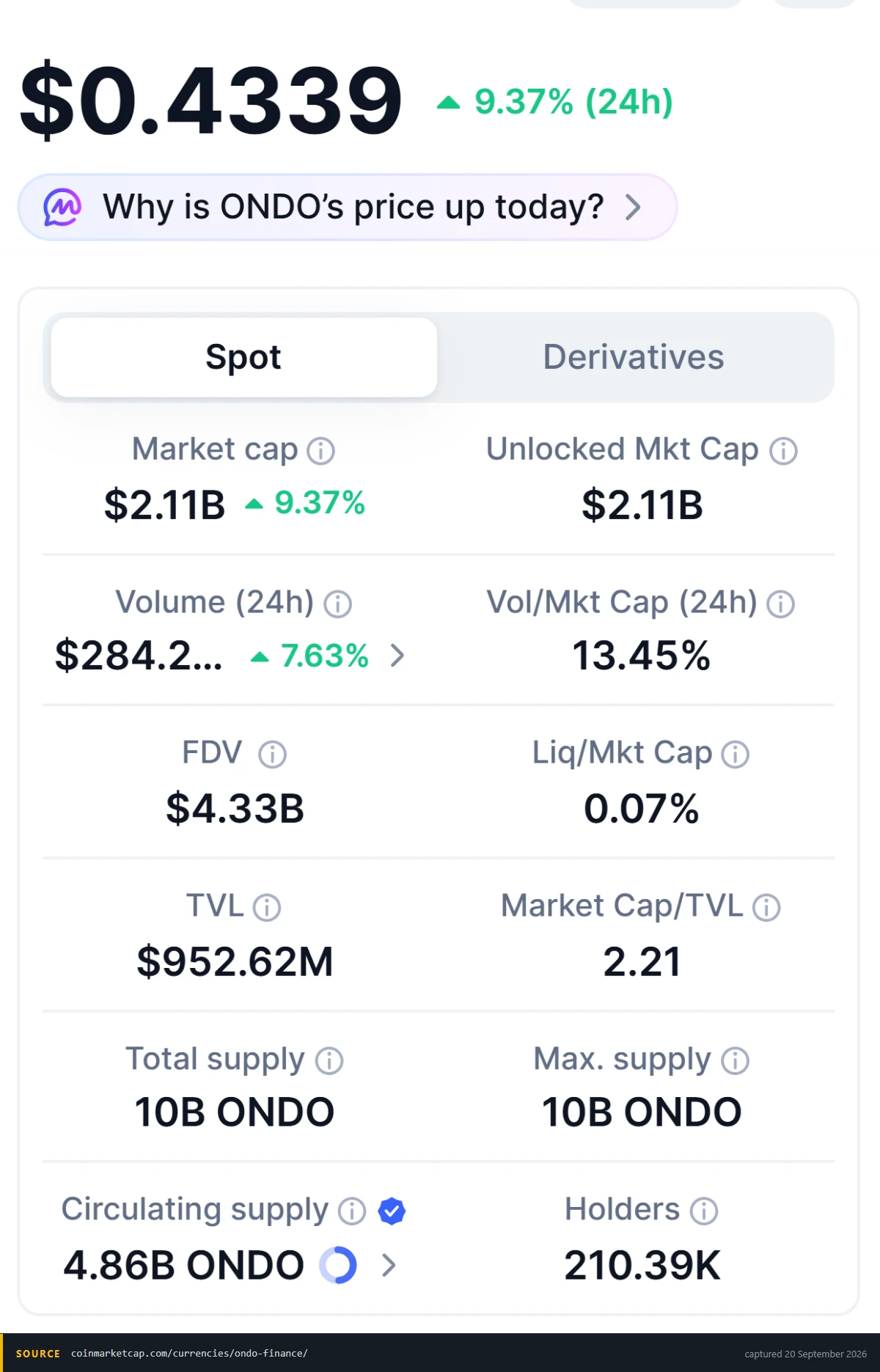
Circulating supply against maximum supply is the dilution still to come. Market cap against total value locked is what the market pays for a dollar of the assets the protocol runs. Both pairs are on this panel.
PENDLE: value capture that exists, with a caveat
Pendle is the useful contrast, because it has the mechanism ONDO lacks.
Staking PENDLE produces vePENDLE, which entitles holders to a share of protocol revenue, voting rights over incentive allocation, and swap fees from voted pools. Pendle distributes revenue from YT fees to vePENDLE holders and swap fee revenue to vePENDLE voters — currently with all protocol revenue going to vePENDLE holders and no allocation to the treasury.
That is genuine value capture. The token is connected to the business.
The caveat is important and widely skipped. vePENDLE stakers receive their cut in PENDLE tokens, which are simultaneously being emitted to liquidity providers. You are receiving a share of revenue denominated in an asset whose supply is expanding. The token remains a governance instrument with indirect value capture, not a direct equity claim on protocol cash flows.
So the ranking is: PENDLE has a real mechanism with dilution working against it; ONDO has no mechanism yet. Neither is equity. Both are governance tokens, and the difference between them is whether a value-capture pipe has been built and turned on.
The test to run on any sector token
Four questions, in order. They take about twenty minutes per token and they eliminate most of them.
- 1. Does the protocol generate revenue, and how much? Fee revenue is usually disclosed by the protocol and cross-checkable against third-party trackers — DefiLlama carries fees and revenue for most protocols large enough to be worth the twenty minutes. Many RWA-labelled tokens front protocols with negligible revenue. If there is no revenue, the value-capture question is moot and you are buying narrative. That is a legitimate trade — just name it correctly.
- 2. Where does the revenue go? This is the decisive question. To a corporate entity whose shareholders are private investors? To a treasury? To token holders? For ONDO the answer is currently the corporate entity. Find the equivalent answer for anything you are considering.
- 3. If value does reach token holders, through what mechanism? Direct distribution, buyback, burn, or staking rewards; each has different tax treatment and different reliability. "The team has discussed a buyback" is not a mechanism.
- 4. What is the emission schedule against that value capture? Total supply is on-chain and takes one call to read: ONDO sits at
0xfAbA6f8e4a5E8Ab82F62fe7C39859FA577269BE3on Ethereum, andtotalSupply()returned exactly 10,000,000,000 on 19 September 2026; the full cap is minted and the schedule governs release, not creation. Compare that against circulating supply on any tracker, and the gap is your dilution pipeline. A token distributing $10 million a year while emitting $30 million of new supply is diluting you faster than it is paying you. Pendle's design is well-regarded and this dynamic still applies to it. Always net the two.
If a token fails questions 1 or 2, the honest description is that you are buying a bet on sentiment toward a sector. That can work. It is not exposure to the underlying business, and it certainly is not exposure to the underlying assets.
Why "RWA exposure" through sector tokens usually disappoints
There is a specific failure pattern with a name, because it catches thoughtful people.
An investor reasons: tokenised RWAs will grow enormously, therefore the protocols enabling them will capture value, therefore their tokens will appreciate. Each step sounds sound. The chain breaks at step three, for reasons that are structural rather than bad luck:
- Value accrues to the corporate entity, not the token. Ondo Finance Inc. collects the management fees. The upside from the business flows to the company's shareholders: private investors, not token holders.
- The most successful RWA businesses have the least need for a token. Paxos, Securitize and Franklin Templeton run substantial tokenised-asset operations with no sector token at all. If tokenisation succeeds as an industry, a large share of the winnings goes to entities you cannot buy.
- Sector tokens trade on crypto beta, not fundamentals. In practice these tokens correlate with the broader crypto market far more than with RWA adoption metrics. You can be exactly right about tokenisation growth and still lose money, because the thing you bought is priced by different forces.
- The assets themselves are the actual exposure. If you believe in tokenised treasuries, hold a tokenised treasury product. If you believe in tokenised gold, hold tokenised gold. These give you the thing itself, with no dependence on a governance vote or an emission schedule.
When sector tokens do make sense
Not never. Three cases:
- You have a specific view on a specific mechanism. You think the ONDO fee switch passes on favourable terms and the market is underpricing it. That is a real, falsifiable thesis with a defined catalyst. Size it as the speculation it is.
- You want governance influence. If you have a genuine interest in protocol direction and enough capital for your vote to matter, the token buys you that. For most retail sizes it does not.
- You are trading, not investing. These tokens are volatile and news-responsive. If your edge is trading, the value-capture question matters much less than liquidity and catalyst flow. Just be clear that this is what you are doing.
The liquid sector tokens trade on the spot market at most large venues; if you need an account, the registration and verification walkthrough covers the process.
ONDO, PENDLE, and what neither of them is
Buying ONDO is not buying tokenised treasuries. It is buying a governance token in a company whose revenue currently accrues to its corporate entity, with a pending vote that may or may not change that.
Buying PENDLE is buying a real value-capture mechanism that is partially offset by emissions.
Neither is equity in the business, and equity in these businesses is where much of the industry's value is going.
If you want exposure to real-world assets, the cleanest path is almost always to own a real-world asset: a tokenised treasury note if you are eligible, tokenised gold with a supervised issuer, or a tokenised equity through a structure you have read. Those have identifiable claims, verifiable backing, and no dependence on a governance vote going your way.
Sector tokens are a separate trade from RWA exposure, and should be treated as one.
This explains a mechanism rather than recommending a token. Token mechanics, fee switches and emission schedules change through governance; verify current tokenomics from primary protocol documentation before acting.